Paul's Heart

Life As A Dad, And A Survivor

Archive for the category “Adoption”

Rethinking A Turning Point


As children, there came a time for all of us that we could not wait for that moment when our parents handed us a key to “the castle”, our house.  At age 11 or 13, there were very few milestones that we were ultimately aware of that were nearly in our grasp.  But getting to stay at home, alone, was the first taste of a much different world to come.

I do not recall the exact moment I was handed my key.  All I remember was that I was tired of having to tell friends that I went to “the babysitter” after school.   It was only briefly, the downtime between the time I arrived home from school, and my grandmother would get home from work.  My parents were divorced when I was three, and my mother had full custody of my sister and I.  But she worked second shift (early evening to early morning hours).  My mother had already left for work by the time school let out.  The routine went, school dismissed, I went to the neighbor’s house and waited until my grandmother got home.  Then I got my freedom.

Something switched once I got the key.  Sure, I got to go straight into my house, but other things changed too.  Most noticeably I became more aware of my surroundings.  I had previously learned about being prepared for emergencies from school and scouts.  But,  I also found that I could get away with things, even if it were just for a half hour.

latch-1

The first new freedom that I discovered was via the television.  For a half hour, I could watch anything that I wanted, which included a cable channel that showed movies that were rated R (today, the movies would be rated PG).  But one day, I stumbled across something else.
latch-2

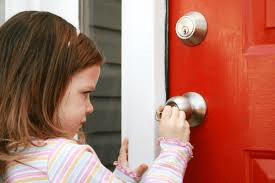
I was a “latch key kid.”  On the television, the personality was talking about children who came home from school to an empty house, referred to as “latch key children.”  It carried a negative connotation only because it concentrated on the fact, that a child was going to be home alone, regardless of the amount of time.  I can understand, parenting in the 1970’s was not like the 1950’s where mothers got to stay at home.  And if you were a single parent, your income was limited to household expenses and unless you had a friend you could rely on, it was going to cost you additionally for a babysitter.

I took the term a bit harder.  Being referred to as a “latch key” kid, was a negative term.  While most of my friends went home to a house with an adult to greet them, going home to no greeting often left me feeling alone, unwanted, uncared for.  Of course today, I do not see it that way because as an adult I can understand the situation more clearly.  But as a child, I did not have the capacity to understand that.  All I was able to understand was what I knew… my friends went home to someone waiting for them, I went home to be alone.

This has an impact on a child’s life not just in the short term, but in the long term as well.  Because, once there is the taste of that independence, not just from the brief time home from school, then both the child and the parent look to longer periods of “latch key” status, with both having their reasons to eliminate the need for babysitters.  Of course, as children grow, they do not want to hear the word “babysitter” any longer, and parents want to eliminate the cost.

But the next phase or transition needs to be handled delicately.  Because the effects of being alone, and the circumstances of the home, can have huge consequences for the children especially, and quite possibly tragic for the family.

latch

Sure, the concept of the movie “Home Alone” had a lot of comical moments.  But the reality of the movie was that a child was left behind for an extended period of time because the family left on vacation without him.  The premise of the movie was not that far fetched, though the boy’s survival tactics while providing many laughs, were not likely to be successful in fending off intruders inside the house while he was alone.

So, how old should a child be to be left alone?  How long should a child be left alone?  These are subjective questions because it all depends on the maturity of the child.  There are many states who have taken this judgment call away from the parents, because clearly, many have made the wrong call.  But another factor to consider is how prepared is the child to be alone.  Does the child know who to contact in an emergency even beyond 911?  If a warning for a weather emergency came on the television (like a tornado warning), would the child know what to do?  Of course, how to handle telephone calls and knocks on doors are critical so as not to alert anyone that a child is home alone.  Then there are rules that need to be established so as not to be alone outside of the home, like roaming the neighborhood, leaving a child susceptible to predators.

Then there are emotional considerations.  Is the child going through any difficult time in school or at home?  A child spending time alone, isolated, when faced with emotional issues is indeed a sad situation.  A child with no distractions or support, will look to alternative means to deal with the issues they are struggling with.  It is during this time that a child will be more likely to give in to peer pressure, to begin smoking, drinking, experiment with drugs, and explore sex.  It must be admitted, the opportunity presented by being alone, means the less likelihood of being caught.  And once a child begins to feel distracted enough, they will believe that these alternatives are the solutions to dealing with their emotional pain.

No, a babysitter for an 11 or 15 year old is not the answer.  That only undermines the emotional growth of a child.  But there are other much more subtle means of providing supervision while giving the appearance of supplying independence.  Encouraging a child to visit with friends, a family aunt or uncle asking for a visit from the child, or even finding a way to include the child in what you, the parent is doing, are all reasonable alternatives to leaving a child alone before they are emotionally and intellectually prepared to be left alone.

 

Excited For The Summer


20130908_150716

This photo was taken a couple of years ago.  It was Father’s Day weekend.  School had just let out.  It was also the weekend that I was memorializing my father who had just passed away from lung cancer, just weeks before.

Yesterday, school let out again for my daughters.  My oldest now finished with her elementary level grades and excited for the new school.  They have a lot to look forward to over their Summer.  And they are excited as well.  But they are not the only ones.

Summer to all three of us means their annual visit to me for the majority of the Summer, not all of it, but a lot of it.  They will get to spend a few weeks with their mother, and then again at the end of the Summer for a couple of more weeks before school begins.  My daughters will spend the balance of the time with me in my home.

I am very excited.  Together, the three of us have come up with things we would like to do, things that we would like to eat, and really, just spend some quality time together.

Parents in my situation, are quick to be labelled “Disney parents”, nicknamed that because it is felt that parents who only get such limited time with their children are assumed to pull out all the “fun” stops, so that the parent is purely only perceived as “the fun parent,” and sometimes, parents actually go to that extreme.

For me, the Summer break for me and my daughters is about showing that they not only have a home with their mother, but they also have a home with me.  How I treat my daughters today, is no different than when their mother and I lived under the same roof.  There are expectations of behavior.  There are rules.  And much to their dismay, as I have done every year since they started school, they each have a transition workbook to keep their school skills ready for their next grade.  Of course, they are also expected to read.

I love to spend time with my daughters.  And as their father,  as they get older, I want them to respect me, so that when they begin to date, gasp, I want them to expect the same of anyone who has an interest in them.  We are looking forward to movies, lots of ice cream, and living close to the beach, lots of fun.  They will get to visit with friends they met during their past visits here.  And they will get to communicate with their friends back home as often as they like.  Again, besides spending time with my daughters, all I want is for them to know that they are actually “lucky” to have two homes.

I am counting down the days now.  My daughters are not the only ones excited for Summer.

Sometimes, The Best Advocate Is Yourself


imagesP2SPLE8S

Advocate ad as defined in the image, “one who pleads the cause of another.”

In my life, I have taken on many advocacy roles, and the list almost grows daily.  From health, I advocate for patients with their care, and their rights in the work place and in the rest of the world.  This started around the time that I was diagnosed with Hodgkin’s Lymphoma, and the first hurdle that I had to jump in my care.  I considered it unacceptable, and knew that if it was happening to me, it was happening to others.  Buy my advocacy in health did not stop with the world of cancer, but has expanded to cardiac, long term survivors of cancer, geriatric care, and simply, the right to receive medical care when it is needed.

With having two daughters adopted from China, I became an advocate for families seeking and dealing with adoption issues, not just internationally, but domestically as well.  Because of having children, I took an interest in public education and fighting to make sure my daughters got the best education possible and supporting those trusted to educate my daughters.  Which of course led to my first and only political run, for local office, school board.  And of course I began paying more attention to politics on the larger level.  But to be honest, the lessons I learned at the local level leave me feeling hopeless at the higher levels.

Getting back to children, well, not just children, I have always been an advocate fighting bullying in any environment.  Sadly, society still does not recognize by ignoring the bullying in schools, those bullies grow up to be adult bullies.  There are plenty of programs to deal with this, but unless they are used or enforced, they are paper tigers.

And then there is Parental Alienation.  This is the blatant act of causing mental and emotional harm to a child, by interfering with the relationship between a child and another parent, usually through divorce.  Talking negatively in front of a child or even as “matter of fact”, causing the child to miss opportunities to spend time with a parent, manipulating the child to develop a negative concept of the other parent, are just some of the examples of Parental Alienation.  And I will not beat around the bush with this, PA is child abuse.  Children have the right to love their parents.

But there is more to being an advocate than just having a cause to fight for.  There is more than just defending someone who just does not know where to start to find the answers to start their fight.  Perhaps, they just do not have the strength to express their needs.  Sometimes we have to be that voice.  And in many cases, it is as easy as just showing someone “where” to begin, or even guide them along their course.

There are also times, when even the slightest effort, without realizing it, you can become an advocate.  Just being there for someone, as an “ear”, makes you an advocate because you are showing someone, who may feel alone, that you care.  And that act alone makes more of a difference than doing nothing at all.

No matter the cause I advocate for, it has made me who I am.  And it helps me to deal with the many things that I face.  I have no quit in me when I know that something, or someone is completely wrong.  And I have paid a price over the years with employers, friends, and family because of my decision not to pick battles.  Even the smallest issue to me, if you let enough of them go, it leads to a big issue.  And I have learned, if you are dealing with the smaller issues alone, when you face the bigger ones, you will still be alone, and that fight is even more difficult, because the other side is not alone.

You will never be taken more serious, when you, yourself, advocate for yourself.  After all, you know more about your particular situation than anyone else.  Sure, the help of another advocate is great, but your own words will be the loudest and get your heard.

Post Navigation