Paul's Heart

Life As A Dad, And A Survivor

Archive for the category “The Heart”

Cancer – What You Want To Know


I have been feeling restrospective a lot lately. And because it has been so long since I was diagnosed with cancer, Hodgkin’s Lymphoma, back in 1988, while I have seen progress in better diagnostics, progress in better and safer treatments, there is still something that has not made much if any progress, and that is, talk about survivorship or life after cancer.

There are three questions that pop into mind once you hear the words, “you have cancer.” The first, “Am I going to die?” And the second, “What am I going to have to go through for treatments?” A compassionate oncologist is going to answer the first question with as much positivity, and with very good reason because of all the progress made in cancer research, many cancers are highly successful with treatment. There are so many treatment options available and thanks to all the cancer survivors who came before them, science has learned what worked, and what needed to be worked on further to increase safety and success. But there is one question that I know I asked my oncologist back in 1988, and I still do not see any kind of answer to that question today. “If I get to remission, how much longer of a life will I have?”, and of course with hindsight over the last two decades, “what price will my body pay for everything that I was exposed to?”

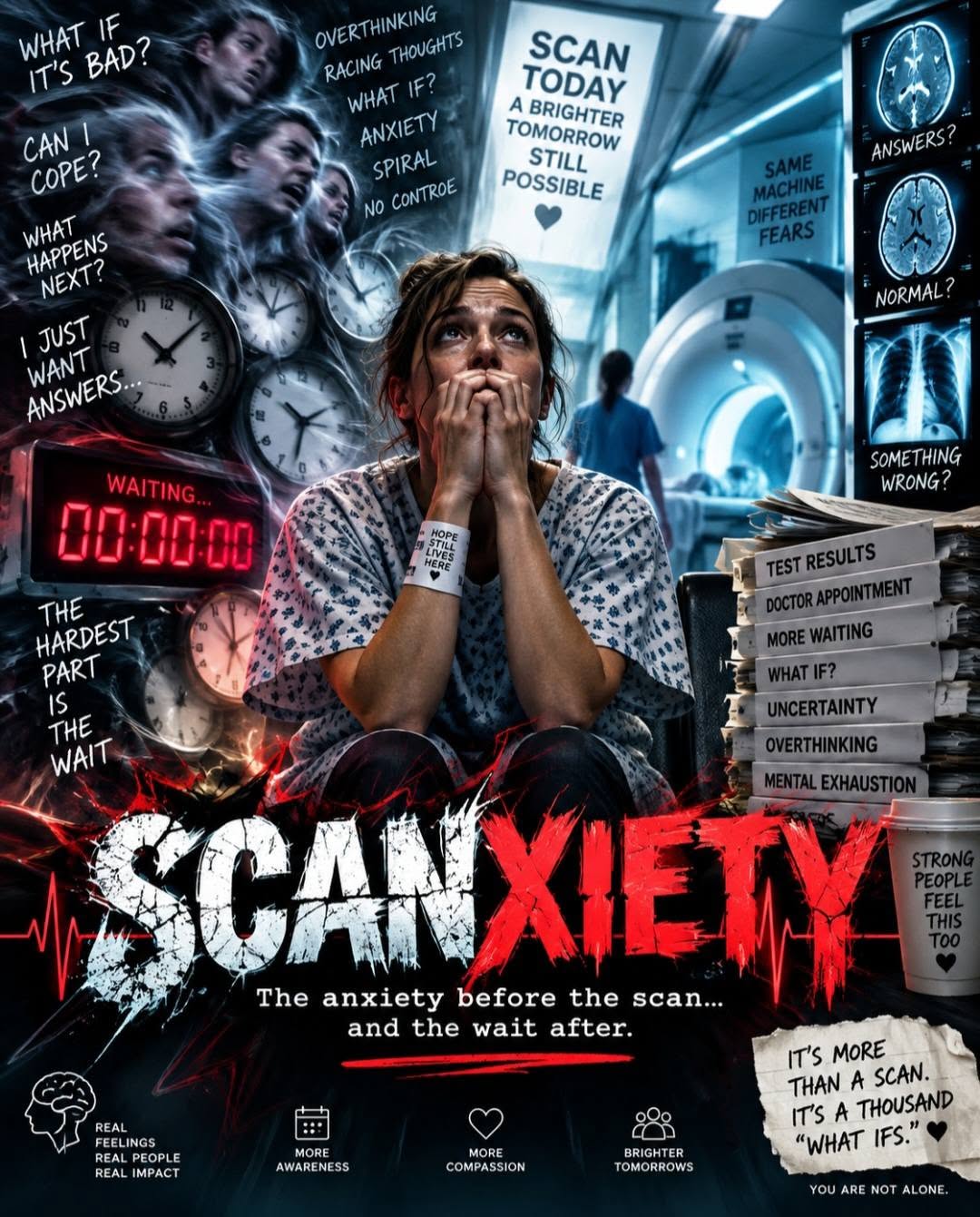
Normally, most of us survivors only hear of the magic “five year” mark. And until we hit that five-year mark, we struggle with powerful paranoia and fear of relapsing or recurrence. Those first five years after treatment ends are the most challenging physically and emotionally. The fear of recurrence or relapse is very real, as every ache, pain, cough, or swollen lymph node immediately triggers the thought, “it’s back.” Follow up appointments which are meant to confirm all is good, can still bring intense anxiety while we wait for the words from the oncologist, “still all good.” And if there are any scans involved, we experience what is called “scanxiety,” a real and separate post.

During those first five years, we are learning to trust our bodies again. No one understands the unpredictability of their body more than a cancer survivor. There is living with the uncertainty, “will it come back?” or “How many years do I have after cancer?”

On top of that, there is the physical recovery, dealing with fatigue, which honestly never goes away fully, stamina, memory or concentration challenges (sometimes referred to as “chemo brain”), nerve problems which can persist long after treatment ends.

And then there is the adjustment emotionally. While everyone else around us celebrates that everything is over “for them” and life can get back to normal “for them,” we survivors often still process what happened for a long time and suffer from anxiety, depression, grief (yes, grief, we have experienced “loss” of what we once knew was our life before cancer), and PTSD, post traumatic stress disorder.

As we return to life, we have to find a new “normal,” as we discover so much has changed about us from how we once were. Our priorities (especially sweating the small stuff), relationships, work, and future plans are all handled differently. We do get back to managing our finances, rebuilding routines, and importantly reconnecting socially. It can be difficult at time as we have to figure out who is able to handle when we still need to talk about our experiences, not everyone is able or willing.

As much as I tried to be an inspiration for being able to get through treatments for cancer early on, after that five years had passed, I became focused on showing newer patients something to look forward to, life after cancer. I got married (twice actually), bought a house, had a nice career, and had two beautiful daughters, and a golden retriever. No, this was not the life I was heading toward in 1988, but it was what I was given after cancer.

But there was one discussion that had been left out, especially after that five years had passed. I was “dismissed” by my oncologist that it was unlikely that my cancer would return after that five years. Great! That’s all we cancer survivors want to hear. This was our gold ticket to move on with our lives. There was one problem, some of us would end up going a separate path from the straight path of life after cancer. It would take decades to get discovered and discussed, and even now does not get the attention that it should. And I am not going to make that part of this post as I talk about it in great detail on this page already, the developing of late side effects from our treatments. There is no rhyme or reason why or who develops them. Those of us who do get diagnosed with these issues are contributing to current information in regard to survivorship. But there still remains one question.

Can you live life after cancer, without having to deal with the memories, or the late side effects? Of course you can. But the question should be, “should you?” Like I said, there are no statistics stating who has gotten to live and how long without ever dealing with their cancer history again. Likewise, your oncologist should be referring you to see your primary care doctor for regular annual follow ups, not for the return of the cancer, but for the potential, not guaranteed, but potential for the development of any late side effects. Again, I have documented often how close I came, because no one was looking.

Of course, if you are like me, having these late side effects, we are documented, now. Because of those like me, and the thousands who came before me, doctors are aware of the issues that plague many survivors. It is just the surveillence and advocacy is not there, until it is too late.

So I did some research as I love to do. Now keep in mind, social media support pages can be overwhelming no matter what they health issue. Why? Because literally, everyone on those pages has an issue. Those who have nothing wrong, don’t need to be on a page like that. And those would be the numbers you are looking for, living after cancer, without the thoughts of cancer anymore. But here is what I discovered.

The fact is, we have no idea how many cancer survivors there are in the world, 30, 40, or 50 years after diagnosis. There are no worldwide or US registry that tracks survivors in that way. But one large long term study found that 52% of Hodgkin’s survivors were still alive after 30 years (it does not specify if with or without late side effects). At 40 years, the number drops down to 42%, but the study hints at issues from late side effects playing a role in the lower number. And well, 50 years, there is nothing to refer to. But I can tell you, I know plenty of 40 and 50 year survivors, and have even seen some 60 year survivors.

It’s frutstrating. Why don’t we talk about survivorship longevity, probably the most important issue once treatment ends? Or rather, why don’t we want to talk about it?

We keep all kinds of statistice on diagnosis and deaths, but never how many survivors there are or the milestones they reach. There is no excuse for losing track of patients today with technology and AI for when patients move or change health care providers. And then there is the biggest reason for wanting to know this statistic, the development of newer, better, and safer treatments.

And then there is this, funding. Survivors are not a priority for research funding. Research continues its focus on curing, not surviving and studying people alive decades after.

Look, you can live a long life after cancer, and also be unfortunate enough to deal with late side effects from the treatments. I know, I am now 37 years from my diagnosis. But because you do not know if you are going to be the lucky one who gets away actully 100% done with the topic of cancer, or someone who will face heart disease, secondary cancers, or endocrine, lung or vascular complications. And only awareness and prevention will give you those extra years. It is not an understatment, I never expected to be here to witness this milestone in my life.

But I did. I have lived long past the period that most cancer statistics discuss. And researchers are increasingly realizing that survivors like me need LIFELONG follow up care. In fact, while the medical community catches up, it is my “older” fellow long term survivors I actually owe my life to, being the ones encouraging me to be proactive, get help when needed, and most importantly, support me emotionally during the times that I struggle, and I still do.

It may have been unintentional when my doctor told me he would not use the word “cure” with me while being confident he would get me into remission. But it is hard to consider myself “cured” dealing with all the late side effects I deal with, while being in remission from the original cause. But boy, do I wish he would have told me that I would need to follow up medically for the rest of my life, that some of these issues could take decades to appear. I wish I had been warned about the emotionaly challenges. And I do wish that the majority of my friends could understand, that I cannot just “move on” or “just get over it.” Because I live with this body and all it betrays me with, every day, and often on my own so I do not burden others.

Make no mistake, cancer survivors are living a long time today. I am only one voice, so I am telling one person at a time. I have written to many networks and organization, and no one seems to want to talk about survivorship, just like science, the stories are only there for who gets diagnosed and who dies.

This is my story. I am a 37 year cancer survivor. And I feel I have a lot more years to go. Who else wants to tell their story?

Question – Must I Avoid My Pets?


(photo from Facebook)

A question came across my news feed, “do I need to avoid my dog when I get home from the hospital after my heart surgery?” A legitimate question, but one I would never think of asking myself. In fact, quite the opposite, I am a firm believer in pet therapy. I wrote about it twice in my book “Paul’s Heart – Life As A Dad And A 35-Year Cancer Survivor.”

My cat played a pivotal role as I went through my cancer treatments. And then 18 years later, my 105-pound golden retriever played a major role following my open heart surgery. Though unlike my cat, with him, I did have a legitimate concern. His whole life, I had rough-housed with him, and allowed him to greet me at the door by standing up on his hind legs, jumping on me. With a surgically repaired sternum (breast bone), this was going to be a major concern. My dog had not seen me in over a week, and clearly he would be more than excited to see me, and I desperately feared him jumping on me or worse, knocking me over.

(photos of my cat and my golden retreiver)

But when I walked through the front door, I was surprised to see him walk up to me calmly, as if sensing something was off. He circled around me, and then just stood by my side, and I gave him a good head rub for being a “good boy.” During the rest of my recovery, it felt unusual that he did not bother me to play or do other things that we normally did. He was content just to stay by my side.

(my late father with a therapy dog during his chemo treatment)

That is why I am such a firm believer in “therapy” pets. I believe they can make such a difference in helping a patient to heal. I first saw a therapy pet in action with my father, and then experienced it myself.

So, the easy answer to the question, “do I need to avoid my pets?”, whether it be during treatments, or recovery from heart surgery, is no. But there are risks and precautions that should be taken, and honestly, care should be taken regardless even if you are a normally healthy person.

The last thing a person going through treatment or recovering from heart surgery needs, is an infection.

(photo from USA Today)

Even if harmless play, a scratch or a “nip” from a cat’s teeth, can quickly turn lethal with someone dealing with a compromised immune system. A cat’s mouth (and dog’s) is filled with bacteria that if breaking the skin, will send that bacteria directly into the bloodstream. And of course there is this… both cats and dogs guilty of butt-licking.

(photo courtesy of Shutterstock)

(photo courtesy of Gray Animal Hospital)

And then there is this toxic waste dump, the litter box. Just as pregnant women need to be careful cleaning the litter box, so do cancer patients and cardiac patients. Dust, bacteria, germs, and other issues (like amonia) can be inhaled while cleaning. Wearing a mask while cleaning the litter box is always recommended.

As I have said, I have had both cats and dogs. So now I am going to move on to my canine friends and the risks they present. I am a large dog guy, and so from a heart surgery standpoint, the risk of him jumping on my chest was a legit concern. But regardless of size, because even the little dogs can pull hard, leash pulling is harmful to those with a repaired sternum, or not needing the cardiac stress from the pull, or if going through cancer treatments, weakness. And again, regardless of size, falling or tripping over a dog who just so happened to pick the perfect spot for them to lay in, or even their toys that may be laying around. If recovering from heart surgery, you likely have a weight restriction, so that means no lifting bags of pet food (dog or cat).

If you deal with pet allergies, this could be a concern, and could cause issues with your recovery. You should consult your doctor for any precautions that are recommended, but the last thing you want is to make your issues worse from pet dander.

While normally pets are more known for the reduction of stress they provide, some, even though unintentionally can create more if they require strenuous care, or constantly wake up in the middle of the night interrupting deep sleep, or if they trigger anxiety due to behavioral issues.

But no, under normal circumstances you do not need to avoid your pets as you go through cancer treatments or recover from heart surgery. Simple and practical precautions that should be followed anyway even if a healthy person; washing hands after handling pets, do not let pets lick surgical wounds, keep claws trimmed and dull, have someone else handle litter boxes and picking up poop, be careful of “pulling” when walking, and most importantly if a heart surgery patient, protect that chest from anyone jumping on it.

The most important thing is to watch for any sign of infection developing, especially from a scratch or bite. It takes no time for an infection to go septic, and if you read “Paul’s Heart,” you know that is not good.

Comparing Apples To Watermelons


I need to offer a disclaimer for this post. I will be talking about radiation exposure used in treating cancer. And here will be the important distinction. The radiation exposure I am referring to is that what was used on cancer patients used prior to the turn of the century, which unknown to cancer patients back then, was not only dangerous, but carried with it, the potential risks for late developing side effects. Fortunately, today’s radiation uses less dosages, and often more precisely delivered to spare wider exposure to the damage done by older therapies, hence hopefully more safely. But if you are someone going through radiation treatment right now, what you are about to read, affects those who came before you, decades ago, before we were told of the dangers and risks. Now, everyone knows.

I have often written about my exposure to radiation therapy for my Hodgkin’s Lymphoma, for which I am grateful, giving me 37 years of survivorship, combined with my chemotherapy, and I have no regrets. The amount of radiation I was exposed to, 4000 rads within 30 days, scattered field upper mantle, just think of my entire upper body to my lower jaw. To put this in perspective, in the US, the annual limit for radiation workers is generally 5 rads for many types of radiation exposure. Look at that again, people who work with radiation are regularly limited to 5 rads of radiation per year. I was hit with 4,000 rads. So, doing the math, if radiation was your career, whether taking dental x-rays or working in a power plant, for someone 60 years old, the “lifetime” limit of exposure would be around 210 rads. I recieved 4,000 rads. Read this paragraph a second time if you need it to sink in.

Now that those numbers have sunk in, when it comes to cancer treatments, the exposure limits are treated differently because of the success of treating many cancers, including Hodgkin’s Lymphoma. So there is no strict lifetime limit. For those like me, treated in the 1980’s and before, Hodgkin’s patients were normally treated with 3500-4500 rads, again, I was treated with 4000.

So how bad exactly is this exposure? 100 rads (or 1 Gray) of whole body exposure can cause radiation sickness. 400-500 rads (4-5 Gray) of “whole body exposure” is potentially fatal. I recieved 4000 rads (40 Gray), my only saving grace, that my entire body did not recieve that amount, just my entire chest area and jaw.

While I live with this knowledge, and my late side effect health issues, it is when I share this conversation with those who understand radiation or work with it, and I see their reactions, I get it, I know they understand me, what I have gone through, and what I am now dealing with, their shock and their tears aside, I am still alive.

(photo courtesy of AIP.ORG)

I used to compare my radiation exposure to the accident at Three Mile Island Nuclear Power Plant in Pennsylvania in 1979. I was thirteen at the time, and lived about an hour away. I remember the panic and the conversations of needing to purchase large amounts of iodine in preparation for a nuclear core meltdown. Without getting lost in all the math weeds, I’ve done the math for you, the average radiation released within 10 miles of the power plant at that time was 0.1 rads. I was treated with 4000 rads. It is no lie or understatement when I say, my exposure was worse than what happened at Three Mile Island.

Recently, I have come across many articles referring to the fact that it was believed that while refusing treatment for Hodgkin’s would likely result in death, the risk from radiation poisoning, possibly during treatment, could also result in death (hematology.org). What it came down to was, you could die with the treatment, or you will die without it. The risk of death without was greater than the risk with.

The frustrating thing is what did my doctor know at the time, because this risk definitely was not explained to me. And I do believe it was known at the time, the potential risks, as you will see shortly in this post. I was never told I could die from my treatment. I was just told of some skin burning, and the possibility of pericarditis, and inflammation of the heart. Now if you follow Paul’s Heart, you know they missed the heart issues by a mile. But my question remains, what exactly did my doctor know back in 1988? Not that it would have changed my decision, it was not a matter of will die no matter what, but the treatment could cause my death.

Fast forward nearly forty years, and several nuclear disasters later, Chernobyl and Fukushima most notably, it was a documentary on Chernobyl that has severely triggered me.

(photo courtesy of CNN Press Room)

I am a history nerd and I love documentaries. And I am always especially concerned for all the survivors when it comes to radiation accidents, especially with my medical history. Now I am not going to review the whole series (four parts), but there is amazing footage from before, during, and after the meltdown of the core reactor. Most heartbreaking, are the images, the videos, and interviews from those exposed either environmentally, or as a plant worker, or volunteer, yes, volunteer.

There are images of people within weeks of exposure with obvious signs of radiation poisoning, from skin burns, hair loss, nausea. There were the workers who were killed instantly by the explosion. And then there was the coverup by Russia, which held Ukraine as part of the Soviet Union at the time. And the last thing the USSR was going to do, was take any kind of accountability.

It is what the survivors tell, and the interviews done at the time, that are just shocking, as they knew the risks, some even taking pride in their patriotic duty to respond. Again, I am not going to go into the whole documentary, but this part was just numbing. So because Chernobyl is going to remain radioactive for likely 20 to 24 thousand of years, the town of Pripyat, populartion of 50,000, remains evacuated, with the core still considered dangerous, the solution was to “bury” the reactor, in what they call a “sarcophagus”.

(photo courtesy of Wikipedia)

Yes, they would literally bury the reactor in a tomb. It was an amazing endeavor. But this was only going to be a temporary solution. 50 years temporary, which we are approaching now. But with Ukraine now independent, it faced the unthinkable, when Russia launched at missle at the sarcophagus piercing a whole, potentially causing the risk of radioactive release again.

(photo courtesy of BBC)

This is the newer and improved encasing of the reactor, let’s hope it lasts. Again, they know it is not permanent, and will definitely need to be dealt with again. I want to talk about an unusual group of “heroes”, and I put that in quotes because these were volunteers, inspired by only their patriotism to the USSR, knowing they faced death in what they were being asked to do, and they were happy to do it. They were called the “liquidators.” An odd name.

(photo courtesy of Smithsonian Magazine)

These liquidators, approximately 600,000 of them; firefighters, miners, medics, engineers, were tasked with putting out fires, burying radioactive equipment, and building the sarcophagus. Much of the “protective” gear they wore was improvised, and their time spent on their assingments was limited to minutes to minimize exposure, often unsuccessfully. The USSR in true communist propoganda fashion, reported only 31 deaths, when in reality it was thousands, and so many more thousands dealing with the late effects of the radiation exposure. No duh! You really have to see the videos of these workers in action to appreciate what they did, that literally saved our planet.

My very simple takeaway is this. In 1986, just two years before I would be treated with radiation for my Hodgkin’s, when the accident occurred, science and the USSR KNEW that radiation in that amount was deadly. Medicine already knew the limits of exposure. And again, I am back to “what did my doctors really know?” Again, I would have still opted for the treatment had they told me the actual risk, but the point was, they were not honest and up front with me about it. Not only that, they did not prepare me for the possibility and eventualities of the cumulative and progressive issues from that radiation exposure. I had to learn and discover everything on my own, often from other fellow Hodgkin’s survivors who have suffered the same issues, and then stumble across a doctor who I was lucky enough to understand what I have been exposed to.

There are several tragedies, one that there are so many Hodgkin’s survivors from the 80’s and beyond, totally unaware of the likely causes of their cardiac and other issues, are actually related to their treatments, but also unaware of the risks of treating those issues without the association of connecting their treatments to their ailments.

Another tragedy being that even if aware of the connection between treatments and ailments, the lack of access to qualified care, or worse, the interference of insurance with denials and pre authorizations for a phenomenon not covered widely in medical texts.

And then there are those like me, aware of and have access to the necessary medical care. For many, it is still not enough. The body can only handle so much trauma. Even if doctors “manage” the late side effects, sometimes it is the spontaneous and unpredicted events, like a virus or accident, the body just does not have enough left in the tank to go anymore. And then there is the risk of the need for additional exposure to radiation for anything from x-rays and CT scans, to God forbid, additional treatment, which I believe I am no longer eligible for should I develop another cancer.

Back when I was being treated, I was often accused of undervaluing the toxicity and the danger of the treatments I was put through. And part of that was because of the way everything was explained to me, ummm, or not explained to me. Sure, I had it in my head, I was going to get through my treatments, and I was going to reach remission. And while I am grateful for these 37 years of survivorship, looking back, at least the last eighteen years, it has not been easy. And perhaps now, I can acknowledge just how dangerous the treatments were that I went through. Maybe it wasn’t so easy after all.

Post Navigation