
Health Care From An 8th Grade Perspective
My children growing up, is both a blessing and a curse. I want to hang on to the innocence that is their youth, totally unaware of the bad things going on in the world today, just eat, play, sleep. But as they are both teenagers now, my role as a Dad has an increased value. I am not just fun, but it turns out, I am pretty smart too, at least when it comes to something that will benefit them.
I have always been involved in my daughters education even before their first day in kindergarten. Today, I am no longer a “teacher” in this position, but an “advisor,” being sought for advice, editing, information, and research. This definitely comes in to play when it comes to any type of writing assignment. My daughters know that I write, and when it comes to their “final drafts,” they want as close to perfection as they can get, which is when they come to me.

This particular writing assignment, for history class, was about the Affordable Care Act, the topic my daughter chose. Though she did not give her reason for choosing the ACA, my daughter unfortunately has witnessed many events that resulted in my hospitalization. So she is more than aware of the importance of health care in our lives, and in everyone else’s. In fact, her interest in health care is so involved, that currently, that seems to be the direction she plans to take her future. To say I am proud of her efforts is an understatement. And just so the record is straight, I am proud of both of my daughters aspirations.
Her request of me was simple, help organize and edit her work. She would do all of the research, including documentation of her sources, all while meeting the requirements for structure from the teacher.
I am trying to convince her to let me publish her essay here, not just as a proud father, but because after reading her rough draft, having done her research, and completing my obligation to her effort with editing, she has created a paper that is filled with facts, and more importantly keeps politics out of the charged subject that affects us grown ups on a daily basis. She is still researching statistics to back up her thesis, so it is not ready to publish. But when it is done, I challenge anyone to disagree with her compelling arguments.
As I said, she has done all of the research on her own about the ACA. The only thing I offered her was a glimpse of what health care was like, prior to my adulthood, which honestly I had to research. As I child, I never paid attention to doctor visits to see how they were dealt with from a cost perspective. While my daughter may not completely understand all the factors that go into health care costs, she was shocked to hear that my mother actually paid $5 for me to see the doctor. And if I needed medicine, my doctor kept all medicines in his office, costing only a few dollars.
I will warn you, my daughters both have an abundance of empathy, and so they both believe strongly, if someone needs help, the should get that help. They believe this, because they believe people are good. And good people do good things. And so, right from the gate, my daughter states that affordable and available health care should be a right, not just something that people with money can afford. Yes, I know, this sounds like a campaign talking point. But at 14, my daughters is at least 4 years away from paying attention to politics. Her statement is not a political one, it is what she truly believes a decent human being would want this for others. I did not even need to whip out the Christian “it’s in the bible that we should take care of one another.”
After her initial statement, she explains why it was so important for the ACA to be signed, listing three reasons, availability, accessibility, and affordability. And again, at no point, did politics come up. She has kept her paper completely limited to the “human aspect.” Her common sense confuses her that the issue of health care, even after decades, has still not been resolved. She does not understand why many people cannot get the medical help that is needed, just because it is not available. It makes no sense to her, that people who were sick in their past, would keep them from being taken care of today. And finally, she is saddened to realize that people can die, because they cannot afford their medicines.
Again, no mention of politics in her writing. She is currently on working on backing up her statements with research, not talking points. I mentioned to her how proud I was of her work and research. And I also told her how spot on she was with what she had stated. I told her how important it was that she stuck to what she wrote, without injecting one-sided political arguments and flat out misrepresentations, because this is what has stood in the way of achieving affordable, available, and accessible health care.
To prove to her just how right she was, I discussed with her, and showed her other posts and columns that I had written pertaining to my support of universal health care. I make no bones about it, I believe in universal health care as a right. And I do believe that if we took the politics out of the discussion, we might just achieve that level of health care.
I then explained to my daughter the many conversations I have with others, and with one simple rule, you allow and respect the other to have their opinion. With that being in agreement, I really believe that you can have an intelligent debate on just what needs to be done, and can be done.
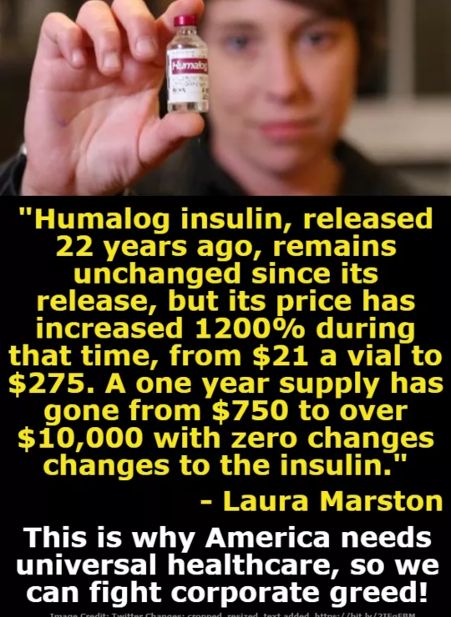
Prescriptions are just one example of health care out of control, and leading to the worst of circumstances. I explained to my daughter the concept of rationing medications like insulin, and the consequences that can occur from that action, including death. Again, common sense, trying to understand why a drug that has remained the same for decades, costs 1200% more than what it did originally. And even more confusing, why that same drug is way less expensive in other countries.

My daughter understands some people are born sick. She also knows that some people’s health are affected by unexpected events such as car accidents. And then there are those, like me, whose health issues were created by health care for other health events. In 1988, I was treated for Hodgkin’s Lymphoma with radiation and chemotherapies. My daughter obviously was not around 30 years ago when this happened, but she has been witness to the many issues that I deal with today, cardiac, pulmonary, skeletal, gastrointestinal and more, all caused by late developing side effects from my treatments. What she cannot understand is, if anyone is in need of health care, it would be me, and others in a similar situation. How could I be turned away just because I was sick before.?

The truth is, universal health care does work. And it has worked for decades. What does not work under universal health care, is profit and greed. My daughter easily has figured out that we are one of the few countries that profits off of its sick. The look of disappointment on her face says it all. I explained to her, that many simply do not want universal health care, for either misinformed, or selfish reasons.
The term universal infers “socialism,” a bad political term going back to the 1950’s and 1960’s under leaders such as Marx. Socialism is often feared as being one step away from Communism. And perhaps it could be. But the truth is, we actually accept “socialism” with some items such as the fire department, police department, paramedics, libraries, and more. So why then would the most important benefit to our lives, health care, not be accepted? If you are against socialism, does that mean that you want to turn back the services of the fire department and other emergency services? Of course not.
What I have found, and again, I insist if you are going to debate health care with me, leave politics out of the discussion, and stick to facts, and we can come up with not only a solution, but the real crux of the problem of universal health care itself, beyond the money-making profit machine of Big Pharm and Insurance.

“I don’t want to pay for someone else’s health care.” Politics and lobbying aside, this is the main argument against universal health care, not whether it works or not, not whether there are problems or not, but rather an individual position.
Again, at one point, getting medical care was easy and affordable. But in the 1980’s, entitlement issues in politics caused a fissure in compassion that we used to have for each other as human beings, if you force me to throw out the Christian card, I will. Rapidly, we began to judge those and their circumstances that caused people and/or their families to be unemployed, for any reason. In simpler terms, these people are not putting anything into the system that they would benefit from with universal health care, and there are those who do not like that. Of course then, I would bring up the other socialism programs like emergency services, that a person with no job should have their house burn down if they do not work or some other emergency, and I am looked at as if I said something absurd. But for some reason, when it comes to health care, there is a line drawn in the sand. No job, “you do not deserve health care at my expense.” And even if it would save money for the working contributor, in other words, instead of paying $12,000 per year (or more) to an insurance company, having a tax take out $2000 per year, saving this person $10,000 per year, those who oppose universal health care stand by their principle, willing to pay the higher amount, just so that someone does not get something for “free.”
It took no time for my daughter to soon realize, health care discussions were a lot more complicated than the thesis she had chosen to write about. But she still stands by what she writes, that health care should be a right. No one should be turned away. Everyone should have access to the best care available. And if you have been previously sick, you need the health care even more. Not paying attention to the political discourse, she is only aware that the ACA is in jeopardy of being turned back 100%. And since she has researched what it was like before the ACA, she can only shake her head that we are going back to the beginning of the argument, and people will die while the process starts over, if at all.


 Paul's Heart