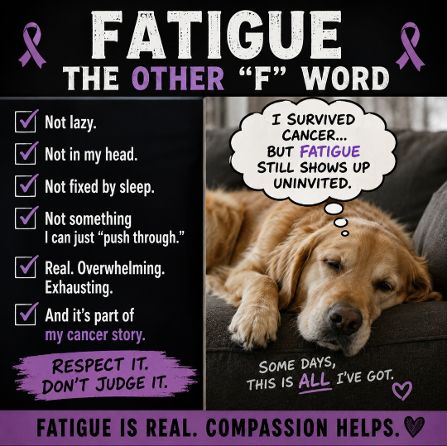
Fatigue is one of the most common and most frustrating parts of cancer treatment and survivorship. I would even go as far as to say it is harder to cope with than any pain, because pain can be medicated, while fatigue affects nearly every aspect of life – the body, the mind, emotions, and even our sense of identity.
Fatigue can happen at any stage of cancer or survivorship. During treatment, fatigue can be caused by any of the following: chemo and radiation, anemia (lowered red blood cells), poor nutrition, weight loss, sleep disruption, pain, stress, anxiety, and just the overall demands of fighting for life.
Even after treatment, fatigue can still persist. The body needs time to repair the damage from the treatments, and this can take months, even years. Heart and lung problems related to the treatment can contribute to fatigue. Hormonal problems such as with the thyroid, chronic inflamation, depression, anxiety, PTSD, and normal aging are all mentally exhausting.
The common question asked by nearly everyone is “how long does it last?” And honestly, there is no one answer. Many people recover within 6-12 months, while others can take several years, usually battling some sort of intermittent fatigue (good days and bad days). Even 37 years out from Hodgkin’s Lymphoma, I still battle fatigue every now and then, as a long term effect from my treatments and various health conditions that I deal with.
Why is fatigue so hard to get over? Because it is not normal “tiredness.” Sleep won’t make it go away. It can appear suddenly, even with the smallest of efforts. Mental concentration and memory can be hindered, sometimes we refer to it as chemo brain or brain fog. It is frustrating because on the outside, we look fine, and those looking at us cannot understand why we feel so bad, and just can’t push through it.
So, what does help? Doing as much as you can, when you can, if you can, and if not, that’s okay. Stay as physically active as you can with gentle exercise such as walking. Pace yourself. Let me repeat that, pace yourself, alternating activity and rest on your good days instead of overdoing it. Get good sleep. Eat right, I know, the obvious stuff. Don’t be afraid to ask your doctor to look for medical issues, such as anemia, thyroid, vitamin deficiencies, cardiac, or medication side effects. A big one which I occasionally struggle with, manage stress, whether through mindfulness, counseling, or support groups. And lastly, accept that your body’s limits may just be different than before the cancer.
But I want you to listen to this important message. FATIGUE IS NOT WEAKNESS OR LAZINESS! I repeat, just because you are fighting fatigue, does not make you lazy or weak. Fatigue is a real issue, a biological consequence of your cancer and treatment. So much pressure, often futile, to “get back to who you were before cancer” to building a fillfilling life around the body that you have today, many survivors find that once they stop measuring themselves against their pre-cancer energy level and instead learn to work with the current abilities, fatigue becomes more maneagable emotionally as well as physically.
The other night, I was watching America’s Got Talent, and there was a comedian auditioning from a wheelchair. What seemed to take the audience by surprise, was that he made “how he got there” a part of his routine. He had been shot. He told of the response he got from a woman what had happened, when he told her that he got shot at a Halloween party, and her response was, “that’s spooky,” to the shock and dark humor look on the judges faces. He quipped that he was dressed up as Spiderman, but clearly his spidey-senses had failed him. He took several shots at himself over the incident, then turned to the next segment of his audition, applying for jobs that he couldn’t do and then just show up to the interview, such as roofing and rock climbing instructor, saying “this is the consequences if you don’t follow my instructions.” He was actually quite funny, and clearly this helps him deal with his disability.
(image from IMDB)
Brad Williams is a great comic of small stature as he describes himself as fun size like the candy bar. And boy does he have the self-deprecating material. Being caught in a major snowstorm dumping a foot of snow, his fear of tripping and falling and dying because no one would find him. Or his father, lifting him onto the kitchen island and leaving him there as punishment (time out) as a child. Even his wife gets in on it, a black belt in jujitsu, gets into an altercation with a man, only to turn to Brad and say, you defend my honor.
(image from Entertainment Weekly)
And finally, there is Josh Blue, a comic born with cerebral palsy. And yes, the majority of his act is about his disability, and he is hilarious. “There’s nothing more entertaining than watching 12 dudes with cerebral palsy getting off an airplane like some sort of zombie parade.” “I mention that I have cerebral palsy because if I don’t, after a while, the audience is sitting there wondering, ‘does he know…that he has that’?” “I went to NYC and tried to hail a taxi and caught a pigeon (because of the curvature of his hand).”
Have you ever heard of the expression, “laughter is the best form of medicine?” It is a centuries old expression with no clear origin, even mentioned in the King James bible (Proverbs 17:22 (King James Version) states, “A merry heart doeth good like a medicine: but a broken spirit drieth the bones”). Laughter triggers profound, measurable physical and mental changes in the body. By naturally resetting your nervous system, a good laugh relieves tension, boosts your immune system, and promotes long-term cardiovascular health. And then I thought, I have never really heard any comedian make cancer part of their act. Sure, plenty comedians have experienced cancer, but I almost think, would there be too much of a risk of bringing down the audience. Clearly the only ones who would be able to tell jokes about cancer, would be those who have had cancer touch their lives. Well, that would be me, a 37 year survivor of Hodgkin’s Lymphoma. How would I create a comedy bit dealing with cancer, without bringing everyone down with what is commonly referred to as “gallows” humor, yes, that kind of gallow? I think the thing to keep in mind, is that most comedians reflect on their lives with their acts, so this actually is theraputic or cathartic when dealing with themselves. Will everyone who has or has had cancer think the jokes are funny? No. Will at least an irony been seen in the routine? Perhaps. So, I thought I would give it a try. Now I’m sure it looks different on paper, than if you were seeing it live or on video. But who knows… So, here goes.
“How’s everybody doing? My name is Paul and I want to let you know, I’m a 37 year survivor of cancer! Thank you, thank you so much. Now I don’t want you to think that this is going to be a bummer set, hardly. I can hit you right from the gate, my favorite Disney movie was “Finding Chemo, and the most expensive haircut I ever got was chemotherapy. I had heard 8 cancer jokes the day I was diagnosed, and if I had heard another, it would benign. I will let that one sit a little.” Or I can just go into a story.
“When people find out that I had cancer, a common comment that comes out, ‘you’re so brave or courageous.’ Now to be clear, I didn’t volunteer to have cancer, though oncologists love to tell certain cancer patients with certain treatable cancers like mine, ‘if you’re going to get a cancer, this is the one you want.’ Want? What the fuck?!? Nobody wants cancer, it doesn’t matter how successful the treatments are.
Like, do you think I would walk into a doctor’s office, like I was looking for some grey poupon and say, ‘excuse me, do you have anything that involves chemotherapy, radiation, and lifelong anxiety?’ Cancer isn’t a gym membership. You don’t sign up because you want to.
The one comment I find somewhat odd hearing is, ‘congratulations on beating cancer.’ ‘Beating cancer?’ I didn’t beat anything, I survived it. Because if I beat cancer, I wouldn’t still be having medical appointments related to my cancer, in the form of late side effects, 37 years later. To give you an idea how this feels, and you don’t have to have cancer to understand this…
Think of someone robbing your house, and every six months the police call and say, ‘we’d just like to check and see if the burglar came back.’
And let’s talk scanxiety for a second. You don’t wait for the results, you rehearse every possible conversation in your head. Five minutes after the scan you’re thinking ‘I wonder if I should start organizing my garage,’ and the tech says, ‘the doctor will call you.’ Really? How about you just give me a thumbs up or down at least, maybe a smile, something to give me hope for the next couple weeks while I wait for the doctor’s call? You are like one of those people who know the ending of a movie and won’t tell me.’
One of my favorite things to hear is, ‘you look great!’ Which is wonderful, because I actually still feel like shit. But at least I got my money’s worth to make me look that great; modern medicine, nurses, doctors, therapists, pharmacists, family and friends who put a lot in to making me look this good.
The hardest question I get is ‘are you cured?’ I have gotten so accustomed to not using the word cured, even my doctor did not like using it, because of the slightest chance of it returning. It’s kind of like asking someone living in Florida, as I do, so…are hurricanes finished after one blows through? While I hope so, I prepare in case another one comes by.
I will tell you one situation that I did not get used to. Remeber the television show Cheers, when the character Norm would walk in and everyone would cheer his name, yeah, I got that everytime I walked into the oncologist office. Only instead of tasty beer, I got the most toxic of chemotherapy cocktails. I would rather run into everyone at a pizza place or bar.
One good thing that came from my experience, was perspective. Before cancer, I would worry about having matching socks. Now, if they’re both socks, I’m having a great day. People think survivors are fearless. We aren’t. We’re just experienced. We know life can change with just one phone call. We laugh harder now. We hug longer and and say “I love you” more often. We don’t save the good dishware for company.
Cancer took a lot from me. But it also gave me more appreciation for boring days, a beer with a friend, sunsets, hearing someone snort they laughed so hard. The moments don’t seem so ordinary anymore. They’re the jackpot.
So if you’re here tonight because you’ve survived cancer – or you’ve walked beside someone who has, give yourself a little credit. You made it through some of the hardest days imaginable. The fact that were here laughing together tonight? That’s not denial. That’s victory.
Thank you…and remember… the best revenge against cancer is living a life that refuses to let it have the last laugh.
I get countless stories across my feed, about patients being denied procedures, treatments, or prescriptions, and not just in the world of cancer. Two recent articles referenced an adult dealing with severe kidney disease and a young child needing medication to prevent flare ups of a chronic illness, which would risk death. Both were being denied what was being decided by their respective doctors by a pen pusher in an insurance company, driven by only profit for shareholders and what is best for them.
It was not always like this. In the 1970’s and early 1980’s, I can recall my mother writing a $25 check to the doctor directly. There was no insurance, just him and his nurse. There was no one dictating to him how to care for his patients. But that all changed once insurance got involved. Then care became about being “managed” with at least some concern about preventative medicine. But still, there were no warning signs that care was going to be sacrificed for shareholder profits as we see today. Today, the insurance industry is out of control with its interference with patient care, resulting in one tragedy after another. And leaving other patients with only one option, to fight the almight insurance company with everything you have, just so that you can get done what your doctor knows is best for you.
First, let’s understand the basics. Only doctors know what is best for their patients for one simple reason. They are the one hands on, in the room with the patient, hearing the patient, with the entire history at their fingertips. Next, insurance companies are like casinos in that, like casinos, also known as “the house”, they both have the advantage, and they only make money if the customers/patients do not win and get paid. So now you understand the odds are against you as a patient. The insurance company cares only about making money for its shareholders, and that means only one thing, deny paying out as many claims as possible, and worse, denying care and treatments.
If you are one of the fortunate, who are either healthy or have what is called a “cadillac plan,” one that covers everything without restrictions, then you have likely never had to deal with a pen pusher denying a claim or treatment. But for those of us that have had this happen to us, we know things have gradually gotten worse, way worse, and people are dying because of it. So I am writing this post, to do my part, to help, at least provide some directions and information, how to do the seemingly impossible, fight the big bad giant insurance company. It sucks that for so many, fighting for their very lives, they have to spend any energy they have to fight for their medical care on top of it, and the odds are against them, and so is time.
Dealing with an insurance denial can feel infuriating because we know our doctors are only trying to help us, but not the shareholders. So there is that constant conflict. And sadly, it is going to take more than one attempt to defeat the insurance company, by putting the right kind of pressure on the insurance company, you can improve your chances. But it takes strategy and focus, all while you are sick, possibly fight for your life against time.
Get the denial in writing and read it carefully. Ask for the exact reason for the denial and pay attention to the policy language they are using as to the denial. Was it:
not medically necessary
experimental/investigational
out of network
preauthorization missing
coding error
Often times, denials are procedural in nature, and can be fixed. A pain in the butt when time matters, but it is what it is. Coding errors are becoming more and more common and can be fixed by the doctors administration staff (remember earlier how I mentioned only a doctor and nurse handling everything, administration staffing is a major reason for health care costs skyrocketing, and mistakes being made).
File a formal appeal immediately. Insurance companies expect you, expect most people to give up. DON’T!!!! But this is where you now have to ask your doctor to advocate for you and file this appeal for you (actually they will likely have an admin staff member do it). This is not a big ask of the doctor and is really quite common. It is in their patient’s best interest to do this, and do so immediately. The appeal needs to include:
a letter of medical necessity
supporting medical records
peer reviewed studies if applicable
a clear explanation of why other options will not work or have failed
If the appeal fails, or time is that crucial, request a Peer-to-Peer Review. This is where your doctor can speak directly with the insurance company’s reviewing physician. But don’t be fooled by the “peer to peer” as anyone knows, there are differences between doctors and specialists. And you do not know the specifically if your doctor is speaking to an actual peer of their standing (as in oncologist to oncologist, neurologist to neurologist or cardiologist to podiatrist or pulmonologist to orthopedist). There is good and bad to this, but hopefully, as long as the conversation is keep professional, if not dealing with an actual peer, the insurance doctor can trust what your doctor is trying to convey. But if true peer to peer, then there should be mutual understanding of what needs to be done. A direct conversation is the best chance to clarify any complexity.
Even then, sometimes those appeals or reviews are not good enough. This is where you really need to advocate for yourself, because your life literally depends on it. It should not be this hard, but you need to do what you can. You have the right to request an independent external review under federal law (the Affordable Care Act). This external reviewer is not employed by the insurance company, and makes binding decisions in many cases. State-specific instructions how to do this are usually found under your state’s Department Of Insurance on the internet.
Depending on your coverage, as in if private insurance, you also have the option to file a complaint with your State Insurance Commisioner. If you are dealing with Medicare, contact the Centers For Medicare & Medicaid Services. And if it is employer-based insurance, you may have to involve the US Department of Labor (ERISA plans). Regulatory complaints often trigger faster re-reviews.
Double-check if it could have been a coding issue. It happens more than you know, especially with insurance companies dictating what appointments should be, versus what the doctor actually does, and contradicts what the insurance company expected. With my complicated health history, this happens all of the time. So, if it was the wrong billing code submitted, or the diagnosis code is wrong or does not justify the test or treatment, or even the provider forgot any pre authorization needed. It is not a big deal to have the doctor’s office double-check the CPT and ICD-10 codes.
If the denial says “experimental,” ask your doctor to be sure to include specialty guidelines, standard-of-care publications, and consensus statements. Insurance companies may relent and reverse when shown what the doctor wants to do is standard practice.
Of course, if the situation is Urgent or Cancer-related, and delay will seriously jeopardize the health of the patient, reqeust an expedited appeal. Response must be faster, hopefully within 72 hours or less. A simple accompanying statement from the doctor, “delay may materially affect the prognosis,” should carry weight.
And if all else fails, there are some other options such as negotiating a cash price (which is often times less than billed rates), speak to a case worker or social worker about financial assistance programs, and if necessary, a legal consultation (especially if the denial contradicts policy language). Your doctor is going to do all they can for you, or at least they should, but understand, like the comparison to the casino, the insurance company only succeeds if they deny, deny, deny, and not pay out claims. They do not care about patients, only profits for the shareholders.
But what the insurance companies do not count on, is persistance. Like really, who does not want to survive what they are dealing with, that you have to fight even harder and waste more time. But keep this psychological strategy in mind. Insurance companies operate on time pressure, administrative fatigue (they count on you giving up), or they may even just get tired of the fight. Some times, persistence is one of the strongest tools in this fight.
Of course, this all circles around to my constant fight for universal health care. Those who oppose it, come up with one excuse after another, and even after it is proven to be the advantage, at the end of the day, it is the mere fact, that some simply do not want the government in charge of the insurance. These people are willing to pay over $20,000 a year, for a private entity to deny them health coverage as opposed to what is already taken out of paychecks, called a FICA tax, which contributes to Social Security and Medicare, an amount of 15.3% total, split in half between the two, so 7.65% to Medicare, already being paid along with whatever your pay towards private insurance. Medicare has a much lower, if any denial rate compared to private insurance, and more importantly there are stronger mechanisms for Medicare to fight any delays or denials. But then the argument falls back on “I don’t want government controlling my health care” or “wait times” (which already exist), or “can’t see who you want” (with a private option, yes you can), or whatever excuse those who oppose want to throw out. It is against your best interest to oppose universal health coverage which is why EVERY other industrialized country has it except for us, because in the US, health insurance is not about patient care, it is about profit over patient. And because of that, good luck with your appeals.
American Cancer On-Line Resources
Internet support from peers, caregivers, survivors, and professionals in several hundred types of cancers and related issues