I write for many reasons. It helps me to keep things organized in my life. Things that I write about help me to remember. I hope that many of the things that I share, inspire, provide hope, cause laughter, or provide comfort and familiarity. Writing is also cathartic.
The release that I get, from putting my thoughts down in a blog, in a diary, or as I have just finally completed, a book, is not only therapeutic, but more times than not, provided me relief when I needed it most. As I tell many, if you do not have a therapist, writing down your thoughts is just as good because it gives you the chance to process your thoughts again.
I am in a strange place right now in my mind, several things at the forefront, coming up in the next week or so. My younger daughter is about to start her freshman year of college, joining her sister now in her sophomore year, a time I never thought I would live to see. I am approaching bi-annual medical follow-ups for all of my health issues, with always the “what if’s” in the back of my mind. And having finished writing my first book, called “Paul’s Heart – Life As A Dad And A 35-Year Cancer Survivor,” as I edit the book, I am coming to a bigger realization, and more than just catharsis.
A therapist I saw back in the days that I was treated for Hodgkin’s Lymphoma often accused me of not recognizing the gravity or seriousness of what I was going through. I knew she was right, but I would still try to convince her that I was taking it seriously. But the truth was, for me to recognize how serious everything was, I would have to recognize and accept my mortality, which was in jeopardy. I felt my mind was in the right way of thinking, that I would get through my cancer. There was also the fact, that I knew that others had it way worse than I did. Some might not even survive. I was not planning on that fate. So no, I would not let myself take this episode in my life so seriously, because I expected to be fine.
Even as I wrote the book, chapter by chapter, as I recalled every detail, I still do not feel I saw how serious everything was that I went through. Sure, I knew all the dangers and crisis that I went through, and just as my therapist reminded me daily back then, it still did not hit me.
Now, with the book complete, I have read the whole thing in its entirety, although for the first time as an opportunity to do a final edit, several times. It has taken four decades, and being able to read through the entire manuscript, all the time periods and details, I can acknowledge just how difficult and dangerous many of the periods of my life really were.
For someone to pass by me on the street, without knowing me, would have no idea of the journey that I had taken over the last thirty-five years, the toxicity that I was exposed to with my treatments, and the health emergencies that I survived. But when you get the chance to read my book, soon I am hoping, I really did go through everything in the book. I may have made it look easy, I may have made myself “think” it was easy, but for the first time, I will say, it was far from easy.
My fight against cancer was hard, and not just my hard head fighting against me and the efforts to treat me. The unknown of what survivorship would bring, from discrimination to one health crisis after another, late developing side effects from my treatments, nearly as fatal as my fight against cancer, starting each day with uncertainty. The pressures of life and stress along with expectations and interference of others served as unnecessary and unwanted distractions. The fear of being the source of loss for the most important people in my life, knowing that my days of uncertainty and survivorship are not guaranteed.
I have no regrets about the decisions I made back in 1988 nor that I make today. Everything I do or write, are with the intentions of seeing another tomorrow, and are part of that plan.
I will continue to write here on “Paul’s Heart,” as I still have nearly 300 stories that I began to write and put to the side, and have many more to go. I will take a little time and then begin my second book. I am actually planning three more.
This is how I deal. Yes, some close to me cringe how open I am with my posts. But as I will never discover anything earth shattering or come up with a cure for something, if my words can make a difference to at least one, then this was all worth it.
The question is, “if you had the chance to go back in time, and re-live something over again, what would you want to re-live and would you do it?”
First, I need to offer a disclaimer and “nerd” alert. I am a huge fan of the television show “Quantum Leap” and the movie “Back To The Future.” So, to understand the above question, I would have to understand the ramifications and risks associated with going back in time. Even the slightest change in the past would have a major impact on the future.
For instance, though there is no known cause of Hodgkin’s Lymphoma, if I were to relive any time period just before my diagnosis, and somehow end up not being diagnosed with cancer, on one hand that would be a great thing. But tragically, that would erase all that I have accomplished over the years, and take away the two most important people away from me, my daughters.
There are definitely things that I would not want to relive again, all losses of loved ones.
As my path through Fatherhood was not as I had originally planned, I did the best that I could and accomplished what I needed to. I have plenty of photos to look back on to relive all of those moments.
There is one moment in my life, that I do wish I could live over again, but this would come at a risk of changing history. Because there would be a slight/major change in the moment.
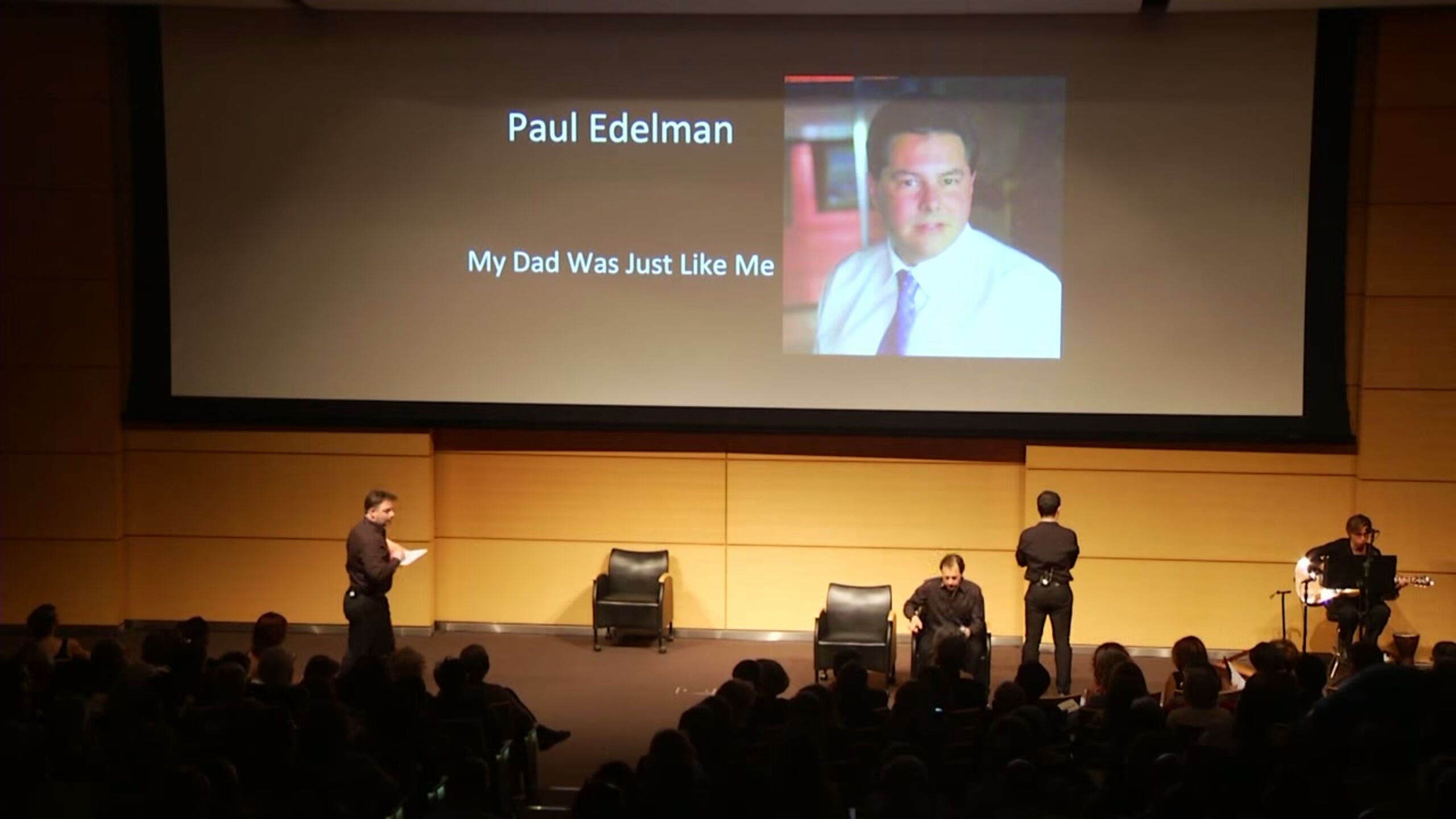
One of many stories I had written over the years was being performed (read) live, by professional actors. It was an achievement I never thought possible. The story was about the passing of my Father. But being recently separated at the time, I wanted my daughters to attend this moment with me, but was denied by their mother. I had promised that everything would be done to make sure they were prepared for, and able to attend school the next morning. I was still refused.
It was one of the most powerful and surreal experiences in my life that I do not know if I will ever get the chance to experience anything like that again. I do not know if getting to go back, have my daughters sit by my side for the performance, meet the actors afterwards, and listen to the kind words of audience members would change any direction of the future. But if I had one moment, to relive over again, this would be it.
Many times, I will get the subject of my posts from questions asked or comments made by fellow long term survivors. This will be one post, that not only benefits long term survivors of cancer, but those who have been fortunate to never have seen the inside of an oncologist’s office.
This is a very popular meme image that circulates around the internet. And since it fits in with my topic today, I thought I would make my own meme with the picture.
I am sure you have heard of the condition “reflux,” commonly referred to as G.E.R.D. (gastroesophageal reflux disease). It is the body’s reaction, a very acidic reaction brought on and aggravated by diet and stress. It is a fairly common condition, and its severity depends on the individual. Not sure if you have ever had to deal with it?
Comedian Rich Hall, gave a very clear and vivid description of reflux, using a term referred to as a “sniglet” decades ago on HBO during one of his comedic segments. A “sniglet” was simply a made up word, describing something that there was no other word for. In the situation of my post, he referred to a “vurp.” Care to take a guess at what “vurp” represented? It describes what happens with reflux perfectly, the combination of “vomit” and “burp” at the same time. If you have ever experienced this event, then you have had reflux at least once in your life. It is not pleasant, and the acidic aftertaste left in the mouth is just awful.
But there are those who must deal with this regularly. And its level of severity is determined by many conditions such as diet, stress, and other health conditions. Treatments can range from eating a diet with less acid (no tomato or orange products), or not eating fried or spicy foods, to daily routines such as not eating by a certain time of the day prior to going to bed or sleeping in a certain position, to using over the counter medications such as TUMS or stronger prescribed medicines.
A single event of reflux may not be such a big deal. However, if it is a situation that is repeated time and time again, it can be something quite serious. As I described above, if you are burping, and instead a small amount of vomit comes up instead of air, this is very acidic. We all had science in school, and know what acid does, eats away at things. Well, the more acid you have to deal with, the worse it will get. And for our bodies, in particular our esophagus, our throat, our mouth, and our teeth, this is a very bad situation. Because of the issues I deal with from my treatments for Hodgkin’s Lymphoma, this situation also almost killed me.
When most deal with reflux, it is often following a meal. We have an opportunity to do something about it, pop a TUMS or some other medication. Assuming we have not eaten just before going to bed, we are likely to stay vertical for a number of hours, allowing gravity to do what it needs to, to keep the stomach acid from creeping up into our mouths. If lucky, just a burp occurs or perhaps, a little bit of “vurp.”
If it advances to its worst timing, at night, while in bed, many problems can occur. Sure, your quality of sleep will be affected as you toss and turn, trying to get the GERD to stop. In my situation, I have two issues that I have to struggle with. Because of damage done to my esophagus from radiation therapy, I have a condition that not only traps food and particles in my esophagus, but also this stomach acid. This twice has led me to the emergency room with something called aspiration pneumonia, the trapped product bacteria gets breathed in to my lungs. My first episode of this, I went full septic, nearly dying. The other issue, is that I can actually “choke” myself out in my sleep as the acidic content fills my throat area. The problem is, I sleep through this event when it happens. So unless someone is around to hear me gasping, or my breathing gets interrupted that it startles me out of my sleep, the episode will not end well. Once I am woken up, it will be hours before I can fall back to sleep, and get the symptoms of the reflux event under control.
So, what can be done to help with this condition? Believe it or not, pretty much! As I mentioned, diet plays a major role. In spite of me being a picky eater, a condition that has me desiring the very acidic products that would aggravate the situation (tomato sauce, orange juice, buffalo wings, etc.), over the years, I have learned to do without these things. This does not mean that I no longer eat them, but it better well be damn worth it if I am going to pay the GERD price. And I do imbibe occasionally, and almost always will pay the price.
Stress, reduce and/or eliminate it. I do not need to go into detail. You know what this means.
Medications can help from over the counter TUMS and Pepcid to prescription level such as I have to take. Unfortunately, I am at a point where I take both, definitely not good to do, and certainly not as long as I have been taking them, nearly fifteen years now. But without taking them, this is not hyperbole, my quality of life is gone.
Timing, as I mentioned earlier, do not eat if you are going to be going to bed soon after. It is best to wait to go horizontal at least two to three hours, allowing for your food to travel where it needs to go, without coming back up.
And the final thing that can help with “vurping,” positioning. To prevent an attack coming on in my sleep, I have actually had to adjust the level of my bed, by about two inches, the headboard end of the bed only, so that my bed is in a downward slant, which allows for gravity to do what it must, to keep the acid where it belongs. All this takes is a simple piece of wood under each foot of the bed at the headboard. But, of course in my situation, this is not enough for me, and that is where the meme above comes in. This is also not the first time, the position that I sleep in, dictates my comfort level.
Back when I had my first heart surgery, done open heart through the breast bone, I was forced to lay on my back, just from the discomfort from the destruction of my chest and rib cage, not a position I normally sleep in. My favorite position has always been on my stomach. In the hospital, my bed was elevated, so being on my back did not bother me. Once at home, sleeping on my back did not work at all. And so, I began to lean to my left so as to change my position enough to get comfortable. A pillow would be placed behind me to hold me in that position. Seemed simple enough, just enough lean, not to be flat on my back.
Then terror struck. No, I had done nothing to my incision or rib cage. I felt as if I was on the verge of a heart attack, as if my heart were going to explode. The beat of my heart was pounding against my rib cage. I began to panic. I removed the pillow from behind me, allowing me to return, flat on my back. Odd, the pounding stopped. I really cannot explain why I did what came next, but I leaned to my left again. Again, that pounding had returned, and I leaned back flat again. Ok. This was weird. But at least I no longer thought I was having a heart attack. Now I was curious. I decided to lean now to my right. This time however, there was no pounding. I would return to my back, and once again, turn to my left. Sure enough, the pounding resumed. Flat, nothing. To my right, nothing. So I was not going to make an emergency phone call or a trip to the emergency room, but clearly someone forgot to fill me in on a very important detail. What the Hell was done to me, that my heart “shifts” when I go to lay only on my left side, that it feels as if it is touching my rib cage, making me feel as if I am sleeping on a bass drum?
An article on “healthline.com” explained that the apex of the heart being closer to the wall, when sleeping on the right side, the mediastinum (a thin lining), holds the heart in place separated from the lungs. Sleeping on the left side, the heart will shift slightly. Combined with my surgery, and things likely moved around internally, this is exactly what was happening. Though it has been studied, the website did not cite the study, but expressed that according to ECG (electro cardiogram) readings, there was a noticeable change in the heartbeat, when laying on the left side, and none, when laying on the right side. There is nothing reported if side sleeping is dangerous or not, nor does it contribute to any kind of heart ailment. For the purpose of this post, that is where I am ending this part of the left side sleeping discussion.
With reflux impacting my sleeping position, I found another discovery about me sleeping on what has become my dominant position now (with me ignoring the pounding heart beat). In spite of the prescription I take, watching what I eat and when, and position of the bed, all too often, that has not been enough for me to get through a night without either choking myself out from the rush of stomach acid, or worse, as mentioned above, developing aspiration pneumonia. I have found, sleeping on my left side, I do not have episodes of reflux. When I begin my night trying to sleep on either my right side, or even attempting my stomach, flat on my back has never been a consideration, my reflux fires up, and sleep is impossible. The problem for me occurs, if I successfully fall asleep on my left side, and if I fall deep enough, I have a tendency to roll flat on to my back, and then, you guessed it, my reflux acts up. This becomes a major issue, because I do not always wake up when this happens, hence, not until I am basically choking on my vomit, I normally wake myself up. If I am lucky, someone hears the gurgle and gasping for air before it gets worse. Once awake, I end up, getting up from the bed, going into the living room, and sitting in a chair for the next few hours, trying to get my chest and throat to settle down.
So of course, I am curious about the “left side thing” in regard to my reflux. According to a the NIH actually confirms the difference between sleeping on the left side versus the right side( https://pubmed.ncbi.nlm.nih.gov/26053170/ ). One hypothesis holds that right-side sleeping relaxes the lower esophageal sphincter, between the stomach and the esophagus. Another holds that left-side sleeping keeps the junction between stomach and esophagus above the level of gastric acid ( https://www.nytimes.com/2010/10/26/health/26really.html ).
There you have it, something from a long term cancer survivor that can actually benefit someone who has never had cancer, but has the nasty torture of reflux and lack of sleep. So yes, if I am laying on my left side, this is exactly what I am thinking about as I go to sleep.
American Cancer On-Line Resources
Internet support from peers, caregivers, survivors, and professionals in several hundred types of cancers and related issues
Childrens Oncology Group
cancer information for patients, survivors, caregivers – child or adult
American Cancer On-Line Resources
Internet support from peers, caregivers, survivors, and professionals in several hundred types of cancers and related issues