Paul's Heart

Life As A Dad, And A Survivor

Archive for the category “Education”

If My Survivorship Will Mean Anything… Part 2


michael-2

This was Michael.  You can read about his story on the “Paul’s Heart” page titled, “Michael.”  There I go into more details of his story, as this post is about a promise that I made to his mother, following his passing.  I was going to find some way, some how, to get some very important information out to the general public, since medicine seemed too slow to do, to prevent another tragic ending, like Michael’s.

michael-1

I have met many other survivors over my decades of survival.  This photo is the first meeting I had with Michael (along with his mother).  Michael had just completed 12 rounds of chemotherapy for Hodgkin’s Lymphoma.  I had already been planning a trip to Florida to launch a campaign of survivorship speeches, in celebration of my upcoming 25th anniversary of beating cancer.

I had known Michael through the majority of his treatments, communicating via Facebook, emails, and Facetime.  In fact, though he had been getting emotional support from me, it was actually him who would help me deal with a critical situation when my father was diagnosed with his own cancer to be dealt with.  Michael had included me on a lot of his chemotherapy treatments via Facetime.  And when it came to dealing with my father, I was actually better prepared as his caregiver to deal with some of the newer situations of treatments.

Over those 12 treatments, I do not ever remember knowing another patient who carried the outlook, the desire for the knowledge of what he was going through, and the ability to carry his family through the emotions of a cancer journey.

But just as I hinted before in prior posts, and on the page “Michael”, the one drug used to treat him, just as was used on me, and the majority of Hodgkin’s patients, had caused a reaction that was already known to have the potential to do so.
adriamycin

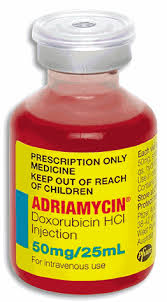
This is Adriamycin.  It is and has been, the go to chemotherapy drug for battling Hodgkin’s Lymphoma.  And this is where this post is directed at everyone else.  Because this drug is now being used to treat other forms of cancer as well.  And while Hodgkin’s is considered a rare form of cancer by comparison, this drug is now being used to treat breast cancer, which affects millions more patients.

For those of us who have been exposed to this drug, many of us call it, “the red devil.”  And I want to clarify and state clearly, I am in no way trying to convince anyone to be against the drug.  Quite the contrary.  I am alive 27 years later because it did get me into remission.  But there is a small percentage of patients who develop a very serious issue because of this drug.  And with the inclusion of treatment for breast cancer, that percentage I am sure will climb.  Admittedly, this drug is successful.  And it did give Michael the declaration of “remission.”  When the picture above was taken, he was two weeks past treatment.

No, the warning of this post is not about the drug.  The drug is necessary until something better and safer is discovered.  But the seriousness for the side effect, no matter how small the percentage, is not taken seriously enough, world wide.  Protocols are now being established for follow up testing during treatments, as opposed to “baseline” studies done prior to the beginning of treatment and at the conclusion.  Because as the next parts of the this post will show, the technology is there, to make sure that in spite of the dangers of this drug, monitoring of the side effects of this drug are possible.  But the trick is getting every oncologist on board with just this simple technology that I am going to introduce you to shortly.

The Childrens Oncology Group today clearly states, what medicine did not decades ago, that the use of anthracyclenes have the potential to cause cardiotoxicity including but not limited to congestive heart failure.  COG has also written guidelines on the dosages to be used and frequency based on age and size, to be adjusted as necessary.  But only recently has it been discovered just how early heart damage can be detected and by what technology.

This technology was not being used by the oncologist that treated Michael.  It is not known if the oncologist was even aware of the technology or was just aware of the apparent low risk involved.  Michael was not known to complain about discomfort, but clearly, something was wrong.  And other than the baseline echo that had been done prior to the start of treatment, and the echo that he never got to have the opportunity to have done, there was nothing done between those times.  And today, is the third anniversary of Michael’s passing at the age of 24 from Hodgkin’s Lymphoma.

Knowing now what I know today, I believe his death could have been prevented.  Yes, Adriamycin is the top choice to get a Hodgkin’s patient into remission, and now it seems a choice for breast cancer.  But precautions and follow ups must be taken and done, to make sure that if something is going wrong, perhaps a different mode of treatment, or at least the modification of the drug, can be done, before it is too late.

Please share this post as this story continues.


If My Survivorship Will Mean Anything… Part 1


  • Author’s note – if you, or anyone you know has received an anthracyclene type chemotherapy, like adriamyacin or doxyrubicin or others, regardless of the cancer, the following post is very important for you.

1440700063544

I am coming up on my 27th year in remission of Hodgkin’s Lymphoma.  For many cancer survivors, reaching the 5th anniversary is a big deal.  But as any cancer survivor will tell you, being able to meet someone, who has beaten the same type of cancer for a much longer period of time that they have experienced the same cancer, it is really a big deal.  I cannot speak from the survivorship perspective of other cancers other than my own personal experience with Hodgkin’s Lymphoma.  I was treated with 4 times the lifetime maximum of ionized radiation.  Mention this fact to anyone working in a nuclear power plant, and forget a doctor understanding the severity of that statement, a power plant worker knows that even they are not experienced to that much radiation.   I was treated with some very bad chemotherapy drugs, poisonous, destructive, not only to the cancer cells, but to healthy cells also.  Fortunately, the modes of treatment I underwent, have been replaced by a better understanding, better treatments, and better follow up guidelines.  But is it 100% better?  Hardly.

As survivors like me began to live longer passed our expectancy, we began to develop late term side effects from the treatments we received.  The bad part is, medicine was not prepared for this.  Research had not been done on long term survival because cancer survivors were not expected to live long enough to develop those late effects.  Survivors like me, became guinea pigs, human “lab rats” for studies to see, just what went wrong, though it resulted in long term survival, and what needed to be changed.  Only a handful of us Hodgkin’s survivors percentage-wise are aware of the many issues that we suffer from cardiac to pulmonary, muscular to skeletal, gastrointestinal to endocrine, psychological, secondary cancers and more.  The rest have no idea why their young bodies have degenerated the way they have, often with symptoms undiagnosable, and definitely not relatable to someone of a younger age than considered normal.  In fact, as I write this, one of my closest fellow survivors is currently in the hospital, being treated yet again (well over 50 different incidents) for an unknown medical emergency, clearly related to her treatment history.

I would love to tell you that in the 27 years since my treatment, medicine has learned more about survival and better cancer treatments and follow up protocols.  But the truth is, only a small amount of medicine is aware of such.  The majority of updated technology and information is limited to the larger cancer facilities along with guidelines established by the Children’s Oncology Group, which now clearly lists the risks associated with each treatment option.

This post, actually being written in 4 parts, is going to be the legacy of “Paul’s Heart.”  Because as you will read on, this story is not just about one survivor, one death, one particular cancer, but for many other cancers as well.  With this post, I am going to going to make my survival count.  I am going to make my survival make a difference.  I am going to keep a promise that I made three years ago.

michael-2

I am asking you to please, continue on with the remaining parts of this post.  Please “share” this story on your own Facebook page, group, Twitter, whatever social media you deal with.  The information I am going to share with you, is going to make a difference to someone you know.  Medicine is not catching up quickly enough, as you are about to read.  But with your help, we are going to help change that.

Please continue on to Part 2.

“Sick” Of Selfies?


012214-sgg-insert5-400x

Perhaps nothing causes greater criticism than someone who posts a “selfie” and explaining that they are dealing with an illness.  Many people, get frustrated enough, that they take the action and “unfriend” someone just because they do not want to see posts that relate to someone being sick.  And while, posting every blink of an eye or sneeze may seem like way too much information, there just might be a benefit to someone who posts about a medical issue they are currently dealing with.  And I should know, because there was a time that I did not have social media during one of my critical health periods, being diagnosed with cancer, and 26 years later, dealing with late side effects from the treatments that medicine did not prepare for, as survivors were not supposed to live long enough to develop any.

No one has posted more personal stuff about medical history on line, than me.  I think that is a pretty safe bet.  And yes, I have made people cringe, unfriend me, stop talking to me completely.  But I have also had overwhelming responses, a growth in the number of people who understand me, and even more of a blessing, learning that there are others who are in similar situations like me.

There are a couple of reasons that I post certain things on social media.  And yes, admittedly, there are times that those posts come back to bite me in the ass because there are those with horrible intentions, trying to use this information against me.  There are laws supposedly in place to protect me from discrimination, but come on, let us be real, there are ways around them and we know that.  So then, why expose myself to the negative ramifications of revealing issues concerning my health?

Well, the first thing I need to express is, I do not do it for pity or attention.  To be honest, both of those are the last things I need when I am dealing with a crisis.  I have always claimed that anything I post, I do it so that others who are going through similar crisis or struggling with issues, might just see that they are not alone.  Also, there are times that I myself am looking for answers, or even seeing that someone who has gotten through similar problems has overcome those struggles.

But now it is being reported scientifically, the benefits to “sharing” information on social media.  Now, it should also be stated, once you go public with anything, it is out there forever.  If you are like me, I do not post anything I am ashamed of, and I clearly know that some of the things that I post, will be used against me as some point of my life.  But my moral compass requires me for the benefit of the good that comes from my posts, to publish many of my commentary.  Not to mention, there is clearly a therapeutic value to putting your feelings into words.

Look, I will never discover a cure for anything, and I am pretty sure I will not have an opportunity to enter a burning building to rescue someone.  But if my experiences helps to inspire someone to fight harder by knowing they are not alone, then I can live with that.

The need to post on social media needs to be seen as the helpful tool that it can be.  To share information, to guide for assistance, and to show that a person does not need to struggle alone.

You can find an article referring to this issue at the link below:

https://www.sciencedaily.com/releases/2016/03/160321110437.htm

Post Navigation