I was diagnosed and treated for Hodgkin’s Lymphoma from 1988 through 1990. Being a rare form of cancer, Hodgkin’s Disease, as it was called back then, was relatively unknown, or discussed. This was especially true when compared to lung, breast, or colon cancers.
Other than “The Terry Fox Story”, or the more recognizable “Brian’s Song”, I had never really seen any movies or television shows dealing with cancer. Which is what caught my attention one late evening during a “midnight” movie on a syndicated station.

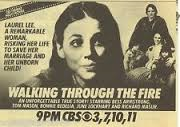
“Walking Through The Fire” had originally aired on network television, but was now syndicated. The movie starred Bess Armstrong as a woman who was diagnosed with Hodgkin’s Disease. But she was also pregnant, and treating the cancer put the pregnancy at risk, and without treatment, she would die. It was a star studded cast for that time period (Richard Masur, Swoosie Kurtz, Bonnie Bedelia, June Lockhart), so I was looking forward to how the Hodgkin’s experience would be portrayed, compared to my real life experience.
Besides it being a midnight movie on television and I was tired, I could not get passed a scene in the movie that involved a diagnostic procedure that any Hodgkin’s survivor from the 1980’s and earlier was most likely subjected to, the staging laparotomy. Without going into the gory details, this was a surgical procedure, that involved a cut from the abdomen to the chest. This procedure involved removal of the spleen and other biopsies, definitely not something you would just bounce back from. But Hollywood and its magic could do what medicine could not, manage pain and recovery instantly.
Over the next many decades, there would be several television shows dealing with Hodgkin’s either in their story line, or behind the camera. As usual, Hodgkin’s did not get any kind of spotlight, which nearly all of us having dealt with Hodgkin’s, constantly hold our breaths for that one moment that will finally get the attention we need.
One of my favorite medical television shows was “House” with Hugh Laurie. He played a head doctor, who got assigned all kinds of difficult cases, which involved partly medicine, but also crime scene instincts. Of course my hope was that one case that would come in, would deal with late effects from cancer treatments such as radiation or chemotherapies. The issues that many of us face, often go undiagnosed because symptoms do not sync with our age, our appearance, and often times our health history.
Some long term cancer survivors are only recently getting the care they need because of a few pioneers who realized that we were living beyond the five year mark, and also realized that we just might be developing long term issues that were never expected because we were not supposed to live that long. But the fact is, WE DO!!!
I should not have been shocked then, when once again, television would use another series, mention the word lymphoma, and then walk away from the episode feeling disappointed. Even more so, because this time, the patient not only had lymphoma, but was being treated for his late developing side effects.

I have never seen the television show “Heartbeat” before, not even previews. But when the feed came across Facebook, that a television show was actually going to tackle long term cancer effects, I could not help but be cautiously curious.
The premise of the show is similar to one of my favorites, “House.” Both are unique doctors with personality quirks and personal issues they must deal with. So again, I am thinking, this is going to be a doctor that is going to show the efforts that it takes to properly diagnose someone who does not know they are dealing with late effects from cancer treatments.
During the first ten minutes of the show, I came to the conclusion I was going to be disappointed. The dialogue of other storylines in this episode were stupid and no different than other “TV hospital story lines.” Then we finally get to meet the patient.
Sal Merrick has lymphoma as a teenager. He was treated with radiation therapy. The show does not mention if there was also chemotherapy, but radiation alone can cause enough damage with late effects, so we will just go with the assumption that radiation is all that he had. After all, he has had this doctor caring for him for a long time, so those details were not relevant to viewers, only those of us who have been there and done that.
The doctor and her gaggle of students are making their rounds to Mr. Merrick, and following the introduction, the doctor mentions “late cardiovascular complications from radiotherapy.” One student as if hit by an adrenaline rush starts blurting out “congestive heart failure… pericardial disease…” and then he is interrupted by the doctor who then allows the patient to explain what is being dealt with.
On one hand, I am glad to see that late effects are now being covered in med school. The doctor gives Merrick the opportunity to explain to everyone what he is dealing with. This is unfortunately an all to familiar experience as many of us survivors, end up educating our caregivers. The difference being, those of us who are lucky or fortunate to have doctors with open minds and willing to be our advocate.
Merrick explains that he has “mitral valve regurgitation”, a common issue, with radiation therapy wreaking havoc on the heart and cardiovascular system. There are many other issues possible for us, the other valves, scarring, etc., but Merrick fortunately was only dealing with a mitral valve problem. And like most of us, we know the risks of the procedures we face, and the ramifications if those risks are not addressed.
Merrick had multiple surgeries, which of course resulted in a lot of scar tissue, with scarring being enough of a concern by itself. But, due to the radiation damage, organ tissue is extremely fragile, and bleeding out is a major concern. Typically, heart surgery on one of us, is done through the breast bone, open heart surgery. That also has its share of risks from bleeding out and infections. But of course, the show does not address that. To Merrick’s credit, he had excellent knowledge of what he has been dealing with, and kept excellent records, as many of us do.
Open heart surgery is one of the scariest experiences someone can have in their life. There is the humongous and permanent scar on the chest, not to mention the long recovery, and the lifetime of fear of “what’s next?”
Technology has advanced in open heart surgery, now many surgeries being done by robot, the DaVinci Robot to be exact, allows heart valve surgery to now be done without going through the breast bone, but through the side of the rib cage. This provides a much quicker recovery, and definitely less destructive to the body.
The only thing is, those of us who have had radiation therapy, we are not normally acceptable candidates for the robot due to all the scarring and potential bleed out issues.
Then, leading up to the surgery, this is where my stomach turned. Merrick’s doctor had never performed the robotic surgery for the mitral valve. He would be the first for her. And then, in dramatic fashion, as she practices with the simulator, she repeatedly kills her patient with maneuver mistakes. There is a back story with the doctor’s sister having died from lymphoma five years earlier. The patient decides that he wants someone else to perform the surgery. When it is decided that his original doctor is to perform the surgery, she has to find a hospital nearby where she is currently located, to perform the surgery via telecom to the robot from another hospital’s surgery suite. All the while, she has her child with her as they were about to attend a school conference. The doctor performs the surgery, of course causing a tear of the heart leading to bleeding, but then saves the day. And is then arrested by the police, with her son, for trespassing.
Merrick did survive, but then again, nothing post op had been discussed, and that is a major issue. Many survivors have passed away, surviving from the surgery itself, only to suffer a setback due to unsuspected infections.
Bottom line, Hollywood and NBC, you blew it. You had the chance to make a major difference for millions of patients. But then again, given the quality of the show, and the ratings, the episode will probably not reach that many to make a difference anyway.





 Paul's Heart