Paul's Heart

Life As A Dad, And A Survivor

The Price Of The Cure


Jerry Garcia

There is the obvious.  Cancer, left untreated will kill you.  Not maybe, it will kill you.  And if you have every been by the bedside of someone dying from the late stages of cancer, the quality of life is painful and upsetting for the patient, loved ones, and caregivers.

There are treatments available for many cancers, many resulting in full-lifetime remissions, and several at the very least, the ability to manage the cancer, in maintenance fashion to keep the cancer from worsening.  And in some cases, the treatments may be ineffective at all.  And while the immediate side effects of any treatment –  surgery, chemo, radiation, immunotherapy, and others – may be unpleasant, the stereotypes do not lie, often times those side effects can also be effectively managed to lessen their severity.

But what happens when the treatment itself is worse than the cancer?  How do you choose between something that is meant to cure you of a fatal disease, but has the potential to make things bad or worse for you in the long run?  What do you decide when faced with the possibility that the treatment could actually make things worse?

After the initial shock of a diagnosis wears off, the last paragraph is the most dominant in concerns.  Untreated… dead.  Treated… remission…other bad things happen because of the treatment.  Treated… dead.

No one wants to die.  And while the initial thought might just be, “oh my God, I’ve just been diagnosed with cancer.  I’m going to die.”, that moment is often quickly going to change to, “I want to beat this.  I can beat this.”

Medicine has come a long way in treating all the various forms of cancer.  But it still has a long way to go.  Nearly every adult has had to sign a waiver that states the risks with any kind of procedure.  And though these waivers are fairly general in nature, all too often, important details are left out.  Minor side effects often do not need to be publicized if the occurrences are not frequent enough.  That does not mean that they do not exist, just that it is not required to be discussed.

Imagine, as I was perusing through my medical records recently from when I was treated for my Hodgkin’s Lymphoma back in 1989-1990.  And I can actually remember everything because I was told exactly what was written.  The exposure to the amount of radiation risked pericarditis, a swelling of the lining around the heart.  Potential risks from my chemo were a secondary cancer, such as leukemia.  If you have followed “Paul’s Heart” or read back posts, you know the doctors and medicine “missed it by that much” (as Maxwell Smart would say).

The radiation I was exposed to was 4 times the LIFETIME MAXIMUM of radiation (much less is used today, thank you very much).  And one of the drugs used in my chemo cocktail was a derivative of a chemical used by Sadaam Hussein to commit genocide on his people in Iraq and Kuwait.  Yet, the possible risks were just casually mentioned.  No need to worry.  The cure will not be as bad as the cancer.  I now have had open heart surgery, other heart valve issues, carotid issues, restrictive lung disease, radiation fibrosis (muscle atrophy), spinal issues, immunological issues, and a whole host of others.  But no pericarditis.  No leukemia.

But then there is the extreme as I mentioned in the story about Michael (“Meet Michael” published in October).  The one drug of his chemo cocktail had an immediate effect on his heart, but no one thought to check, and he died.  My father had gone through surgery to remove his “stage 1 lung cancer”, went through chemo as preventative, and against my recommendation, went through radiation therapy additionally as prevention, only to seemingly have his cancer turn super aggressive to stage 4, untreatable, and die.

I often get asked, “would I go through it again?”  Back in 1990, I said emphatically , “NO!”.  If it ever came back, would I ever go through treatments again, and I would say “no.”  But after the adoption of my daughters, everything changed.  I wanted to live for them.  But I am saddened by all that they have had to witness with my health since, and having watched their grandfather die from lung cancer.  If you asked Michael’s family if they would allow him to choose treatment again, their answer most likely may be different.  I know for a fact, my father would have given anything to not have gone through the radiation.

This post is not to be “anti treatment” at all.  It is rather meant to be an illustration of the agonizing choices faced by patients and families.  There are over 12 million cancer survivors and not all have issues like I have, and in my lifetime, I expect that number to double.  Which means we are also not solving the issue of cancer prevention, let alone, finding a safer cure any time soon.  But it is one of the hardest decisions a person will have to ever make.  It is about the quality of life we want to spend the rest of our lives.
I Miss My Dad


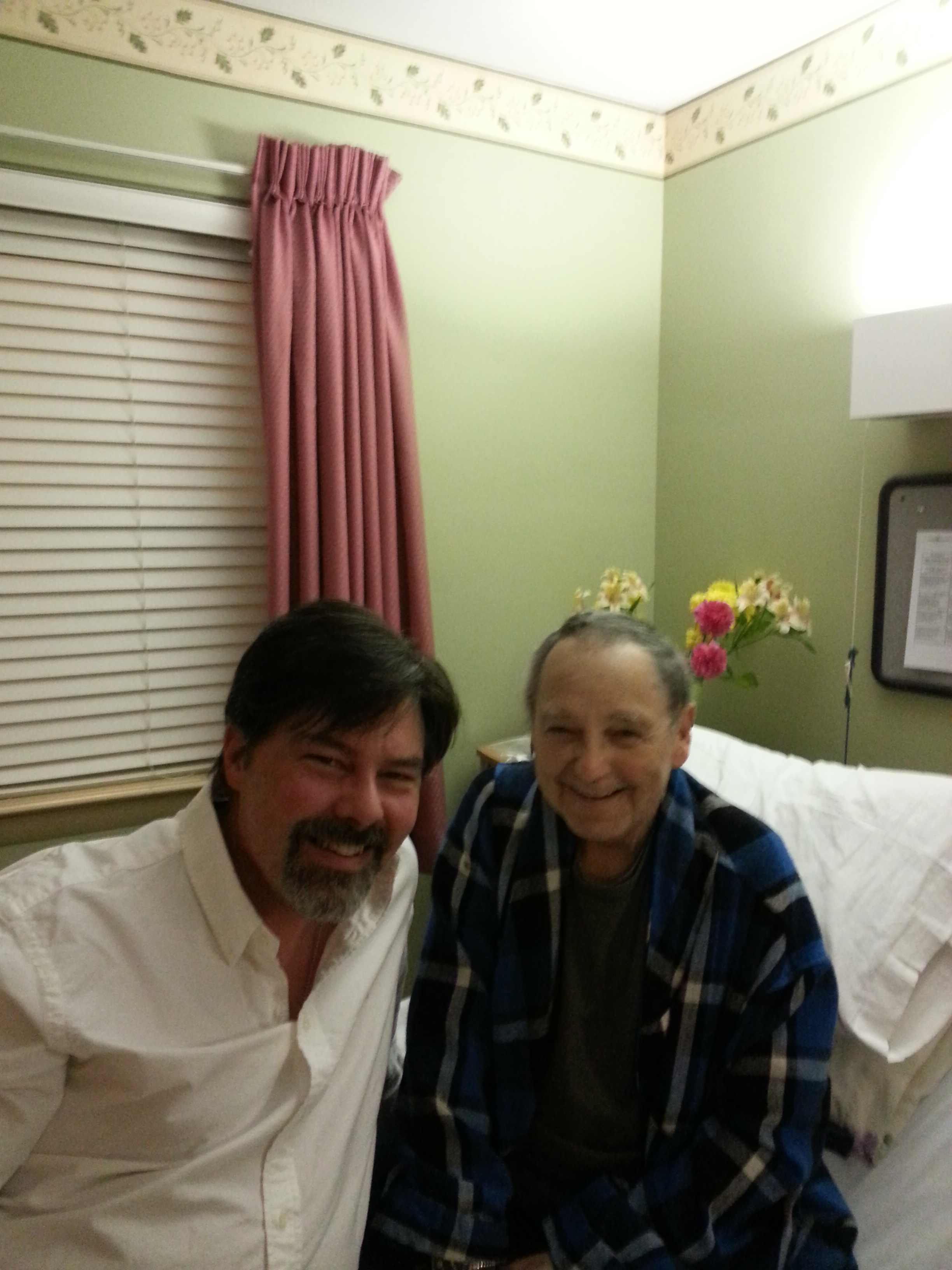
I am sitting at my laptop, as I do often every night.  As I do, I am always listening to music.  A “supergroup” called Mike & The Mechanics featuring Paul Karrack and Mike Rutherford of Genesis recorded an awesome song which addressed a son’s unresolved issues before the loss of his father.  I am fortunate that I was able to have closure  with so many things with my father before he passed.  But the song reminded me of what could have happened had my dad and I not taken the opportunity.

Here are the lyrics to “The Living Years” recorded by Mike & The Mechanics.  Dad, I miss you.

20140331_201548

“The Living Years”
Every generation
Blames the one before
And all of their frustrations
Come beating on your door

I know that I’m a prisoner
To all my Father held so dear
I know that I’m a hostage
To all his hopes and fears
I just wish I could have told him in the living years

Crumpled bits of paper
Filled with imperfect thought
Stilted conversations
I’m afraid that’s all we’ve got

You say you just don’t see it
He says it’s perfect sense
You just can’t get agreement
In this present tense
We all talk a different language
Talking in defense

Say it loud, say it clear
You can listen as well as you hear
It’s too late when we die
To admit we don’t see eye to eye

So we open up a quarrel
Between the present and the past
We only sacrifice the future
It’s the bitterness that lasts

So don’t yield to the fortunes
You sometimes see as fate
It may have a new perspective
On a different date
And if you don’t give up, and don’t give in
You may just be O.K.

Say it loud, say it clear
You can listen as well as you hear
It’s too late when we die
To admit we don’t see eye to eye

I wasn’t there that morning
When my Father passed away
I didn’t get to tell him
All the things I had to say

I think I caught his spirit
Later that same year
I’m sure I heard his echo
In my baby’s new born tears
I just wish I could have told him in the living years

Say it loud, say it clear
You can listen as well as you hear
It’s too late when we die
To admit we don’t see eye to eye

My First Survivor


Throughout my childhood, I had only heard the word cancer in passing.  In elementary school, there was an annual campaign for the American Cancer Society called “Send A Mouse To College” to raise money for cancer research.  Fundraising efforts have come a long way since the 1970’s, but awareness and cures still have such a long way to go.

October is National Breast Cancer Month.  Breast cancer is also the first personal experience I faced with cancer.

PART_1413411433365_Image1413411433361

My grandmother stood only 4’11”, but legend of the strength she possessed inside that small frame was dramatically understated as she faced one of the toughest challenges in her life.  Being diagnosed with cancer would place her in an unfamiliar role.  My grandmother had always taken care of everyone else, and with a cancer diagnosis, she would find herself in the unusual position of having others wanting to take care of her.

We all know someone who “if anyone doesn’t deserve a certain fate, it would be her/him” person.  My grandmother was one of those people.  Throughout my childhood, everyone of my friends knew of my grandmother as “their grandmother.”  If someone fell and got hurt, they ran to my grandmother for the care of the wound.  No one had better snacks.  But as I got older, I saw why she was so well looked up to and respected.  My grandmother was the most selfless person I would ever know in my life.  There was no greater example of the benefits of helping others before yourself.

It was late 1986, and I had been offered a management job in retail.  Accepting the job would mean two things.  The first, I would be leaving college with just 3 courses left to take.  The second, I would have to relocate as the location of the job was more than two hours away.  But managing a retail store (at the time) was a huge opportunity for me.  My grandmother knew this.  As much as she wanted me to finish college (I was hoping for a psychology degree), she knew this was an excellent opportunity.

I would need some start up money in the form of first month’s rent and security deposit, and my grandmother was more than willing to help me get my head start.  She believed in this move that I was making and she wanted the best for me.

I was not in my first apartment more than two days before I got a phone call from another family member.  They informed me that my grandmother had just had a mastectomy.  She had breast cancer.  I was floored.  I knew my grandmother always took care of others before herself, but this was over the top.  As soon as I hung up, I immediately told my superior that I needed the next day off, so that I could return back home to visit my grandmother.

As I pulled up to the hospital, all I could feel was upset and anger.  She was dealing with a potentially fatal diagnosis, needed to take care of herself, and without saying a word to me, made sure that I got a good start in the new direction my life was taking.  My life was fine as it was.  I was just a semester away from being the first in my dad’s side of the family from graduating from college.  I did not have to take the job up north.

I walked into the hospital room where my grandmother was resting.  As she saw me in the doorway, before I could get one word of my frustration with her out into the open, she quipped, “at least I will be able to fit into your shirts while I recover.”  Of course she was making reference to having the mastectomy and having less up top inch-wise.  With a tear in my eye, I could not help but laugh.  She was still my grandmother, even with cancer, she was still trying to take care of me, putting me at ease, this time with humor.

I told her I was upset that she had taken the time to set me up in my apartment with a cancer diagnosis hanging over her head.  To which she replied, “everything turned out fine with the surgery” and she would be fine.  It was more important to her that I took advantage of the opportunity.  That would be the last we talked about her breast cancer.

I went back to my apartment and new job.  I know that my grandmother underwent some form of chemotherapy, though I do not know what.  And it was not until later in life that I learned of it.  Later, because it was only when I was diagnosed with Hodgkin’s that once again, my grandmother and I would have a discussion about cancer.

My grandmother was my role model for so many things in my life.  But none with have any bigger implications, than my own fight against cancer.  She had survived her breast cancer about three years when I was diagnosed with Hodgkin’s Lymphoma.  Fighting cancer carried enough risks, but none so important as finding the right doctor.  It was not as simple as just opening the Yellow Pages and picking an auto garage or  restaurant.  I took the best example I knew, my grandmother, and felt that the man who saved her life, would be good enough to save my life as well.

It was by my grandmother’s example that I took on my cancer head on.  And just as she did to me, I made sure that I was not a burden to anyone else, not just a physical inconvenience, but an emotional one.  I did not want anyone to feel sorry for me, because I was going to beat my cancer.  I just knew it.  For someone to feel sorry for me, I would take that to mean they had given up on me, something I was not ready to concede.

Of course my grandmother continued to offer care for me during my treatments, because that is what she did.

My grandmother would live several more years.  She is the first cancer survivor I ever personally knew.  Years later, she would eventually be diagnosed with another cancer, this time, ovarian cancer.  In her typical fashion, she handled it on her own terms, controlling what anyone knew or heard.  The cancer would soon after take her life.  But it was on her terms, and that will be another post.

I miss you Grandma.

Post Navigation