
Paul's Heart

Life As A Dad, And A Survivor

Before It’s Too Late


If there is one lesson that I learned from my late father, it would go along with the expression, “don’t go to bed angry.”

On a December evening, just days before Christmas, my father and stepmother were having a discussion, okay, maybe more of an argument, I believe over auto insurance.  I do not know all of the details of the conversation, but it clearly was not something that was going to end in the next few minutes.  They were pressed for time, with some last minute Christmas shopping.  So with frustrations built up inside, both of them got ready to do that shopping.  My father crossed the very busy street alone, started up the car, and waited for my stepmother to leave the house.

She never made it to the car.  And my father witnessed it all happen.  And for the nearly two decades that followed, my father carried guilt with him of that night, the rest of his life.

Many church-goers have it easy.  Go to church, confess your sins, ask for forgiveness, and move on.  All is good.

Not so for my father.  Already carrying major amounts of guilt for other things in his life, he would never get the chance to make things right with his wife.  She would survive the accident, but there were so many things that my father would never give himself the opportunity to forgive himself for.

He felt that if he would have crossed the street with her as he normally did, he could have prevented the accident.

But worse, with no memory of the accident, and never being able to fully recover from the accident, he would never get the chance to say he was sorry to her, and to have her understand what he was saying to her and why.  My father carried this guilt to his grave almost two decades later.

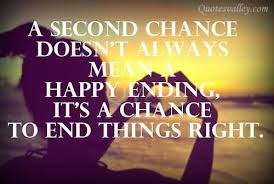
And so, it is during this time, that I too learned the hard way, never go to bed angry at someone.  You never know if you will ever get the chance to make things right.

2nd chance2

My dad often lamented on things he wished that he could have done differently with my sister and I in our childhood.  He wished that he could have had time back.  And I am sure that tormented him as much as my stepmother’s accident.  The only difference was that my father and I had an opportunity to make things right.

And I wrote it, in the post “My Dad Was Just Like Me” just the other day.

It was a comment that was made to me though after this story came out, that had a strange effect on me.  I generally do not reflect for too long on the things I write, as I am always trying to go on to another post.  But a gentleman said to me, “thank you for your story.”  I responded, “your welcome.  I am glad you enjoyed it.”

The man said, “no, you do not understand.  I have been battling prostate cancer for six years, and it has gotten worse every year, and today I got news that it could not get any worse.”  Again, I offered, “I’m so sorry to hear that.”

He continued, “That’s okay, I expected that this time would come.  But I have to tell my children (adults) of the latest news and I don’t have the best relationship with my son.  Your story put that into perspective for me.  And I want to thank you.”

I gave the man a hug.  It is all I could do.  And I hope that he gets that chance to mend the hurt between he and his son.  I sat for the next ten minutes thinking about this conversation, and where I would be, had things not turned out like they did for my father and I.  And I don’t have to find out either.

2nd chance1

Children Of Divorce


This post is not about my own personal situation, nor will it discuss any details about my personal situation.  Examples listed in this post are just that, examples, which hope to bring awareness and understanding to a difficult situation that many families deal with.

DSC03196

No one is more aware of the emotional impact on children, from the divorce process itself, than someone who once was a child of a divorced family.  Of course, there are the cynics who will refer to divorce statistics to reinforce and coerce potential suitors of the potential marital future of any suitor.  And then of course, there are those who offer unsolicited judgment in the form of criticism as the only form of support.  A former psych major in college, I can tell you that books, opinions, and statistics pale in comparison and meaning when actually dealing with a child caught in the middle of a divorce.

People need to understand, that using statistics as a way to sway or pressure someone to somehow prove everyone wrong by staying in a bad relationship, or by insinuating that the children have been through enough trauma in their life (for whatever reason), that it should be better for them to continue life in a home of constant stress and turmoil, than go through the divorce process.  Quite the contrary.  To continue to subject children to the typical hostile environment of a bad relationship, married or not, is child abuse.  FLAT OUT CHILD ABUSE if you continue to leave your children in that environment.

It is much better to have the differences between parents separated, to be dealt with between the parents, than to put the children at risk of being emotional collateral damage.  As Dr. Phil states, “it is better for a child to be from a broken home than to live in one.”  Children have amazing hearing when they want to.  They also want to be able to have unrestricted and unsuspect conversations with both parents.  Children are not pawns.

Statistically, yes, I am now second generation divorced.  I proved the statistics correct.  But more powerful than the statistic is that I know what it is like to be a child of a divorced family, and experience means multitudes more than any information provided by books.  I know what my daughters are feeling right now.  I also know and understand what my parents had to deal with.  This should be a good thing and help in protecting the children and keeping the emotional scarring to a minimum.

But there are so many in the world, who have not had any experience with a divorce, other than receiving or observing input provided by bias family members and friends who may or may not have gone through a divorce.  For many, opinions and recommended by nothing more than “bandwagon jumpers”, totally unaware of the complete history of the relationship, and rely solely on, “stick it to him/her.”

Again, I am not referencing my own situation.  I will not discuss those details.  This post is about providing awareness.  Awareness that I am indeed trying to practice what I preach, but to also let others know, who are in the process of a divorce, the children’s well-being need to be considered first and foremost.  Would the children actually be better off if the parents did not get divorced?  How to protect the children from comments not only from within the four walls of their home, but also from mean-spirited playmates?

The potential dangers are of serious concern.  And regardless of my experience as a child of divorce, that does not necessarily mean that I can prevent these things from happening to my children.  But rather, by being aware of them, I know the potential things to keep an eye out for signs.  I refuse to be a parent who claims “I didn’t know”.  So I would like to share with those of you, dealing with divorce and custody things that I have learned or experienced when children are involved.

For most children, having both parents in the home (not being insensitive to those who were brought into family with only one parent), having both mom and dad is all that they have ever known.  Even when the time has come that both parents do separate activities and rarely spend time together as a family, holding hands, kissing, simply cohabitating in the house, the children still see both parents at the same time.  Regardless of the problems, “mom and dad” are still together.  And it is important to make sure that no child ever feels as if they are to blame for the divorce.  And this feeling will develop if not careful to watch conversations around the child.

But when the two parents decide to separate and divorce, it does not take long for a child to figure out that one parent will no longer then be living in the house.  The relationship between mom and dad does not change ironically, because they have been acting in this manner for a long time.  But now the children recognize it.  Unless the children are shown that they will not have to prove loyalty to one parent or another, it will not take long until the children are drawn into the process itself.

My main intent when I left home was to make sure that my daughters understood two things.  Their mom was always going to be their mom, and I was always going to be their dad.  And we made it as positive an experience as I could, that our children would learn that they had two places to call home.

But children, while very intuitive and adaptable, are also capable of making their own opinions, and when you mix children who are about to enter puberty, or are already teenagers, divorce and custody can get very complicated.

As children get older, they already gain independence.  And children who struggle with divorce, have a tendency to grow even more independent.  And that could be understood.  Parents will be taking attention away from their children to deal with the divorce, and children soon learn to rely more on themselves for even the simplest of things.  But there is a reason why we do not let 8 year olds drive cars or legally permit 15 year olds consume alcohol, because they are not capable of making grown up decision.  Yet that is exactly what happens to a child who escalates this independence if not followed closely enough.

Suddenly, those that the children spend the majority of their time with, and not the custodial parent, are the ones who will make lasting impressions as well as enable the hurting child to erroneously make horrific and sometimes tragic decisions.  And it is amazing nonetheless to hear a parent proclaim that they had no idea, when a child’s school grades suffer, bad habits like smoking and underage and unprotected sex occur, and possibly worse, such as issues with legal incidents.

Things to be concerned about and watch for?  Depression, anxiety, smoking and drug use, and sexual activity.  To assume “not my child,” all but seals the deal that they will face those behaviors and activities.

I once kidded with my former spouse, when we first adopted our oldest, that she would constantly come to me first, when picked up from daycare.  After all, my ex was the soft and cushy parent, where as I was known as the strict one.  I explained that it was the security and dependability that she always got when she came to me.  Whereas with a softer parent, decisions are made on emotions, which are neither reliable or dependable.  So it should come as no surprise if either of my daughters should some how now describe me as being unreliable or dependable, because I am no longer with them 100% of the time.  Which is why, I spend each and every day talking to them through Facetime so that daily, they are reminded that  am still a major part of their lives.

It is important that a child knows, that love will never be lost between the parent and the child.  And that is difficult, because their only examples of true love are now in the process of divorce and separation.  And if it can happen to their parents, who is to say it will not happen between parent and child?  Emotional reactions will be determined most likely by their age.  Younger children may have a tendency to regress in behavior while older children may lash out in anger or other harmful behaviors.

Parents have to understand, in dealing with children and divorce, although “grieving” is most often affiliated with death, grieving is actually associated with any kind of loss, and that includes the loss of the family as a unit.  Children are not adults, but they will grieve just as adults.  The important thing to remember is to pay attention to the children even more so than when you did as a family unit.  There is nothing worse than hearing a parent say “I wish I had known” or “I never saw it coming.”

As a child of divorce, I have just told you.

My Dad Was Just Like Me


Every year, I make a contribution to a book called “Visible Ink.”  This is a book published via Memorial Sloan Kettering Cancer Center, written entirely by cancer patients and survivors.  This year, marked the seventh edition.  I submitted two pieces, and the following piece is the chapter that was selected for this year’s book.  The story is very personal to me, a tribute to my father who lost his battle of lung cancer last May.

Birth photo 1965 dad and I 1

“Like Father, like son.” A timeless expression echoed by the lyrics to the song, “Cats In The Cradle,” popularly recognized from Harry Chapin. The song tells the story of the birth of a son, the absence of the father in his life because he is trying to provide for his son. When the son is grown and on his own, the father tries to capture moments of fatherhood, only to find out his son is busy juggling his own life between work and family. One of the final lyrics in the song, the father says, “As I hung up the phone it occurred to me, he’d grown up just like me. My boy was just like me.”

last photo of my dad and I before his cancer

For years I had often wondered, what would have reminded my father about me. But it was during my father’s battle with lung cancer, I discovered a new expression, “like son, like Father.” Most people grow up with two main role models in their life, their parents. But how often does a child get thrust into the role of role model for a parent?

my dad

My father had reached out to me, a long term cancer survivor, because he had just received news that doctors think he might have lung cancer. Though the news should not have come as a shock for a sixty-year-smoker, a spot on his lung was confirmed by a PET scan. My father was now the fifth family member besides me, to be diagnosed with cancer. And up to this point, I was the only one who had survived.

most recent portrait

The times had changed dramatically even in just over two decades since I had been treated for Hodgkin’s Lymphoma. There were better options available. Better technologies were to diagnose patients. Even the chemotherapy suites were more inviting, like a local coffee shop complete with meals and entertainment.

treatments

As time went on, my father underwent successful surgery to remove the tumor. Under doctor’s recommendations, my father underwent both chemotherapy and radiation therapies for preventative measures. It was during the radiation treatments, something went horribly wrong. Though there was no evidence of his lung cancer present during even the chemotherapy, some cells that had survived the chemo had transformed into an even more aggressive, and rapidly growing cancer.

We were all gathered by his side when the doctors came to discuss the situation with my father. His cancer was now terminal. My father always knew that lung cancer had been a possibility, and that he had cancer, and might die from it. But up until that moment, he believed he would beat it. Refusing to give up hope, although acknowledging the doctor’s prognosis, my dad’s response to the doctor’s final question, broke me down into tears due to the words, I was not prepared to hear.

The doctor and his care team had just explained to my father all the things that they would do to care for him, as the cancer progressed, to keep him comfortable. But my dad’s denial and defiance shined bright when the doctor asked, “What is one thing we can do for you right now?” My father responded, “I want to be a survivor like my son.” He pointed over to me as everyone in the room turned their heads in my direction.

the last photo with my dad

This hit me two ways. I beat my cancer, Hodgkin’s Lymphoma. I had his genes, his personality, his pride, his determination, and perseverance. If anyone had a better chance of defying a cancer death sentence, it was my father. I survived cancer. My dad witnessed it could be done.

just before

But in that same moment, I saw his comment for what I truly think he meant. We never expressed feelings in my family, and up to that point, my father and I could have just been two ships passing in the night. But I took his words that I will always remember, he was telling me that he was proud of me. I had never heard that from my father before that moment.

He would live another three months. And as I sat by his bedside each and every day, we share memories that we remembered, and memories that we did not share in the past. We forgave each other for things we had done and said. And during the night before he passed, as he lapsed into a calm and peaceful state, for the first time in our lives, he heard my voice, not in spoken form, but in music. As I said goodbye to my father, who was a true survivor and just could not recognize it, I sang to him, the words that I could not speak, “Cats In The Cradle.”

his empty chair the day he passed

In the end “Dad”, your boy is just like you. I am glad we had the chance to know that.

Dad, I miss you so much.

Post Navigation