Before I begin this post, I need to stress, and I mean STRESS (for the sake of the trolls that follow my blog), this post does not reflect my personal situation concerning my divorce. The comments mentioned below are documented facts and are for the sole purpose of drawing attention to the devastating effects of parental alienation and those that are responsible for the decisions and actions. Any similarity between my situation is purely accidental and coincidental.
This shit has got to stop! Families are being torn apart, not just by filing or finalization of a divorce, not just by rulings made by a court or enforcement of those rulings, but also by outsiders who should have no voice in the dissolution of the family unit involved. The process of a divorce is traumatic enough, whether the filing was expected or by surprise, whether mutual or provoked. But when children are involved, by no choice of their own, as they belong to both parents, there needs to be a different process to dissolve a marriage, because it is not just a marriage that is being broken up, but a family.
Keeping it simple, according to Webster’s dictionary, the act of divorce is to dissolve the marriage contract. And yet, as the average person will be more than aware, the process of divorce is not just undoing all of the marriage vows – for better or worse, sickness and health, richer and poorer. But because many couples cannot resolve their differences as just a couple (the irony being that if they could work things out with each other, they would probably not be getting divorced), lawyers get involved bringing a “take no prisoner” approach often drawing out the process, bankrupting their clients, and in extreme cases, resulting in the following situations that I am going to discuss. The bottom line, it seems completely inappropriate to call the system handling the breakups of families, a “family court”, because those that will suffer the biggest impact of the divorce, those without a voice, are the most important part of the family, the children.
The process is pretty much universal. One spouse files for divorce. As in many states, it is usual considered “no fault” meaning it does not matter why the divorce was filed which is meant to keep the process from getting really ugly. But the reality of “no fault”, is that the issue behind the divorce often never gets dealt with. Which means, when it comes to agreements, both sides can feel jaded, screwed, if things do not turn out the way they want, or feel entitled. But there are several steps to each chapter of a divorce, from finances to assets, and custody and support. Rulings are often made on assumptions, not actual facts to make sure that there is no abuse by either spouse to try and get away with anything, which is exactly what results. And then it is left up to appeals to straighten everything out. But when sanctions end up being enacted and enforced, the results are… well… tragic.
And before I list those examples, let me be clear, yes, the examples will be all male, but they could easily be female. And I also want to state, these were not “deadbeats” by the definition, as they were not intentionally avoiding their child support payments. And there is a difference. Again, “deadbeat” can be applied to both genders. The following stories are all tragic from the “why it happened”, to “what could have been done differently”, to “who failed who”. But the one common point that is going to be made, in the end, in the attempt to alienate one parent, a child lost at least one parent in the living sense, but lost both in the emotional sense. And it does not matter whey the hell your marriage fell apart, it is not, and never should be made your child’s responsibility or burden. But the child has the right to love both parents without any interference. Up until the filing of the divorce, a child loves both of their parents (I mean no disrespect to single parents – but clearly this article is about divorce). And the only way, THE ONLY WAY a child stops loving another parent, is when the child is taught to, also known as parental alienation.
Bradley Stone

I will not make Stone a martyr for dads who are struggling with the family court system. What he did was wrong and devastatingly tragic. Several people ended up dead by his hands, including a teenager. In the process, a child was orphaned, and a baby lost his father, all because of a bitter custody battle. No one seemed to think the father was capable of such an act. He was a decorated Iraq war vet, but definitely had some issues with PTSD according The Reporter (Lansdale newspaper). Most witnesses all confirmed custody issues as the main point of contention between the parents, the mother claiming to never wanting the father to have his daughter, and others making statements that Stone was a great father. The crazy thing is, both had moved on in their relationships with others, including Stone having remarried with a new baby. This entire act made no sense other than after a failed attempt to alter the custody agreement on his part, something went horribly wrong. A manhunt ensued for him, after several of his ex-wife’s family had been slain, only for him to have taken his own life.
Walter Scott

Scott’s case made national attention earlier this year. He was unarmed, and murdered by an police officer, all resulting from a non-moving traffic violation. While he was remembered as a member of our military, he also had a bit of criminal history, not all of it relating to his parental history. But nothing, NOTHING he had done should have resulted in his murder. But having been incarcerated before for child support, once the officer had returned to his patrol vehicle to process the charge for the “broken third light” violation, Scott ran. He was hit by the officer’s taser, but then got up and continued to flee, this time being fatally wounded by the officer firing at the unarmed Scott.
As I stated, these were not “deadbeat” dads. Both were involved in a system that is supposed to have the best interests of the children of the parents involved. But from the beginning, not just Stone and Scott, but so many others, often find themselves behind issues that end up insurmountable. It was easy to find stories about “dads” in this situation, and I could have probably found some where the mothers were the ones being treated as “deadbeats” also, ending in tragic consequences.
But as an advocate for so many different causes, it is often one story that provokes me, unable to hold my tongue anymore about a particular issue.

A post appeared on my Facebook feed that just tore my heart out. Completely tragic just as the two other instances mentioned above, but as my obscenity stated above, it left me with a feeling, when will it be enough for the courts to recognize that when both parents want to be involved in their child’s life, EVERYTHING must be done to make sure of it.
I will not quote the entire post. But it is summarized this way. It has been officially two years, that the father took his own life, having been completely consumed emotionally as an alienated father. The post goes on to point out those that contributed to the construction of the alienation, accept no blame, in spite of their orchestrated harassment, instead saying he had mental issues (let’s examine this… keeping a father away from his children… making his children hate him when all through their lives all they had ever done was love them… no… that is not mental issues. That is sabotage and alienation of a parent).
The author of the post was recalling this tragedy for a particular post he wanted to write, when he was contacted by another father, who had actually telephoned the author to inform him that his 15 year-old son had committed suicide. Clearly this was a result of parental alienation. And here is why. The father himself had struggled with the mother for nearly six years with custody, and attempted suicide himself. Fortunately, he did not succeed. But the ramifications were tragic. His son blamed himself for his father’s feelings of hopelessness, and took his own life. Because of the father’s attempt on his own life, he had just one fifteen minute conversation with his son until his son had taken his own life. This should have been a wake up call for everyone, but it was not.
To add insult to injury, no one on the father’s side, had even been notified of the child’s passing until the day of the funeral.
I am going to turn my final comment on this to gender neutral because it is not okay for either parent to ever allow a child to take the blame for something the two parents caused themselves, and were not able to fix. A parent seeking revenge and being spiteful, teaching the child to hate the other parent, just because the custodial parent hates the former spouse is wrong. There is nothing that happened in the marriage that is ever the child’s fault. The recipient of a divorce paper hurts, of course they do. But a child loves both their parents. A child only learns hate when it is taught by either the parent, family of the hurt parent, or friends of the custodial parent who along with the family have no clue, nor any interest in what is best for the child, only loyalty to the custodial parent.
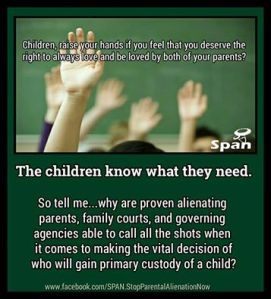
A child has the right to love both of their parents unconditionally. No court, no lawyers, no in-laws, no friends, and definitely no parent has the right to interfere with that.