Paul's Heart

Life As A Dad, And A Survivor

Archive for the category “Politics”

This Of Course Is A Course In Discourse


***while this post references politics, it does not lean in either direction

It is not something unusual for me to spend time with my daughters and during that time, I make moments learning opportunities.  There is nothing better than real time examples to remember by.  But this moment, more rare than two full moons in one month, the 2nd on Halloween (and if I have to throw in the fact that it is 2020), being able to experience and explain an election with my daughters in the great details that I was taught growing up.  Like many across the country and the world, we were no different, following results and commentary.

At no time did they hear me “ooo” or “tsk” as results came in.  In fact, at no time, did either even ask me who I voted for, one of the first things I told my daughters, their vote is sacred to them, and it is no one’s business who they voted for.
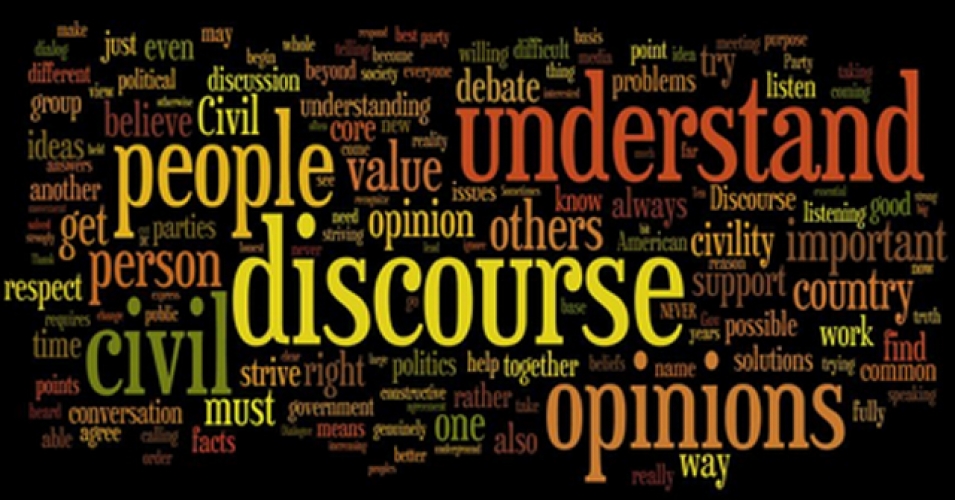
But as time went on, they did not hear me complain, see me celebrate any calls made.  They did hear a lot of “what’s” and “why’s”.  You see, some day, they will get to vote.  And as one friend of mine snapped back at me when I stressed the importance of understanding the election process, “don’t tell me I am not informed about who I vote for,” she clearly missed the point.  I will get to that in just a second.
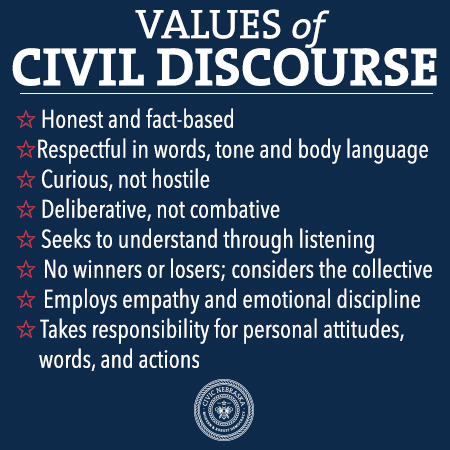
I am a registered non-party, because I cannot stand behind either one.  I know and understand the platforms of both.  But it is the ideas of my friends who support both parties that have me curious.  But in order to understand them, you have to have conversations.

There are two friends (since High School) that I talk with occasionally to get their perspectives of how others think politically.  Not in the literal sense, civil discourse is an oxymoron, two terms having seemingly opposite meanings.  Discourse is of course a debate, or argument.  And we know many arguments are far from being civil, especially when it comes to debating politics.

But I lean on these two friends, and honestly, the list is growing larger of people willing to talk, and learn how others think and what they believe.  We still disagree at the end for the most part, but we each have a respect for each other because of our tones and not only the willingness to talk, but to listen.

One constant debate we have, is the concept of the “united states” versus the responsibilities of each individual states.  They believe that the federal government should be responsible for some things, and not others, and I believe, that 50 different ideas to handle one problem, makes more problems.  But we have many of these types of discussions.  And conversations are always respectful, and we end as friends.  Civil discourse.

So when I commented on a friend’s FB page, answering to an impatient voter, spouting of one of the many conspiracy theories of the current election, “you need to be more informed of the process of the election,” she took it as “don’t you tell me that I need to be more informed about my candidate.  I do my homework.”

You can see, the first issue of dealing with civil discourse, is making sure you are on the same page.  I never once told her that she needed to do her homework on her candidate.  Although, if you are a party voter, chances are you go straight down the ballot of your party, and truly have no idea anything of the candidate, other than the initial after the name, issues of the individual candidates making no difference.

No, I was referring to the actual process itself, after the vote is cast.  And this is the problem, and the perfect opportunity to explain to my daughters, how elections work.  And because I am an independent, I can do so without leaning in either direction.

I need to offer a disclaimer, I am not an expert in elections, nor did I major in political science in college.  But I do have a simple understanding of the election process, much of which came from my own local campaigns years ago.

One simple question, what happens after you vote?  Simple answer, you count.  Now, over the years, so much has been done to suppress voting rights by humans, and in 2020, a pandemic threw a huge wrench into the works resulting in record turnout of voting by mail.  More on that in a bit.

After the count, the votes get certified by each state.  Then the electoral college meets and casts the “ceremonial” vote.  Congress confirms the vote.  And of course, then there is the inauguration, and we have a new president.  Over our years, elections have not always run smoothly, but there are processes in place to protect our most cherished quality of our democracy, the right to vote.

Until now, our most controversial national election was 2000, between Al Gore and George W. Bush.  Initially, election night had Gore leading Bush by over half a million votes in the state of Florida, the state that would ultimately decide the presidential election.  The media networks had claimed Gore was the projected winner.  But we soon were informed that the lead had shrunk to just a couple of thousand, forcing a retraction of the projection, and the controversy of the “hanging chad.”  In 2000, ballots in Florida were punch cards, and apparently, some of the cards did not punch completely, leaving the “scrap” called a “chad”, hanging, leaving the validity of the ballot in question.  There is more to the story, but you get it.  It was a clusterfudge.

The 2020 election has so much more controversial fuel, potentially causing great harm to our sacred voting process like never seen before.  Social media, main stream media, campaigns, and even the candidates themselves are causing confusion that the average voter forgets, there is a process that has to take place.

We knew there would be no result on Tuesday, November 3rd.  And it had nothing to do with the overwhelming votes by mail, but the record setting turnout.  Though honestly, for being a free country of 330,000,000 Americans, having a turnout to vote of 150,000,000 is pitiful.  The media was much more careful not to repeat what happened in the 2000 election.  Social media was much more reckless.

But unlike when I first voted, the state I grew up in, only had to deal with in-person voting the day of, and absentee voting.  But the 2020 election had now three major components in most states, including my former home state, mail-in balloting, early voting, and day of voting.  Then of course you factor in the animosity that each side has against each other, and you have a record turnout, in spite of blatant acts of voter suppression in various states.  But that is another post.

Here is when the person I spoke about earlier needs a lesson in the election process, not just picking her candidate.

Fact, our election day is officially the first Tuesday of the November.  Why on a work day, I will never know, because clearly holding an election on a weekend when most have the day off would allow more people to vote without having to take off from work.  But I digress.

Mail-in ballots come in as early as weeks in advance, and some states allow them to be received after that 1st Tuesday, as long as post-marked by then, up to a certain time window.  And given the knee-capping that the postmaster general gave the postal service, causing a major slowdown and loss of mail, everyone knew this would cause problems.  That was the intent.  Non-the-less, this is the process.

As is typical, at least as long as I can remember, TV networks at the end of Election Day would “proclaim” the winner of the election.  It is ironic that it occurred much more smoothly than with all the technological bells and whistles that we have today.  But traditionally, this is how it has been.  But officially, it is not the networks that declare the winner.  That actually does not happen for many weeks after because there are other steps in the election process to take place first.  But we are an instant gratification society.  We need an answer right away.  And really, the TV networks are not far off (usually) from the exact results, figured out by mathematicians and statisticians, winners are declared, not certified.

In the meantime, and it varies from state to state per their election rules, recounts can occur, and lawsuits may be filed to nullify results.  These are all part of the process.

It is not until the results are certified, by county election officials I believe, that they election is official.  And even then, there are still more steps until we have our next president.  Once certified, then it is off to the electoral college.  I am not going to get into the weeds of what the electoral college is, but basically, it consists of 538 representatives, one for every member of the senate and house of representatives in Congress.  Each state’s political party in power picks their EC members who are then expected to cast their votes, based on the will of the state for that candidate for president, a formality if you will.

Here is where it gets fuzzy.  Just because a candidate wins a state, electors can go rogue and vote against the popular winner of the state.  I have heard stories that it can happen, but usually does not.  The intimidation and basically thuggery that occurs with that type of attempt is overwhelming.  So, we will keep it simple, the EC goes as it is supposed to and we have a new president according to the EC.  The results have to go before Congress, and THEN, we officially have a new president-elect.  The president is called that because until the president is sworn in on inauguration day, that individual is not called the president (nor does that person possess any of the powers of that position).

There is squabbling, again, something I have never really seen in my voting lifetime, this refusal to accept the results of election day, even if proclaimed by TV networks to call the victor “president-elect.”  And it is even more absurd, that after all of these decades, now those opposed to the apparent winner, want to wait for the official steps to be taken, even if mathematically confirmed, before acknowledging Joe Biden as the president-elect, as if holding on for a few more weeks will change anything.

So, when this individual that I mentioned back at the beginning of this post took offense at my suggestion that she needed to educate herself on the voting process, she clearly missed my point.  As brief as her objection to my comment was, so was her knowledge of the election process.

But do you know who knows more now about the election process than that person?
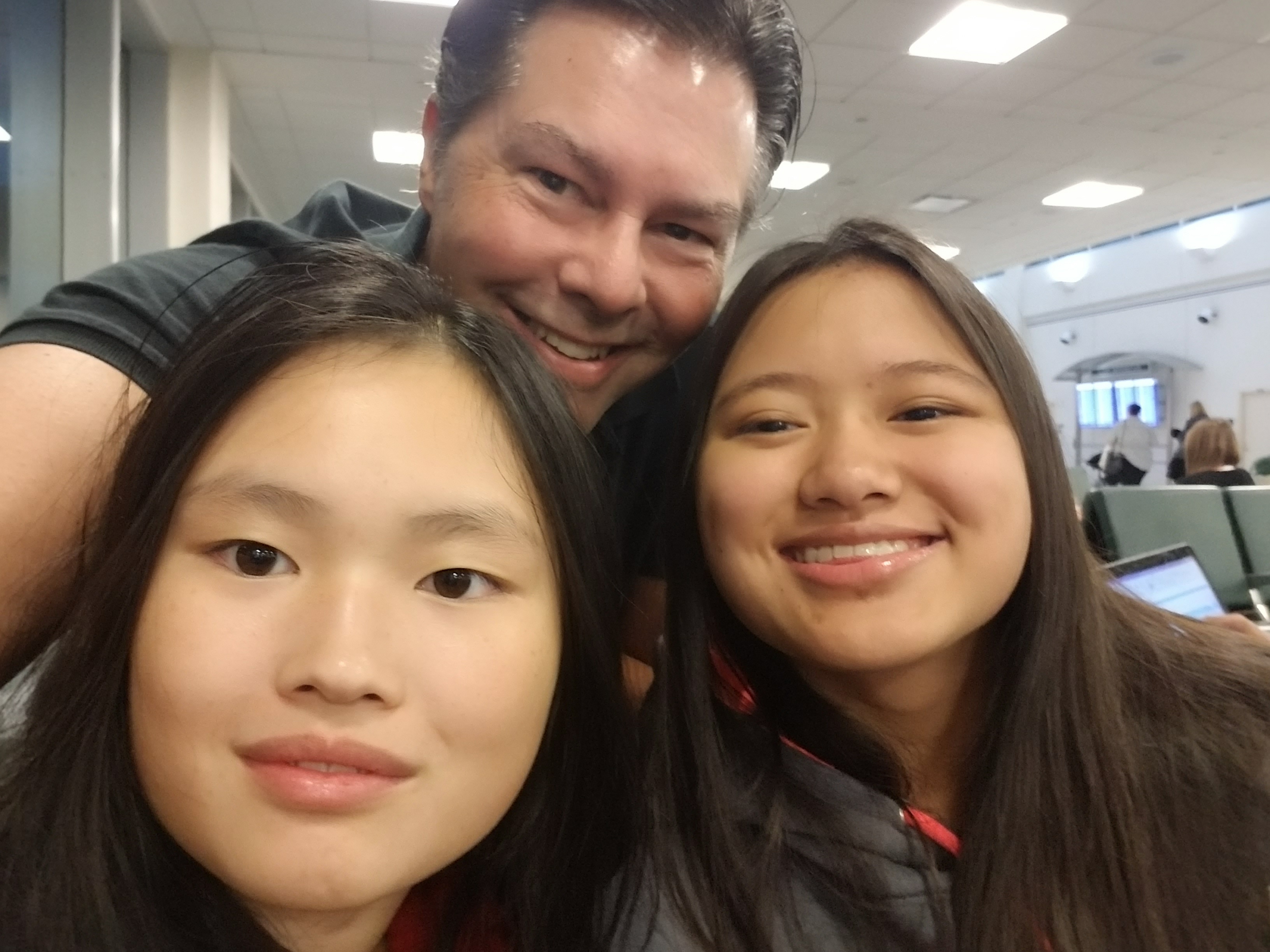
My daughters.  They are not old enough to vote.  But they have witnessed the good and the bad of this election cycle.  And like many other teenagers, they will make an impact in 2024.  And at least my daughters will understand there is more to our elections than just casting a vote, which they also definitely understand.
Voter Fraud This Is Not – Part 2


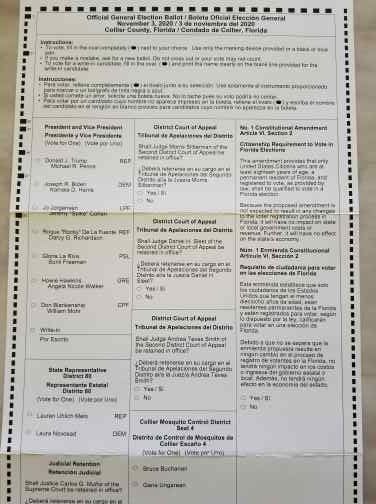
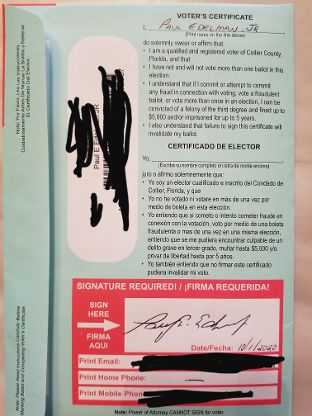
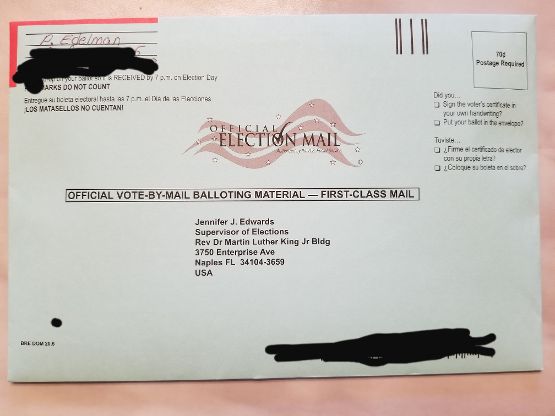
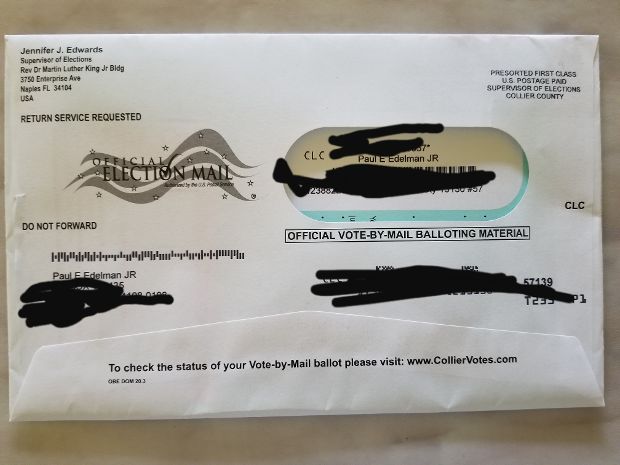
Here it is.  My official “mail-in” ballot.  IT IS THE ONLY ONE THAT I HAVE RECIEVED!  If you recall, in the first part of my “not voter fraud” post, I shared with you several items that I did receive that some people perceive as “ballot” material, which those items were not.  Though I have redacted bar codes and certain information, you can still tell that this belongs to me.

Now I know, there is the chance that someone might say, they have received multiple ballots, or even dead people have received them.  No, they do not.  If you received another ballot, it is because there was a mistake that has been corrected, and those very bar codes like you see on my packet, will no longer work on the incorrect ballot.  And the only way that a dead person will receive this is after they have died before the system has been able to catch up before ballots get mailed out.  Now, that that is out of the way.

So, the most important thing inside the packet, is the ballot itself.  My ballot happens to be 3 pages, but I have only pictured the first.  And of course, I had not filled it out just yet.  But this is the exact same ballot that I would receive, voting in person.

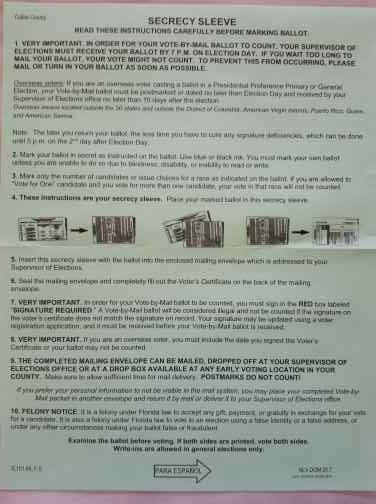
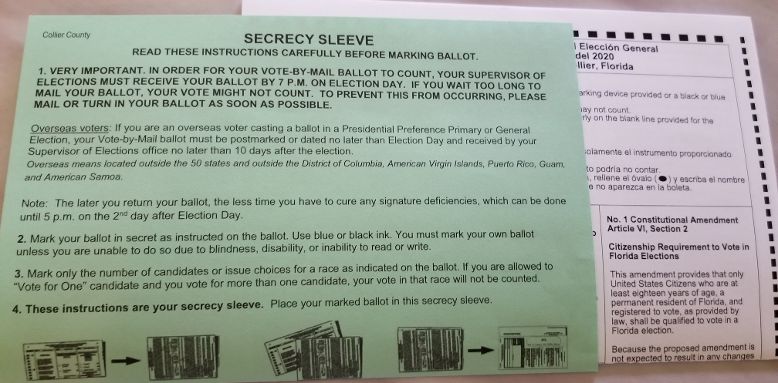
The next part, is really interesting.  The Secrecy Sleeve.

It is just a piece of paper, with instructions on how to secure your ballot, privately.  And to do this…

you fold the “secrecy sleeve” in half, and place the ballot inside.  And ta-da, you ballot is cast in secret.

Next, you place the ballot in the envelope that is supplied.  On the back side, is your affidavit that the ballot is yours and that you have filled it out.  It has the bar code to register that you cast your ballot, and… AND… it has a place for you to provide your signature.  That’s right, you have to sign your mail-in ballot.

Here is where the “criers” chirp the loudest.  “Nobody will check the signatures!”  Of course they will get checked.  The bar code will bring up the signature to compare the signatures, and just as if you were in person, if the signatures were not close enough, the ballot would be rejected.  Having voted in person, I have had my signature rejected in person, even providing my driver’s license.

And with that, I filled out my ballot, folded it in half, and placed inside the “secrecy sleeve”, and sealed the envelope.

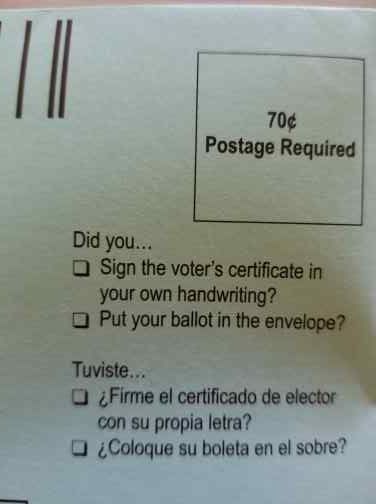
Only one thing left to do, put postage on it, and mail it.  The one thing people may not be aware of, is the extra postage needed because of the larger envelope.  POSTAGE TO MAIL YOUR BALLOT IS $.70!  Again, there is a bar code on the envelope.  Why?  It allows you to confirm that your ballot was received, and cannot be submitted again.

NO VOTER FRAUD WITH THIS BALLOT!

These are difficult days for us as a country because of Covid19.  But even without Covid19, there are difficulties with voting and voter suppression.  Polling places being shut down, limiting access.  Drop boxes being eliminated.  And even difficulties with registering to vote in the first place.

Our right to vote is one of the most important rights we have as an American.  I have several options that make it fairly easy to vote, whether in person, early voting, or by mail.  And it is my right to choose how I vote.  I do not buy into conspiracy theories while at the same time, I do acknowledge that there can be problems, just not widespread enough to affect an outcome.

It does just so happen, I am one of the “vulnerable” to Covid19.  And though there are some who feel the need to “shame” people whether with words or memes, that if you can “stand in line at Home Depot” or Walmart, you can stand in line to vote, as the president himself now faces the reality, that even in an outdoor setting, someone can still contract the virus.  So, no.  Standing in line for a prescription or perhaps some groceries is a necessity for me.  Standing in line to vote, when other options are available, are not.

My ballot has been mailed, and I plan to verify that it was received.

This is not voter fraud.  And that is the end of that.

Voter Fraud This Is Not… And Here Is Why


I do not normally do these kinds of posts, but as I often use writing to express frustrations, this is one of those moments.  But it is also a teachable moment as well.

First, I want to be clear.  I HATE POLITICS!  Second, I am an independent voter, have been my whole voting age.  I have voted for both Republican and Democratic presidents and lower level politics.  I am an independent for two reasons.  The first, I do not agree completely with the policies and beliefs of either party.  And second, I will not be told I need to believe a certain way to belong to that party.  Now with the serious stuff out of the way.  I would like to share something with you, quite interesting.  Because what I am going to show and tell you, is not voter fraud, though it is confused as such.  But it is a major pain in the ass.

As I stated above, I HATE POLITICS.  But in 2009, because of a teacher labor issue, and the way the bullies of the current school board had chosen to negotiate in public in a variety of negative campaign methods, I had enough and decided to run for school board.  I was fed up with this bullying behavior and felt I could make a difference.  The experience of a campaign was not only fun, but eye-opening.  The goal of my post is not to talk about my school board campaigns, but rather to pull back the curtain so that you can see why I have titled this post the way that I have.

Lesson #1 – seeing is not believing

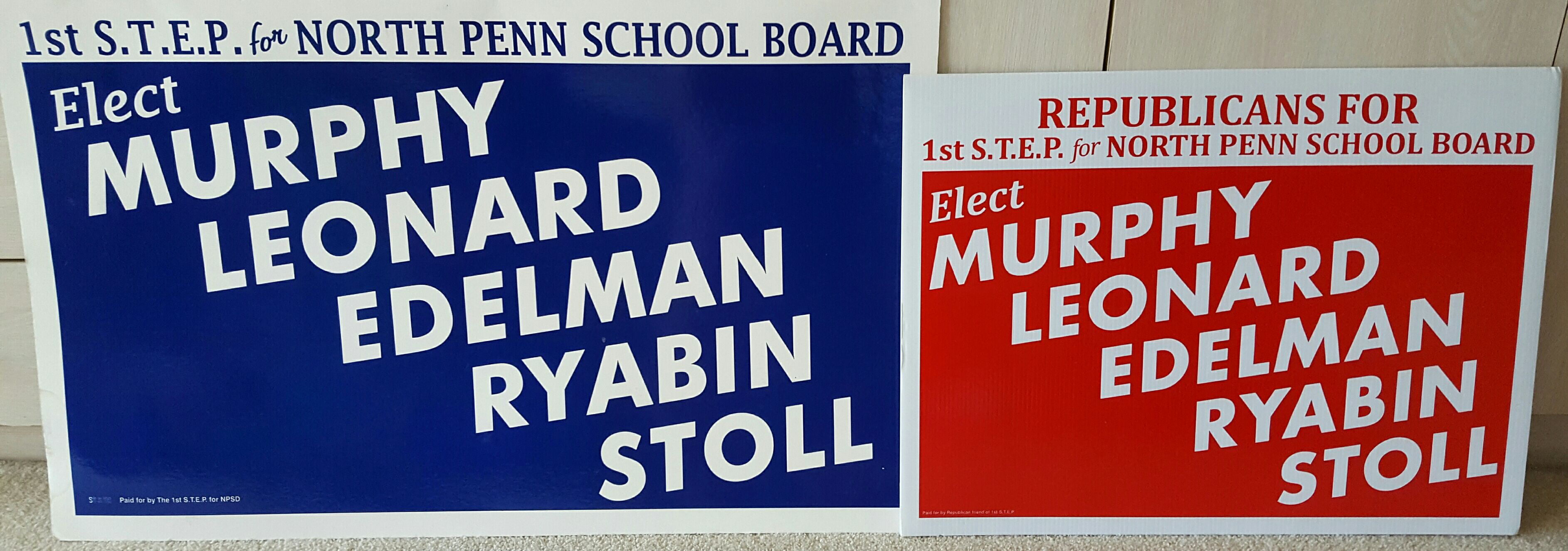
Campaign signs.  We see them all the time.  And for the most part, we associate blue with Democrats, and red with Republicans.  So, why are there two different signs?  While campaigning as a Democrat (one of the two and temporary times I was not an independent, and there was a reason I chose Democrat as opposed to Republican, strategy only), it was thought that if we could show that we were supported by Republicans, that would gather more votes, which is why the sign says “Republicans for”.  But we thought, why not fully commit to making the sign red.  Republican voters will think that we are the Republican candidates, because their signs are normally red.  Devious, I know.  But it gets better.

Lesson #2 – the same but different

Something that most voters are not aware of, in local politics, there are options for candidates to “cross file” for an election, in other words, run as a candidate for both parties, not just the party you represent.  In elections with a primary election, this is often a good strategy to eliminate an opponent and not having to face in a general election.  Two such positions are school board member and local judges.  There is only one catch.  Just as you have to for the higher elections, you must collect signatures on a petition to support your candidacy.  But if you represent one party, and especially in today’s political climate, how do you muster up enough signatures from the opposite party?  It is not as hard as you think.  So when you show up at the election polls for the primary, voting in your primary, all you see is your party’s candidates which also include the “sheep in wolves clothing” from the opposing party.  Devious.  But there is more.

Lesson #3 – tools of the trade

Political mailers.  So many trees have to die so that politicians can get their information out to you.  Some may be informative.  Some, like this one that was sent out against my campaign running mates, can be quite offensive.  And my opponents were severely criticized for this ad.  It should be noted, that not all of these come from the candidates themselves, but rather PACS (political action committees), which ironically, many candidates often belong to.  It is a way for them to participate in the shadows, and deflect anything negative that comes from a tactic (“Neither I or my campaign had anything to do with this.”) which is a technicality, but not illegal.

But the question is, how do you get these things?  Voter registrations for one.  There are several tools available to campaigns, that are public knowledge just because you registered to vote.  It is not necessarily a bad thing.  It makes it easy for your political party to keep tabs on you.  That’s right, each political party can tell when you voted, or how often.  Campaigns use this knowledge, to figure out who they need to concentrate on.  If you are a regular voter, you will not likely see as many because it is the lesser frequent, perhaps even non-voters that they want to concentrate on.  That information is at every candidate’s fingertips.  A totally pain in the ass if you do not like getting robo-calls and these mailers, but totally legal.

Lesson #4 – politics on 2020

So, tricks like this do not just happen on local levels, but state and national.  Parties and candidates will pull out all the stops to convince, and if necessary trick voters in to casting their vote for them.  And I want to be clear, I am not speaking for or against our current president.  But what I am going to do, is straighten out one thing that I have noticed, because the confusion it has caused, and it has caused quite a bit of confusion, is not voter fraud.  Though I have seen many of my friends make this claim.  And I am going to prove to you that this particular situation, if you have seen it, is nothing more than a campaigning method, and totally legal.  You have to be smart and see the difference, pay attention, and cast your vote intelligently.

NOT VOTER FRAUD

Example #1

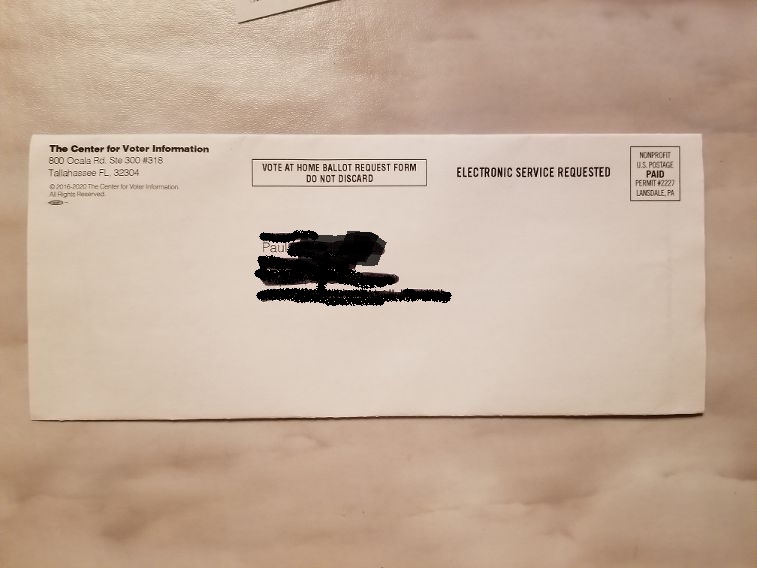
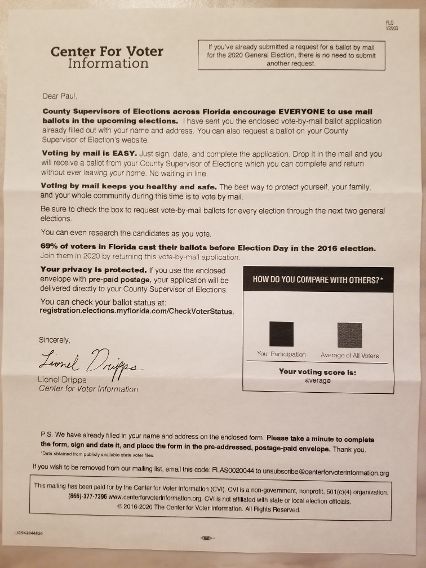
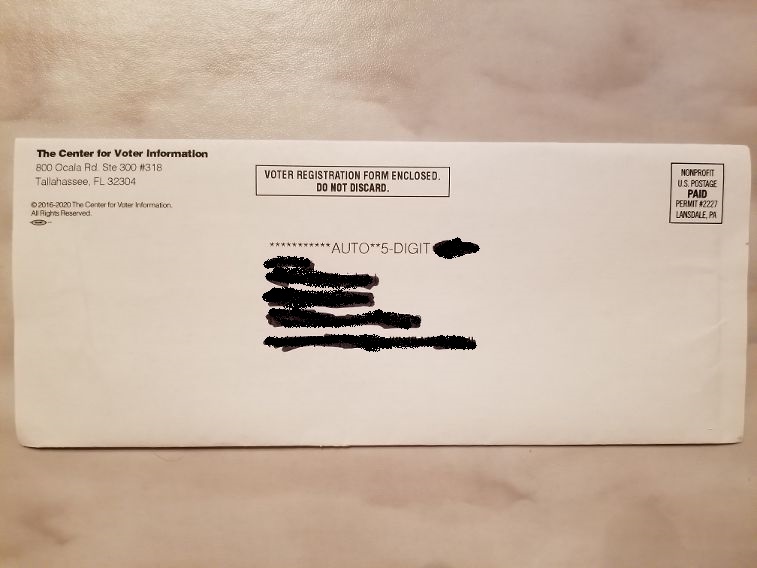
I received this packet about a month ago.  Like many, at just a glance, I automatically assume it is a ballot for the upcoming general election, which I have already requested for by mail.  Everything looks official.  Until you look at it closer.  The envelope, redacting my personal information and barcoding, was accurate.  And the return address looked official.  But I thought it was odd, as it did not come from my election commissioner, but some other entity, the Center For Voter Information, a lobbying group located in Tallahassee and Washington, DC.  But to be clear, what they sent me, was NOT a ballot.  It was however, an application for REGISTERED VOTERS to register to vote by mail.  And their effort was quite convenient.  Again, this was for registered voters.

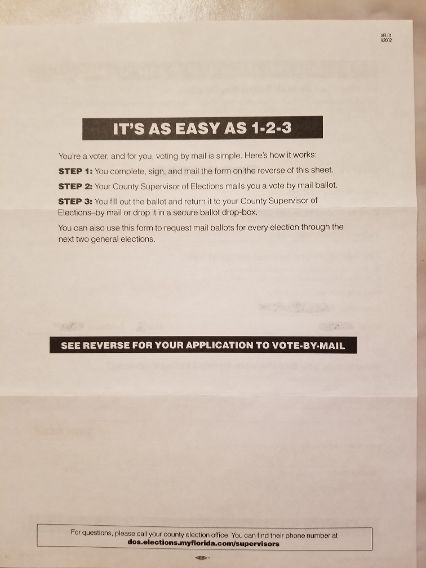
There was a nice letter explaining quite clearly how convenient it would be.  There was a step-by-step instruction, also quite easy to read.  And then, get this… the actual application to request a mail ballot.  Did I say convenient?  It was already filled out with my name and information.  All that I had to do, was sign it and mail it in the envelope that was also provided, to our local board of elections, my return address already on the envelope.  And the postage was PAID!

Make no mistake.  THIS IS NOT VOTER FRAUD.  THIS IS NOT A BALLOT.  And while it came from a lobbying group that had my voting information, they were not privy to the fact that I had already registered to vote by mail.  So, no ballot fraud.  No vote submitted.  No voter fraud.

Example #2

A-HA!!!  Voter fraud and the post office is in on it now too.

No.

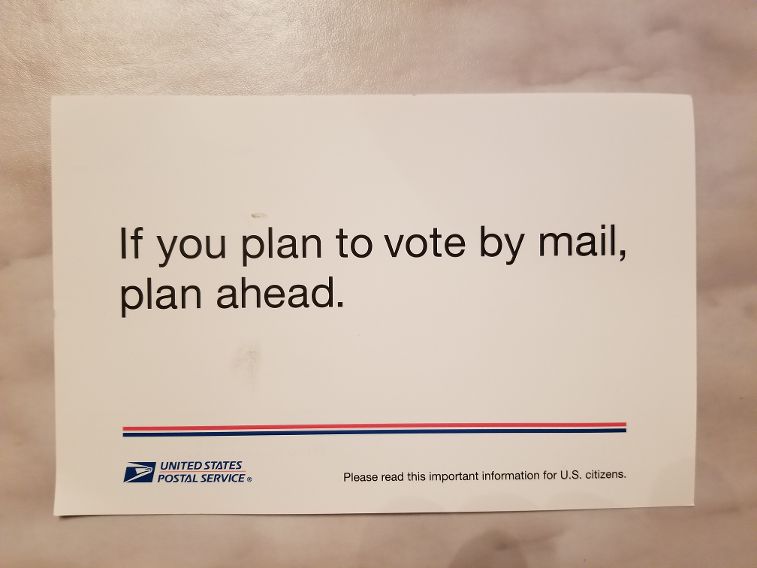
I got this a couple weeks later.  With all the problems going on with the postal service, the USPS put out a simple information card, assuring customers that if they planned to use vote-by-mail, you could count on the USPS for your vote to count.

You need to read everything on this card to see, it has nothing to do with registering to vote or supplying ballots.  It is simply how to make sure your vote counts.

Example #3

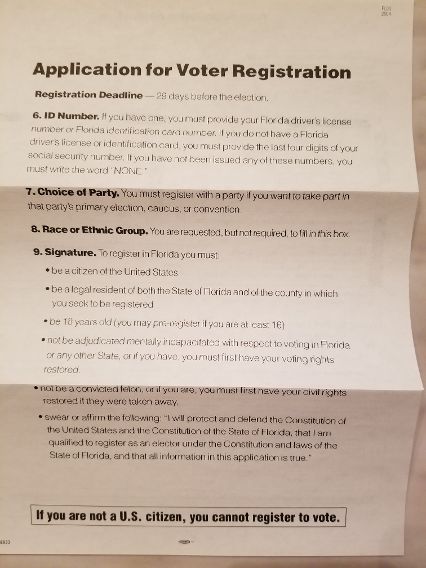
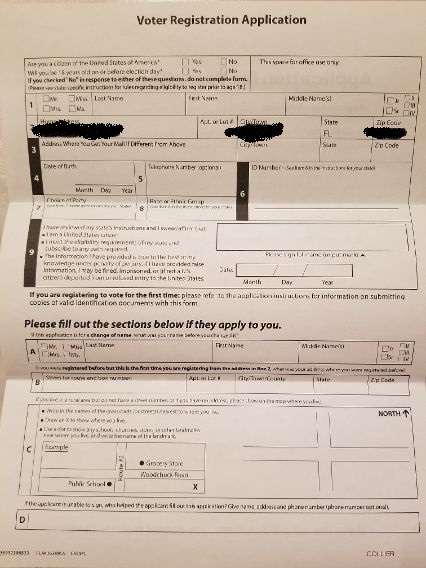
If this look familiar to Example #1, it does, with a couple of differences, one of those major.  Although I have it redacted, this packet came to “resident” instead of addressed to me personally, though it did have my address on it.  The major difference?  This is an actual voter registration form.  There are two easily readable pages with instructions followed by the application itself, which as in Example #1, is pre-filled out, without my name of course.  But the address has been filled in, and the return envelope is addressed already to the board of elections, and the return address is my address, just without my name.  And this too was pre-paid postage.

Again, THIS IS NOT A BALLOT!  This is not voter fraud.  As annoying as it is to get now the second mailing from the same Center For Voter Information, it is just an effort to get out and vote.  Helping people to register to vote this way is no different than when we apply for a driver’s license, or sign up at some recruitment drive, and it makes no matter where it is done, whether at a mall or a high school.  It is just a registration.

Example #4

Annnnnnddddd…. here comes another mailer from the Center For Voter Registration.  Some slight differences, but still just a registration attempt.  NOT A BALLOT!  This is not voter fraud.  They made this mailing a more compact as the way the literature folds, the whole thing is only one page.  But still completed the same as Example #3.

These mailers are not ballots.  And I believe in most states, early voting (or absentee voting) has not even begun yet.  So unless you are Michigan, Minnesota, New Jersey, Pennsylvania, South Dakota, Vermont, or Wyoming, you definitely have not received a ballot, and if you are one of the mentioned states, it is only possible that Pennsylvania has made the mail in ballots available prior to this post.  In other words, if you are receiving something that looks formal, READ IT!  It is likely not a ballot but rather an attempt to either register you to vote, or to vote by mail.  And that is not fraud.

One final note, about “dead people” receiving stuff like this.  Again, entities like the Center For Voter Registration, do not get death notices, which is why “dead people” still get stuff like this, and other unwanted junk mail including credit card applications.  But you county election board will have the death on record, and that “dead person” will not be able to vote.  And anyone attempting to vote using that identity (if the death has not been processed in time for the election) is committing a federal crime.

Having the right to vote, is a serious right, guaranteed by our Constitution.  So many have died fighting to protect this right.  The least we can do, besides being informed about candidates (I am not a straight ticket voter being an independent, I actually take the time to push each button), and be knowledgable about the options available to complete the process, and recognize when someone is peeing on our shoes and telling us that it is raining.

So with that, get registered to vote.  You still have time depending on your state.  And then do your duty on November 3rd.  If you can vote in person, do it.  If transportation or poll inconvenience is an issue, mail it in.  If you are trying to protect yourself from the health crisis that has killed so many Americans, mail it in.  And for crying out loud, enough with the “if you can stand in line…” memes.  That is both ignorant and arrogant and has no place in the people’s right to vote.

Wow, I was actually able to keep this down the middle.

Post Navigation