Paul's Heart

Life As A Dad, And A Survivor

Archive for the category “Cancer”

When Emotional Support Is Needed


I came across an article that I had published by Bridges, a quarterly newsletter through Memorial Sloan Kettering Cancer Center in New York.  The article I had written was about the addressing the need for emotional support before, during, and after cancer.  Of course, the article can pertain to anyone dealing with a severe illness or disease.

I apologize, I was trying to get the link directly, but I sometimes have my limits with technology, so here is the scanned copy of the article, as well as the text printed below.  (Please keep in mind, this article was written 4 years ago, there have been some changes in my life.)
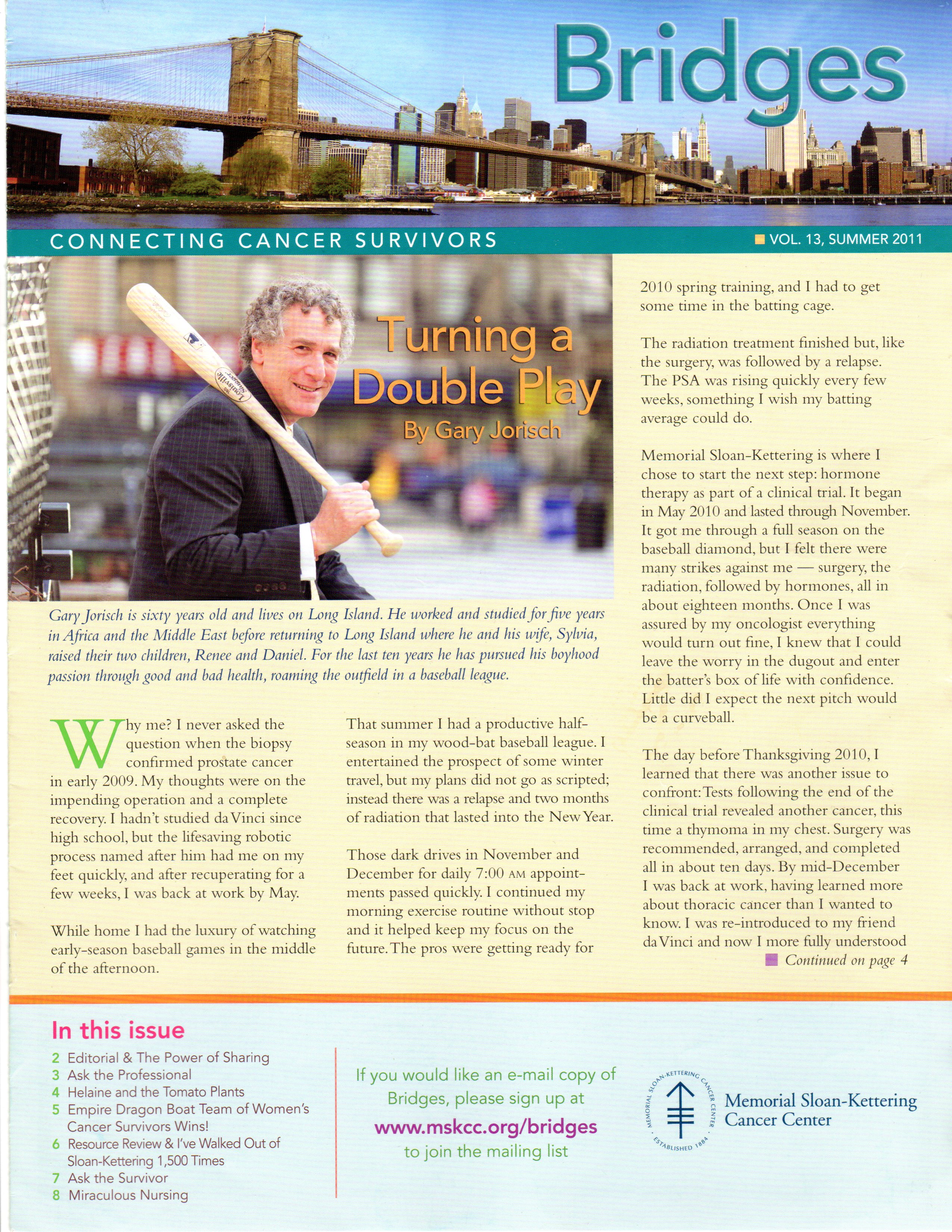
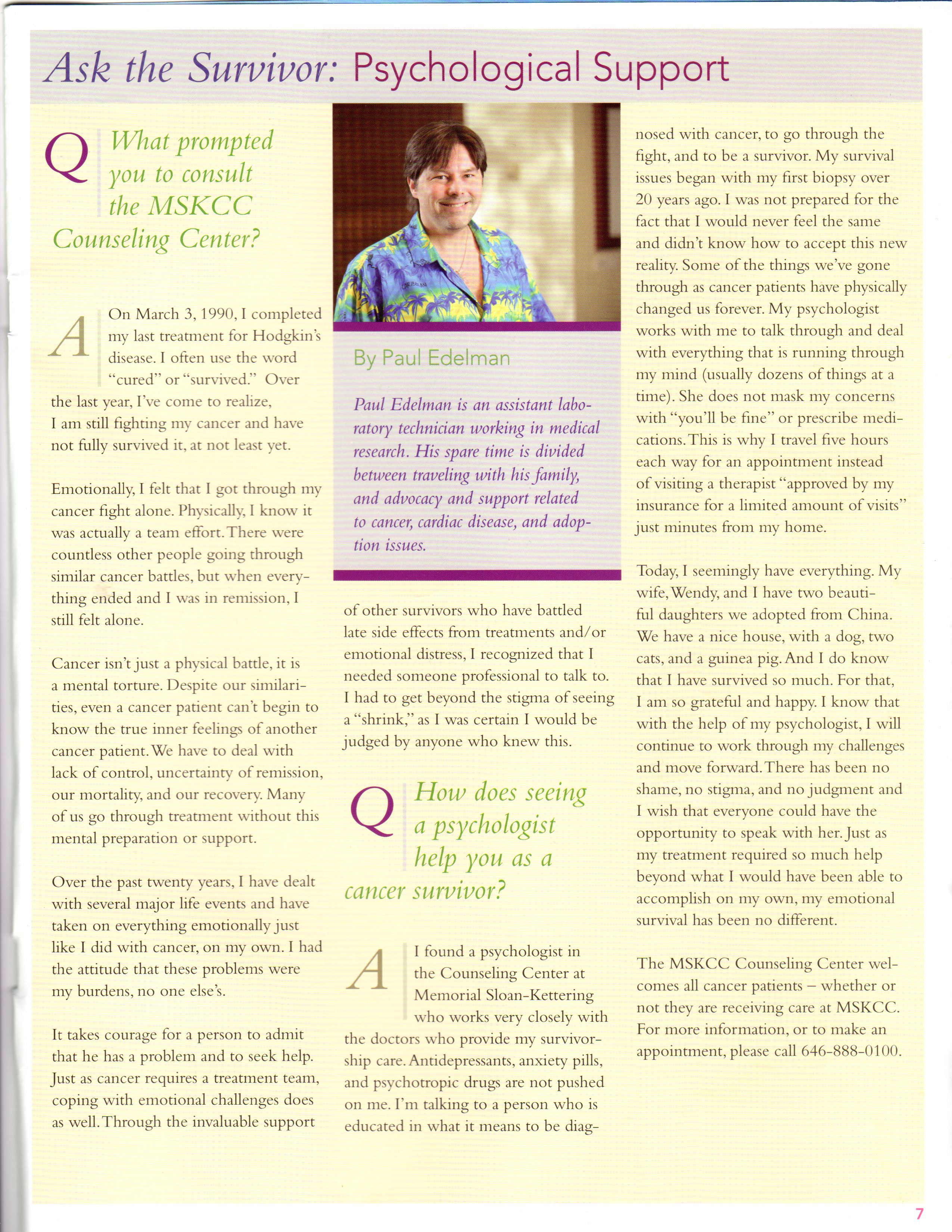
img067 img068


What prompted  you to consult  the MSKCC Counseling Center?
On March 3, 1990, I completed my last treatment for Hodgkin’s disease. I often use the word “cured” or “survived.”  Over the last year, I’ve come to realize, I am still fighting my cancer and have not fully survived it, at not least yet.
Emotionally, I felt that I got through my cancer fight alone. Physically, I know it was actually a team effort. There were countless other people going through similar cancer battles, but when everything ended and I was in remission, I still felt alone.
Cancer isn’t just a physical battle, it is a mental torture. Despite our similarities, even a cancer patient can’t begin to know the true inner feelings of another cancer patient. We have to deal with lack of control, uncertainty of remission, our mortality, and our recovery. Many of us go through treatment without this mental preparation or support.
Over the past twenty years, I have dealt with several major life events and have taken on everything emotionally just like I did with cancer, on my own. I had the attitude that these problems were my burdens, no one else’s.
It takes courage for a person to admit that he has a problem and to seek help. Just as cancer requires a treatment team, coping with emotional challenges does as well. Through the invaluable support
of other survivors who have battled late side effects from treatments and/or emotional distress, I recognized that I needed someone professional to talk to. I had to get beyond the stigma of seeing a “shrink,” as I was certain I would be judged by anyone who knew this.
How does seeing  a psychologist  help you as a  cancer survivor?
I found a psychologist in  the Counseling Center at Memorial Sloan-Kettering who works very closely with the doctors who provide my survivorship care. Antidepressants, anxiety pills, and psychotropic drugs are not pushed on me. I’m talking to a person who is educated in what it means to be diag
nosed with cancer, to go through the fight, and to be a survivor. My survival issues began with my first biopsy over 20 years ago. I was not prepared for the fact that I would never feel the same and didn’t know how to accept this new reality. Some of the things we’ve gone through as cancer patients have physically changed us forever. My psychologist works with me to talk through and deal with everything that is running through my mind (usually dozens of things at a time). She does not mask my concerns with “you’ll be fine” or prescribe medications. This is why I travel five hours each way for an appointment instead of visiting a therapist “approved by my insurance for a limited amount of visits” just minutes from my home.
Today, I seemingly have everything. I have two beautiful daughters we adopted from China.  I do know that I have survived so much. For that, I am so grateful and happy. I know that with the help of my psychologist, I will continue to work through my challenges and move forward. There has been no shame, no stigma, and no judgment and I wish that everyone could have the opportunity to speak with her. Just as my treatment required so much help beyond what I would have been able to accomplish on my own, my emotional survival has been no different.
The MSKCC Counseling Center welcomes all cancer patients – whether or not they are receiving care at MSKCC. For more information, or to make an appointment, please call 646-888-0100.

A Comment To Stand Alone


letter

A couple of weeks ago, I posted a special “open” letter written by a fellow Hodgkin’s survivor.  It was written to hopefully inspire those in oncology to recognize and deal with some of the emotional needs of cancer patients.

I am always willing to allow comments to go through on posts, but there was one post, that received a comment that I did not share, until now.  I did not want to the comment to take away from what the intent of the post was trying to get across.  But that does not mean that the author of the comment did not have a point.  I have edited the comment slightly for my own reasons, but here is the bulk of the comment:

“Traumatized by her first encounter with the commercially-motivated sick care system, she reacts. That is nice.. BUT, the far bigger issue is missed here.. The methods applied with her, “Chemo”, is NOT what she THINKS it is. Far from being “a therapy”, it causes much more premature deaths, destruction of immune systems AND “implants” highly carcinogenic elements within her body, so her prognosis is, let’s say, unfavorable. Oncologists fail to inform patients of the long term risks, and if you care to read them, on the Oncology sites, they “hide” this very crucial one at the bottom, since they know most people get tired of reading anyhow, so there it is- http://www.cancer.net/survivorship/long-term-side-effects-cancer-treatmentPlease READ carefully, all the way down , where they hide the fact, it causes more new cancers.. called “secondary cancers”.
Oncologists are ANGELS. The only question left to answer is weather one wishes to meet the angels before his/her time..”

I have not disclosed the author of the comment until I receive permission.  But the author does make a valid argument, and from the tone that it was written, perhaps a personal one.

I have seen enough in my 25 years, to know that not all cancer stories have happy endings, and yes, many continue on as nightmares.  But compared to the decades ago, when most of us were only aware of cancer’s automatic death sentence, there are many more success stories than unfortunate tragic endings.  In just the past two years, I have lost more than five close friends and family due to either cancer or complications from the treatments, short term and long term.

All the more reason, we need attention brought forward, we still need better and safer treatments.  I am currently looking for my original treatment sheets from 27 years ago, but I know what I read way back then “risk of pericarditis and secondary cancer such as leukemia.”  That is all I was told.  Back then, that is all they knew.  But they missed that mark by a ton (I discuss all my issues on this blog).  And just recently, a very close friend of mine is grieving for the loss of her sibling, succumbing to complications caused by treatments received decades ago.

No, medicine is not perfect, and neither is how we treat cancer.  But for now, we have to accept that what has been scientifically proven to work, and better than the alternative for the most part, and fight with all we have.  There are alternative and complimentary treatments as well, but while they may be safer with side effects, they do not have the scientific backing.  I want to make it perfectly clear, I am not pro “big Pharm”.  But having been in the world of cancer half of my life, I have seen the progress.

It is my hope that some day, and soon, we can finally have the better surveillance to discover the brutal and tragic side effects that sometimes occur.  One battle is enough for someone to face.

Not The Way I Wanted To Start Lymphoma Month


When I started “Paul’s Heart,” I wanted to do two things, bring awareness of the needs of long term cancer survivors who have been forgotten because they lived past the magical 5 year mark, and were no longer being followed up for their cancers, and thanks to the fast track for cures, leaving long term survivors and doctors without information about what can happen to a long term cancer survivor long after they have been cured.  The second thing I wanted to do, was to bring awareness to progress, better diagnostics, newer treatments, safer treatments, more successful treatments.

Last year, I added a third goal, to bring awareness to the need for a better protocol, one that is adhered to, during treatments for cancer.  After the passing of a young friend, Michael (I wrote his story on “Paul’s Heart” last year) from the same cancer that I had, it was believed that one of the same drugs that was part of my chemotherapy cocktail, and part of Michael’s, was responsible for his congestive heart failure, just a couple of months following the completion of his treatment.  Cleveland Clinic is the first hospital network that I have become aware of, that is actually giving echocardiograms to patients receiving the drug that killed Michael.  And they do not just do the echo once, it is through the entire treatment to follow the damage development in the small amount of patients affected before it becomes too late, as it was for Michael.  He was only 24 when he died.  A simple and inexpensive test done after the first, if not the second treatment most likely would have picked up the damage and other options could have been considered before the damage was too great and a young man would lose his life.

bleomycin

Today, on my personal Facebook feed, for Lymphoma, another post came through, just as tragic.  Another young man, is now facing an end that should not have happened, and again, with another drug that I am familiar with as part of my treatment, but also part of his.  Bleomyacin is known to have an impact on the lungs, scarring.  The damage when it occurs is irreversible.  To make matters worse, it seems to help the young man with his breathing, they gave him oxygen therapy.  And as I found out once I was dealing with late effects from treatments, any patient with lung damage from radiation or Bleomyacin should not get pure oxygen.  In the case of the Bleomyacin, the oxygen actually stimulates the Bleo toxicity.  And this concern not only exists during the treatments, but as I am aware, even decades after treatment.  Once the damage is done to our lungs it is too late to treat us conventionally.

And now, a wife is faced with a decision that I guarantee she never thought she would have ever had to face when she gave her wedding vows.

I just cannot fathom, that how a common person like me, with no medical background, other than the medical research I have done to deal with my late effect issues, can know these risks, but most of medicine still does not.  What is it going to take to finally stop saying “it is not cost effective” to follow up more closely, drugs that are known to have a potential side effect on a particular body organ?  Another young person is going to lose their life, because someone has decided that a protocol and follow up, is not “cost effective” yet the extraordinary measures that have gone into saving his life, a life that will be lost, is some how the better solution.

This is inexcusable and unacceptable.

Do not get me wrong, I still believe in this drug as a treatment for Hodgkin’s.  I will never deny that.  I am here 25 years later because that was part of my chemo cocktail.  But for a percentage of patients, this drug is responsible for suffering and even death.

A closer eye needs to be kept on patients given this drug during treatment and for the rest of their lives.  End of story.

This is not the way I wanted to start of Hodgkin’s Lymphoma Awareness Month.  Medicine still is not aware.

Post Navigation