There are very few months that are not difficult for me to deal with emotionally. June is when my grandmother passed away after her second fight against cancer. November is when I was diagnosed with my cancer, Hodgkin’s Lymphoma. December is when my stepmother was hit by a car while crossing the street. January is when my first wife was involved in a near fatal car accident. April is when I was faced with emergency heart surgery. The list goes on.
The month of May brings with it a lot of emotional pain for me.

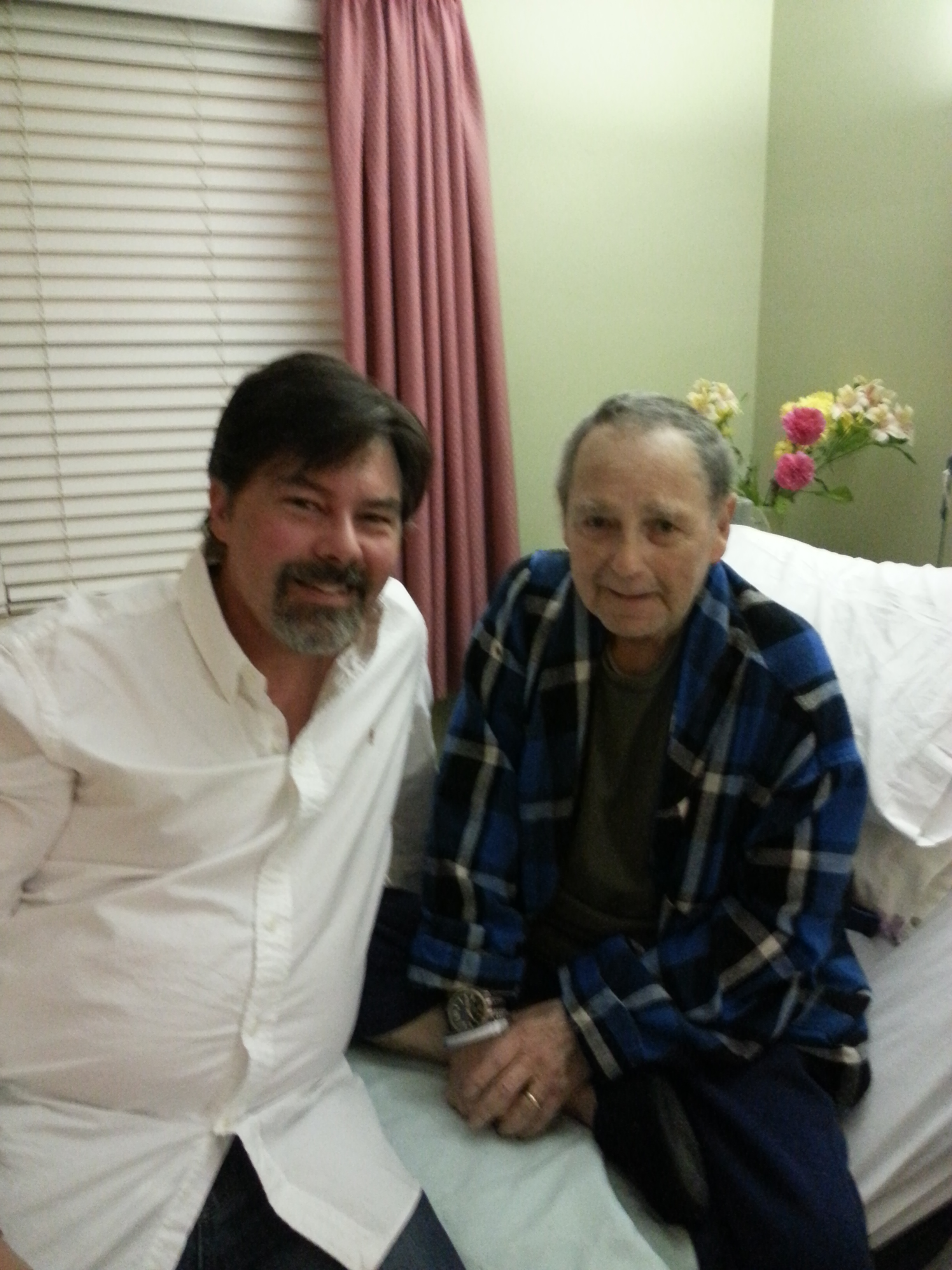
At this time three years ago, my father, a smoker for more than 55 years, was undergoing surgery to remove one half of his left lung due to a cancerous tumor located critically close to the heart.
My father was a private man. He was definitely not used to getting attention, whether it be from family or friends. When it came to dealing with this diagnosis, I found a huge similarity with how my father dealt with his diagnosis, to how I dealt with mine. The only difference, I had no one to look up to or refer to, for helping me get through my fight with cancer. He made it very clear even in front of the doctor who had just given him his terminal prognosis, that all he wanted was to be a survivor like me.
My father did not want this cancer discussed with anyone at this point. In fact, he was more concerned with the care for my stepmother, whom he had cared for since her tragic accident. To keep his situation from getting out of control and too many people involved with well-intended but ill-wanted intentions, my father confided in two people, myself and my brother.
I was glad that my father was thinking things so clearly. Often times, when the average person hears the diagnosis, their thought processes go out the window. Something my father and I shared was our ability to focus on the task at hand. We would fall apart later if needed, but for the moment, there are things that needed to be taken care of.
It was a no-brainer, that my brother was asked to handle my father’s financial and legal needs. He was more familiar with my dad’s home environment, more importantly, those very decisions would have an impact on his mother. My father chose to lean on me, for everything medical, something my brother had no issue with either. We both understood our roles with our father.
My father asked me to be his medical proxy. He knew my experience with medicine both as patient and caregiver. My dad knew that I would ask the questions that needed to be asked, explain things to him so that he understood everything that was about to happen. More importantly, he knew that I would protect him, advocate for his care, and if need be, respect and honor his wishes with his care, regardless of the status of his health. He also knew that between my brother and I, that we would respect his wishes to keep things confidential until he decided when it was time to tell other family members.
Up until this point, my father had every reason to be positive. His cancer had been classified as Stage 1, best case scenario. The removal of the half of the lung would be expected to eradicate the tumor, and any potential cancerous cells nearby the tumor.
I do not know if I am a worse patient, or caregiver. I get frustrated in both roles. I knew the surgery would not be a “walk in the park.” Surgery would last many hours. But we were all confident that this was the best option for my father, and he would be able to recover and go on with his life.
Many hours went by, and then I was informed that the surgery was successful and my father was in the recovery room. The nurse mentioned that he had actually been there for some unusual amount of time. They were still waiting for him to come out of the anesthesia. No one seemed alarmed by this.
In anticipation of something being more complicated, I made some phone calls. I had to arrange for more involved coverage for my stepmother’s care. I phoned my employer to let them know that I may need some extended time off. I also had a local election campaign that was getting ready to do some publicity events, and I informed them that I would be unavailable until further notice. I was prepared for the worse, now I would just hope for the best.
They wheeled my father in to his room, and as to be expected, he was in some pain. And I made sure that the pain was addressed and dealt with. He still was not very coherent, but he was able to express his discomfort.
Over the next 24 hours, I would only leave his bedside for a short time, to run home to get showered and changed into new clothes, and stop by my dad’s house to let my stepmother know that “the old goat” was doing okay and recovering. The next part of the recovery from this phase was of course to begin drinking and eating. But he was really having none of it. And it was pretty much just chalked up to the trauma that his body had just been put through. Everything else seemed to be okay upon exams by doctors and nurses on their rounds.
The second day following his surgery, some strange things were noted. I had driven back home to shower and change again. My brother called me to ask me where I had place our dad’s reading glasses. I told him they were in the drawer by his bed, and then asked why? My dad was complaining that he could not even see the coffee cup right in front of him. I insisted to my brother that my father was not “blind” and he did not need his glasses for drinking coffee, yet my brother insisted that was what my father was saying. In my mind, I could recall plenty of times that I had seen my father without glasses, and at no time, was he not able to see.
Upon my return to the hospital, stopped by the cafeteria. I knew my father had not eaten yet, and admittedly, hospital food is really not tasty, especially when it is dictated by diet. But it was two days now, I decided to get something from the cafeteria that I knew my dad would eat, mozzarella sticks. My father wore dentures (for those not old enough to know what they are… false teeth). He had placed them in his mouth earlier before my arrival. But as I showed him the tasty snack I had brought for him, I did not say what it was, figuring he would see what it was and that would be that.
He questioned where his dentures were. I told him that he already had them in his mouth. He seemed to get frustrated with me like I was messing around with him. For my dad, he does not have a practical joke style sense of humor, so as he reached into his mouth, he pulled them out, and proceeded to argue with me, that he did not have them. Worse yet, he placed them down, and then began to tug aggressively at his bare gums. Something was definitely wrong.
After getting him to understand that he needed to put them back in, he proceeded to grab one of the cheese sticks, took a bite, and gave a content and satisfying groan. He was enjoying the tasty snack I brought for him.
“How did they get this so soft and chewy?”
My brother and I looked at each other, very confused and concerned.
“Dad, it’ a mozzarella stick. It’s supposed to be soft and chewy.”
“No, it’s a carrot stick. It’s orange.”
I wasted no time in arguing. My brother and I were definitely convinced something was wrong. We were there every time there was an evaluation for his recovery. But his not being able to see made no sense. When he was standing, and attempted to walk, he would drift to the right. He would actually drift off while having a conversation with us.
A neurologist came in, and asked my father how he was feeling, to which my father said, “fine.” Then the doctor pulled out a piece of paper, laid it on the table horizontally and drew the following pattern on the paper:
______ ________ ________ ________ _________ _______ _______
He drew seven or eight rows like this. And then handed my father a pencil, and asked him to make a vertical line through each horizontal line. My dad thought it was an unusual thing to ask him to do, and nonchalantly completed the task… sort of. My dad put the pencil down and stated, “finished.”
The neurologist questioned, “are you sure?” My dad said yes and the neurologist moved the paper a couple of inches to the right, revealing to my father that he had missed the entire left half of the columns of lines. My dad commented that he honestly thought he was done, and then proceeded to actually finished the paper.
Then the neurologist looked at my brother and I. I think your father has had a stroke.
He was immediately ordered to undergo scans which revealed my father had actually suffered two strokes, one in the front of the brain, and one in the rear.
His care getting more complicated, I had to make arrangements to juggle my job, my home, my family, my campaign. But not only was he my father, I was his caregiver, his advocate. Everything in my life would not be challenged to its limits over the next year and a half. I gave my word to my father, that I would honor all of his wishes, how he wanted things communicated, quality of life issues, and of course, end of life. I could not handle these as his son. I had a responsibility as his caregiver and proxy. His cancer would actually be found to have spread, and become more aggressive.
Of course in the midst of all this, I would end up filing for divorce several months later, not due to my father’s health, but my father’s care would be brought into the process as if to justify and question my whereabouts, my commitment to my family. But with the reactions to the divorce being extremely negative, words were never going to be satisfactory enough to explain anything. I would discuss of my dad’s health with my daughters, explaining where and what I was doing, assuring them that grandpa was in good hands. My employer was completely understanding with my father’s failing health.
There is a lot more to my dad’s story, but for the purpose of this post, my father ended up passing away, a little over a year later. That anniversary is coming up soon. It is a time that I will never forget for several reasons. But the most painful one for people to understand, as I do not discuss it, are certain actions that occurred with my father towards the end. The divorce process would actually involve my father’s health and passing when an accusation of “not being there for my wife” was made during her recovery from an elective surgical procedure that I had asked her to delay until my father’s health was resolved one way or the other and she chose not to do so. And I know what was being attempted and it was going to fail miserably because I could prove where I was and what was happening. Clearly this was a piece of scum attorney for making that statement, my wife told her about the situation, and the attorney decided to use typical “out of context” approach , that I “was not there for my wife in her time of need”, but bottom line, my wife allowed the comment to be made because all is fair in divorce court to get everything you possibly can right? I nearly leapt from my chair, my attorney restraining me that I would get my opportunity to explain. I SHOULD NEVER HAVE HAD TO EXPLAIN!!! THIS SHOULD NEVER HAVE BEEN BROUGHT UP!!! MY DAD HAD NOTHING TO DO WITH THE DIVORCE!!!
Upon my turn for testimony, my attorney asked me where I was during her recovery from elective surgery. “I was by my father’s bedside as he was fighting for his life against lung cancer.” There was no further questioning. And no one in that courtroom would even look me in the eye afterwards.
My father’s final time with me was hard enough. I have never really been able to grieve for him, because as his caregiver and proxy, I could not afford to let my emotions interfere with what he had wanted. And nearly everyone had a hard time understanding that about me, that I was actually doing it. I was his son and should have acted differently, go against what my father had wanted. But I did not, which is why my father was very clear about having asked me to be his proxy and caregiver. And I know that to this day, discussion combining my father and the divorce is still happening. Funny though, for all the things people “know,” no one has even talked to me about it. The only conversation really was held in a divorce court.
Yes, May is very hard for me. I have no regrets for honoring my father’s wishes. I miss my friend, my confidante, my dad, immensely. May was made harder than it ever should have. But I can only deal with my thoughts. Not worry about the innuendo and conspiracy theories that others want to generate to provide some sort of justification.