Paul's Heart

Life As A Dad, And A Survivor

Archive for the category “Side Effects”

A Tree With No Roots

I have no problem amusing myself.  Because my health often does not allow me to remain in one position for too long of a time, I often have many “irons in the fire.”  A recent project I have started up again, is my family lineage.  My father had given me documentation just before his passing, which allowed me to trace back nearly 150 years of his side of the family.

I did not know that much about my mother’s side of the family.  In spite of having a family tree project in school, information on the paternal side of my mother’s family was sparse.  I was able to go back several generations on the maternal side.

Until recently.  A project started by a cousin on my maternal father’s side has sparked a new interest for me.  There is actually information about that part of the family that I had not known previously.  There is some information that confirmed what I did know already.

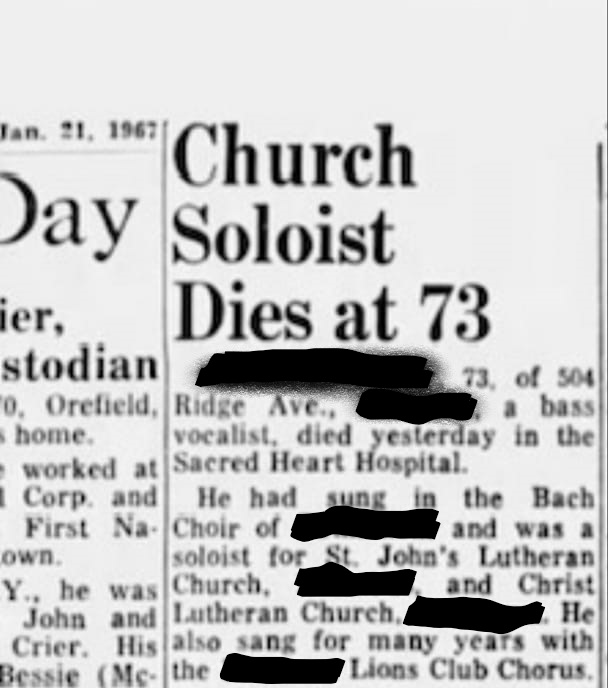
I did not get to know my maternal grandfather very long as he passed just passed my first birthday.  All I knew about him was how I was drawn to him.  Now I know why.  As his obituary shows, he loved music.  I recall hearing an actual vinyl recording of him singing “The Battle Hymn Of The Republic.”  From that point, I was hooked into music.

From church choirs to school choruses and chorales, competitions, symphony choruses, cover bands, and karaoke, I found my place in music, singing.  I did also further music studies, including guitar and piano.

Music would take a bigger part of my life, during my battle with Hodgkin’s Lymphoma.

Have you ever heard a song that pops into your head, and automatically your mind takes you back to a specific time or place?  Mine used to take me back to fun memories such as an amusement park, or maybe an ice cream shop.  But because I spent so much time in a chemotherapy suite, I listened to a lot of music to get me through my treatments.  During my recovery and rehab, I listened to even more.

This is when I realized music was not only fun, but had healing potential as well.  Now, my singing also plays a pivotal role in assisting with my pulmonary rehab, a lot more fun than using the spirometer thingy I have.

But the best thing, my daughters have the appreciation of music as well.  And like me with my grandfather, they have heard me sing as well.

Anyway, it was during this search, I not only confirmed where I got my interest in music, but also shined a light on the other side of the family that I did not really know.  It was interesting and exciting.  Always looking for more grown up things to talk about with my daughters, I saw this as a good one.  And then it hit me.

With my daughters being adopted, there are moments that I have learned, extra sensitivity and attention are needed.  And this was one of those moments.  It is one thing to be adopted domestically.  There would be some glimmer of hope, if it was desired to trace and find where someone came from.  But being internationally adopted, there is a “needle in a haystack” chance of discovering this information.  My excitement could easily cause heartache, and I do not want that.

A favorite television show of mine growing up was “I Dream Of Jeannie.”  Typical story.  Someone rubs the lamp, a genie pops out… yada yada yada.  In this series however, the genie stays.  One episode had “Jeannie”, the main character, sad, because she did not know when her birthday was.  And due to that sadness, she had begun to physically fade away.  In spite of all her happiness that she had with her “master” and eventual husband, the lack of knowledge of her birthday proved powerful enough, it needed to be found.

This has always stuck in my mind with my daughters.  And up to this point, I have actually taken several steps to help them, should they ever decide that they would like to see if they could trace their past, perhaps even find their birth parents.  Research and investigations provided me with information on caregivers, foster parents, and locations.  My daughters are now aware that the information exists, should they decide that they want to go further.

And I have given them both my word, if they do decide to pursue finding their origins, I will do all in my power to help them both.  It won’t be easy.  But who knows what can happen in a decade or two?

But at this point, there is no reason to risk any kind of hurt to my daughters, with my research on my family from a geneology standpoint.  But on the family tree, they are on there, and so will their children, and so on.

You Only Get One Warning


I need to provide a disclaimer before I proceed with this post.  This is not my current condition.  Do not panic.  I am fine currently.  But I am a hypocrite, offering the “do as I say, not as I do,” advice.

You only get one warning.  That’s it, just one.  Depending on which function of the body it is, it could be nothing, or it could be really bad.  Involved in as many of the peer support groups that I am, it is all too common for the messages “asking” what should be done, when an excruciating pain or uncontrolled dizziness is occurring.

You do not need to be like me and my fellow survivors either.  You could be in perfect health when one of these situations sneak up on you.  The point is, if it grabs your attention, it needs your attention.  So then why is time wasted, when the answer should be quite simple?  What good does asking my or anyone else, what we think you should do?

For the most part, fear.  We do not want it to be what we think it might be.  But there is literally only one way to find out, and only one person who can, and that would be a doctor.  The good news is, that a doctor can also be the one to tell us it is nothing.

But if we are getting that warning, we are only getting that one warning, and there is likely not a lot of time to react.  I have had multiple events over the last fifteen years, here comes the hypocrite part, that I have ignored warnings.  One time, I was left no choice as I was taken out of my house on an ambulance stretcher at 3am.

In 2008, I was suffering a chest tightness for nearly four months before I went to the doctor.  And then only on a hunch by my doctor, an unusual test was ordered, and thirty-six hours later I was having emergency open heart surgery.  I was about to die from a fatal heart attack.

In 2012, as I mentioned, an early morning ambulance ride resulted in me being diagnosed with aspiration pneumonia, full blown septic.  The bad part, I do not think I had any symptoms, or at least I did not recognize any.  Yet, my bloodwork showed I had been septic for at least 48 hours.  I should have been dead by then, untreated.

In 2019, again, a follow up test revealed I had another major blockage with my heart, yet I felt no symptom that I am aware of.  The repair, thanks to advances in technology with my health history, was a lot easier than open heart surgery.

But while several of my episodes have been without recognizable symptoms, I have had plenty that did have warning signs.  Years ago, I was left paralyzed in the middle of my work area, alone (because everyone else was on lunch break), with a piercing chest pain, unlike my other condition.  I thought for sure I was having a heart attack, and was afraid to move, thinking that would be the last thing I would do.  I would actually have several of these “attacks” over the years.  Some would result in a trip to the ER, sometimes not.  The point is, only one person could determine if it was something or not.

Later in 2019, I had another one of those episodes, that resulted in me being admitted.  They were certain that something had happened, just not sure what.  It is believed that I suffer from “lightning strikes” as one cardiac nurse calls it, a result of the type of bypass that I had done back in 2008 (more complicated to explain without detail on this post).  There is nothing that can really be done for them, but let me tell you, they get my attention.

I know that I am not healthy as the rest of most I know.  So when I do see a friend or acquaintance, talk about an unbearable pain in the side, chest, dizziness, whatever, I do not hesitate telling them to go straight to the ER.  Time wasted with a serious warning like that can mean the difference between life and death.  The best that can happen, is be told you are fine.  But hopefully the worst, you are diagnosed with whatever is causing the symptom and it can be corrected.  But you only get that one warning.

When Those Closest Do Not Even Get It


When someone gets diagnosed with a serious illness, such as cancer, initial feelings for those around the patient, are often shock, fear, concern, hope, and encouragement.  In too many cases however, these feelings often fade or are extinguished as quickly as a match’s flame is blown out.

And just as when that match is blown out, it leaves behind an awful, sulfur smell.  Of course we do not expect a match to stay lit forever.  And nor should we expect many who we are acquainted with to carry the concerns and encouragement for a successful path in dealing with our serious illnesses.

The truth is, we do expect, and we should expect, those closest to us, such as our family, closest friends, and perhaps even co-workers, to continue to be concerned and offer encouragement.  After all, these are the people that patients spend most of the time with, witnessing all of the stressful moments, struggles through treatments, and the fears of the possibility of not reaching remission.  It is a no-brainer.  If the patient is your spouse, parent, child, sibling, best friend, close co-worker, you are expected to be there no matter what.  We need you.

Then how do we go from them being there for us, to not being there, and/or betrayal?  Wait.  WHAT?  Betrayal?

That’s right, I said betrayal.

Being there goes without saying.  Your loved one or close friend, likely one to even be a medical advocate or proxy for you, stands by you no matter what.  Their only concern is helping you get through this awful journey that you were forced to take on, through no fault of your own.

And if you are lucky, this is exactly the situation you have had, or someone you know may have experienced.  The last thing anyone would expect to happen to a cancer patient, or anyone facing any other serious illness, is to get “kicked in the teeth”, “punched in the gut,” whatever expression you want to use, while going through something so difficult, often times possibly fatal.

It happens more often that many may be aware of.  And unless you participate in many of the forums as I do, you may be unaware just how often this occurs, or how serious it gets.  Experiencing this behavior myself, on numerous occasions, I have seen countless others, even as they faced death, be treated just as horribly.

As I said, there are two types of this unacceptable and inexcusable behavior.

The first, if you can believe, develops as a “jealousy.”  That’s right.  The cancer patient must be getting some special treatment that is not enjoyed by all.  An example, back when I was diagnosed, many co-workers thought I was given special privileges for time that I would miss from work.  It never happened.  I lost income from the time I missed unless I used sick pay.  During my survivorship days, where I have struggled with my health from the treatments thirty-one years ago, physically unable to do many of the things I once did, and protected by the Americans With Disabilities Act, it was common for co-workers to bitch that it was not fair, that I got paid the same rate, and was unable to do every task that they, being healthy were expected to do.  Imagine that, jealous of the guy who has cancer, or just had open heart surgery (my list goes on).  I challenge one person reading this, who would jump at the opportunity to switch places with me.  No, seriously, I would love to play baseball again, or go whitewater rafting or skiing like I used to.  Come on!  Any takers?

But the truth is, this behavior is all too common, and unfortunate.  There is not one person I know who asked to be challenged by a battle with cancer.  We are the one being inconvenienced.  You get to go through your life all happy and healthy.  The attention given to a cancer patient eventually ends up too much for many to accept.  Even vows of “in sickness and health,” no longer matter.

Sometimes, the “loved ones” will attempt to pull attention away from the patient, gathering pity for themselves to make them more of a focus.  “I can’t believe this is happening to me, having to deal with this.”  “I can’t get anything done I want because everything revolves around her.”  The comments go on.  The most nauseating comment I have ever heard, “I can’t believe I am going through this.  After they’re gone, what am I going to do?”  Seriously, if you are in a situation of losing a loved one, and those words leave your lips, the loss of your loved one is the least of your self-absorbed problems.

But hey, once a person is cured, all is good!  Forget anything happened, right?  Let’s move on!  No more pity.  In fact, “it” shall never be mentioned again.  Of course that is a feeling that both patient and caregiver clearly hope for.  But there is a reality.  It does not work that way.

Ask any long term cancer survivor.  Many of us treated decades ago, were done so experimentally.  Short term, doctors knew treatments had a good chance to work.  Long term, they had zero idea at what cost.  Well, many doctors now do know.  But the problem, remember how concern and empathy changed when we faced our cancer?  This attitude returned in a much more awful way.

“I don’t understand, you were cured!  This is bullshit that we have to keep going through more.  Your cancer is gone!”  Many of my fellow survivors will agree, they have heard something similar.

While family may be the same, spouses may be different, different co-workers will be likely, the responses by all are likely to turn darker, unimaginable to come from people we thought cared.  Betrayal.

It is hard enough for us long term survivors to even find doctors who understand or know about our issues.  We are happy to even have a doctor with an open mind, willing to seek outside help.  Many see a doctor, with a definite issue related to treatments, only to be turned away because the doctor is ignorant in our treatment histories.

Even that could be understood to a point.  If it was not covered in medical school, which is was not until a decade ago at the least, how could a doctor be expected to know, unless they attend conferences or continue their education?  I am blessed because I have a doctor who does just that.  But the majority of doctors I have faced, have had no idea.

But a reluctant family member, friend, or co-worker who has had enough the first time if they were around for that, and if not, may not accept that there is even any proof that anything was ever wrong in the first place.

Two things are likely to happen.  Get the situation corrected.  It could be a surgery, perhaps medications, whatever.  Good, all better.  Move on.  You are good to go.  Denial.  Cancer patients now face lifetime surveillance to follow up for potential long term complications.  And a Hodgkin’s Lymphoma survivor treated in the 20th century is likely to have a long list of issues that will never be recovered from.

Again, hard enough for the patient to deal with, those around the patient, push back.  “It’s not fair!”  “I have given enough!  It’s time for me to be able to enjoy life!”  “Why can’t they just get over it?”  Or, “they’re better now!” and settling for the next shoe to drop whenever it does.

Then it comes, betrayal.  It may seem like denial, but it is betrayal, because the loved one actually refuses to believe there is anything wrong with the patient, actively participating in efforts to smear the patient, demeaning the patient into someone just pathetically looking for attention.  The word “lazy” will also often get tossed around.

Many of us have been in this situation.  It is horrific.  We have enough on our plates, including fighting against doctors who may not have the knowledge or will, than to fight our caregivers as well.

In a perfect world, people would simply just care when another is ill, and that is all.  Not worry about what perks they are missing out while they get to enjoy good health.  Not to be resentful because a life-plan did not work out the way it had been dreamt.

In a perfect world, if you are reading this, and this has not happened to you, then I, and everyone else are happy that you have had support that has at the least, been never ending.  Strenuous is one thing.  But if it has never waivered, then you are one of the lucky ones, and I could not be happier for you.

And if you have gone through behaviors like this, you are not alone.

Post Navigation