Paul's Heart

Life As A Dad, And A Survivor

Archive for the category “Side Effects”

Two Reasons I Do Not Like Mid-April


I think it was Ben Franklin who stated, “only two things in life are guaranteed, death and taxes.”  Of course I am paraphrasing.  But in April of 2008,  I almost proved Ben correct.

I want to indulge this post, because I am preparing for our local Relay For Life, and will not be able to post this “anniversary” post.

On the day after the deadline to file income taxes, I underwent a nuclear stress test, which had nothing to do with the tax preparation or results for the record.  I was dealing with annoying chest tightness, and my family physician of nearly forever recommended the test based on my history of having had cancer as well as other biological health issues.

Now rather than repeat the entire story, you can check out the page “CABG – Not Just  A Green Leafy Vegetable” for everything that happened by the detail.  But long story short, 36 hours later I would end up having emergency heart bypass surgery.  The cause of the blood restriction to my heart was the real shock, because up until that point, there was no reason to be concerned about cardiac issues.

The main artery to my heart had been so badly scarred from radiation damage during the period I was treated for my Hodgin’s Disease.  That was just the first discovery of many, that would now become my current world of long term cancer survivorship.

20131109_200245

A week later, I was sent home, along with my “heart” pillow to help provide comfort for my very tender breast bone area.  I would make my first phone call to Memorial Sloan Kettering to begin what should have been done eighteen years earlier, post treatment care.

By now, almost every area of my body has been checked for late developing side effects caused by either my diagnostic methods, or chemo and radiation treatments.  The list of diagnosis of serious issues are more than a dozen long.  For now, doctors concentrate on the major and potential life-threatening issues:  cardiac, pulmonary, immunological, gastrointestinal, neurological, muscular, and orthopedic, and of course psychological.

It is one thing to have beaten cancer, but it is another to have to deal with permanent issues that medicine had no idea they would be dealing with, once cancer patients would begin to live regularly past the magical five year mark.

This post is not about dealing with all those issues.  No, I want this post to be positive.  This year marks the 7th anniversary since I had my double CABG.  And as I have pictured above, there are only two reasons I got through that procedure and the reason I am still around today.

Medical Proxies


proxi

I have been hospitalized several times over recent years.  And of course, one of the questions regularly asked is “do you have a living will or medical proxy?”  The purpose of either of these two acts, is to make sure that should a situation arise while in the hospital, that you are no longer able to make a medical decision on your own, for any reason, that your wishes are known before hand, and enforced.

I am not too familiar with each specifically, although I know in recent years, I have had to deal with both.  I do have a living will that was created a few years ago, which specifically stated my wishes as far as my care should I be unable to make the decisions on my own.  It is also expressed as an “advanced directive” such as artificial measures meant to prolong life or other extreme measures when there is no hope.  Note to self, I have since filed for divorce, so I should probably change some of the directives and who carries them out.

A medical proxy on the other hand, is a person who actually and legally makes the medical decisions on the behalf of the patient.  In most cases, the proxy will simply follow the living will, if that directive has been shared with the proxy.

One of the first things, and actually smartest things that my father did, when he was diagnosed with lung cancer, was to make sure that steps were in place, should anything happen to him, that his wife would be cared for, and what little assets he possessed would be protected.  My brother would be given all legal power through what is called a power of attorney, in other words, if my father were unable to make any decisions, or even pay bills, my brother had the legal authority to make those decisions.

The same decision making power medically is given through a medical proxy.  Again, the responsibility to make sure that all medical wishes are followed through.  In my case, my father asked me to take on this task, not jus because of the “what if’s”, but also, he knew that I would be his strongest advocate to explain to him, things that there happening, things that needed to be done, and to make sure that he got the best care.

Both power of attorney and medical proxy can be very frustrating positions.  Under normal circumstances, only one person is selected for either, and just as when only one family member is selected as an executer of a will, feelings can be hurt, and actually complicate the enforcement of important decisions.  Then there is still the time period, when the patient is still fairly in control of their mental faculties, and the patient either complicates efforts or even sabotage efforts.

But when a patient is in need of both a power of attorney and a medical proxy, unless it is a long term medical situation, the only other time that these positions will be in need, are during the stage of life, preparing for death.  Now I want to make sure that I am clear, any comments that I make in this post, are not a reflection of what happened with my father and I or any family members.  I am actually in communication with a couple of friends who are in the very situation right now.  And “Paul’s Heart” is about helping others and so, I decided to write this post.

Anyone who takes on the task of having power of attorney or medical proxy has to be counted on, by the patient, to carry out the wishes and legal needs no matter what.  Feelings of others are bound to be hurt, decisions are going to be questioned, but in the end, having followed what a POA or MP were charged to do is what matters most.  Those two titles are charged with a responsibility to do what the patient is not able to do, and wants met.

Once a patient’s status gets bad enough, that hospice gets involved, the two positions of power of attorney and medical proxy take on even more importance.  Emotions among family and friends are likely to escalate, as only the people involved in the decision making only know all of the facts involved in the care, and legally, this is important to protect the patient’s privacy rights.  Even though everyone could be related, protecting that privacy may have been important enough to the patient.  As the time drawers near, it is important for both of these legal representatives to understand just how important their roles are and that there will inevitably be conflict.

While my brother was my father’s power of attorney, I was my father’s medical proxy.  My father had his reasons for appointing us this way.  And I believe the two of us both agreed.  My father’s decision to ask me was based on the fact of my experience in the cancer world.  But as time went on, and his cancer got worse, my role went from just questions and information, to decisions.  Eventually the decision would have to be reached between my brother and I, to have my father placed with hospice.  With his mother, my stepmother involved, this was going to be the most important decision of all.  For the first time in nearly 40 years, our parents had the possibility of being separated for the rest of their lives unless we could locate a facility that could accommodate the levels of care necessary for each of them.

Once the nursing home was found, and yes, we were able to accommodate both of our parents, next came the hard part, filling out the paperwork, and agreeing with the new level of care that would be given to make our father as comfortable as possible in his final days.  And this would be the most difficult.  Because with hospice involved, and my father’s living directive, it was clear what my father wanted and did not want.  Again, my father knew I would be able to separate the role of proxy and son, emotionally this would be critical.

In a patient’s end of days, the suffering can be immense, and the person in the role of the proxy must do exactly as the patient wants.  There is no room to allow emotions to factor into any decisions for to do that would only increase suffering.  Family dealing with sorrow, in spite of recognizing that death is imminent, a grieving family member will do what is normal and expected, reach out for extraordinary measures to somehow, turn the condition around, from investigating a last minute attempt at a cure, to treating symptoms, which would only prolong the suffering and death.

Hospice gets involved when death is not only certain, but imminent.  There is no chance at cure.  There is no last second miracle coming, and to believe otherwise is cruel to both patient and family member.  And even when it is just comfort that is sought, decisions are actually made to remove medications that at one point were taken daily for daily health, trying to justify to other family members that there is no benefit to continue those medications.  But perhaps even more frustrating, is if a patient, in hospice, were to contract an infection or pneumonia.  There is the likelihood of family not understanding that treatment for the normally acute illness would not be administered because at this stage, there is no desire to draw out and extend the life.  Really no different than if he were to suffer a heart attack or stroke.  The orders are strict, there is to be no attempt to prolong the life which would definitely increase the likelihood of suffering.

The role of proxy is a difficult position to be put in.  I have been in the caregiver role for twenty-five years, but my father was the first time I had been placed in the role of a proxy.  I did what I had to do as I made sure my father’s wishes were honored.

Managing Meds


pill5

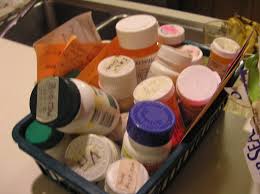
It happens in an instant.  You can spend your entire life, having taken nothing more than vitamins, but with a trip to the emergency room, or a diagnosis of a serious illness, as if you did not have enough to deal with, you will most likely be introduced to the world of prescription medications.  So, now you will not only have to deal with possibly a life-changing situation, but now, you will probably be concerned with side effects from the new medications, as well as learning how to take the many new medicines that will become part of your every day life.  You will have to learn the timing of taking these medications as “absorption” of the drugs is just one of the situations that can have an impact on the effectiveness of the medicines.  There are foods that need to be avoided, and some actually increased.  Times in between taking certain combination medications.  There are many other issues that can impact “when” you take a medicine.  And for someone who has never taken a prescription medication for the long term, even one drug, having to take a regimen of drugs, and scheduling when to take them, simply put, can be overwhelming.

For me, my life turned upside down in 2008 with my heart surgery, a result from radiation damage for my Hodgkin’s Lymphoma back in 1988.  All of a sudden, I was taking 7 prescription drugs, along with several supplements for calcium and vitamin deficiencies.  For the most part, my meds were all single dose per day, except for one of my most critical drugs, for my heart.  That was taken twice a day, but I was having a hard time remembering to take that second dose.  It was determined that I could take a similar drug, with extended release action.  Regardless of the consumption being ideal to the medical world, I took all my pills at the same time, as part of my bedtime ritual, this way I would never forget to take them.  And for me, it has worked.  Again, not the way the doctors would like me to take the meds, but my body has done okay (just) with this method.

But then, one of my medications needed to be increased, and I was forced to once again, go back to having to take a med twice a day.  And having concerns how to remember, I did something I saw only elderly do…

Pill1

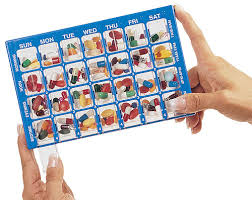
I bought a pill box organizer.  I was still able to take my pills at night, but to make sure that I remembered to take my pills in the morning, I always had my car keys sitting underneath the box.  There was no way that I would forget.  The system works when someone has all their mental faculties.

But what happens to individuals who have no one to care for them, and yet, must be trusted to remember to not only take their medications on time, and the correct dosages?  And follow all of the other instructions with each prescription?

My father’s situation was not just a typical example, but unfortunately all too common.  A combination of effects from two strokes he suffered during surgery to remove his lung cancer, complicated with cancer cells spreading to his brain, my father, not only completely independent his entire life, but also the caregiver for his wife permanently injured in a car accident, he was unable to monitor, and administer not just his pills, but his wife’s also.

We had hired caregivers, round the clock, but my father was notorious for sending them home.  His attitude was, his house, his rules.   I wanted to kick his pride right in the ass.  But even when the caregivers were there, they were not allowed to administer or even remind him, to take his pills because that was not part of their job description, officially or legally.

So, in the beginning, of this stage of my father’s life, I drove an hour, each direction, just to manage his medications, and my stepmother’s.

pill2pill2pill5

I had to arrange two different boxes, and then somehow, figure a way to make sure that my father did not mix the two up.  I had to take a sheet of paper for each of them, write their name on it, and the name of each drug, dose, and how many times a day on it.  Then fill each container for both.

Within a week, I got a call from my father, that he had extra pills left over from earlier in the day.  I made the drive up to his house, and found out this did not just happen once, but several times.  I had to come up with a different solution.  I could not afford to stay with my dad, nor could I make daily 2-hour trips every day.

pill3

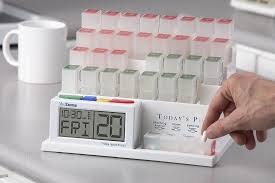
After research, and some assistance from FB family members, I found out about an alarm clock that had multiple settings, just for the purpose of taking medications.  I could program it, and it would go off, reminding the patient to take the medications at that time.  The only thing was, I was relying on my father to remember why the alarm would be going off.  But for now, it was the best solution yet to deal with the mileage that I was putting on my vehicle just for managing his medications.

pill4

Then I learned about something new, courtesy of my father’s pharmacist.  Most chains now have a delivery service.  The pharmacy gets the prescriptions, and prepacks them into the organizer, and then delivers them, normally at no extra cost. I want to make note, I was not trying to get out of the weekly chore or travel of managing my dad’s meds, but I knew as time went on, my father would need our efforts more as his condition got worse.  But for the time being, this system worked well, even my father who was not a big fan of trying something new, liked the idea of having the pills delivered already prepared.  Combined with the alarm settings, the system worked until the time came that my father approached his next level of care.

For those of you reading this post, if you are in this situation, I know how stressful, scary, and intimidating it can be.  I wanted you to see that there are options available to help you if you are thrown into this situation.

Post Navigation