
Starting Over
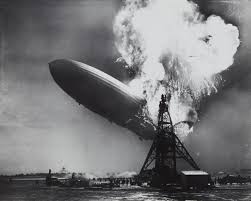
(photo of the Hindenburg disaster courtesy of Wikipedia)
This is probably the most confusing way for me to start a post, contrasting both the cover photo with the title. But I do not have permission to use the photo I would rather use. This photo does have some relevance though.
My first ever family doctor, was a kind and soft-spoken elderly gentleman. In fact, his office consisted of only he and his nurse. His office was in a cordoned area of his huge Victorian house. There was an exam room, which tripled in purpose as a lab, and pharmacy area. Outside the room was the waiting room, which was actually a hallway. At the end of the hallway, was the entrance to the house. I never saw any members of his family beyond that door, ever.
Sitting on the bench, waiting to be called in, looking straight ahead in front of me, on the wall, was a framed cancelled ticket, for that final and fatal flight of the Hindenburg. My doctor, an accomplished flyer himself, was supposed to be on that flight. I do not remember why he was not on it. But he would continue being my family doctor, practicing medicine fifty years. His obituary was filled with acomplishments, one after another, a major pillar in our small town.
Having to find another family doctor, I discovered that the term seemed to change to “family practice,” or general practitioner. I began to see a new doctor for a few years after which a new doctor had joined his practice. He would retire, turning the practice over to that other doctor, now only my third doctor, and who I thought would be my final family doctor, now referred to as a primary care doctor. She would be my only family doctor for the last four decades.
Now the title of this post may be starting to make sense, because here is the deal, she is retiring, and that means, that I will need to find a new doctor once again, something that I do not have a lot of experience in, and for good reason. But if I am being honest, I really did not expect to see this day, at least not on my end with the complicated health history that I have. But I digress.
For the first half of our patient-doctor relationship, I took it pretty easy on her. My Hodgkin’s Lymphoma treatments were over, and other than a seasonal allergy shot I received, I rarely if ever saw her. In fact, on one rare occasion, after tangling with some poison sumac, I showed up at her office, all in the office seemingly surprised to see me so unexpectedly, the comment was heard, “it has to be something bad if Paul is here like this.” I was covered in huge blisters, painful, due to the sumac exposure. And the doctor knew what needed to be done.
There was also another situation that came up in 2003, when I was injured on the job. As many employers are prone to do, though it was definitely a work-related injury, the insurance company handling my claim, denied my case. And it was during this process, the doctors I was forced to see, missed, or ignored the actual injury. But once I was denied my claim, I was allowed to seek medical attention outside of the workers compensation process, and guess what, my family doctor ordered whats workers comp would not, an MRI, and found out that I did indeed tear a cartilege in my wrist. And this was not just a regular tear. It was only the kind of tear that could come from a violent action, job related, such as jack-hammering, or playing hockey, a heavy torqueing of the wrist. My doctor knew me well enough, I did nothing in my personal life that could cause that severe an injury. Nine months later, I won my claim appeal. And it was because of my doctor’s persistence and knowledge.
The most consequencial diagnosis from my doctor would come in 2008, when I made just a random phone call to her, with an “annoying” complaint involving a chest tightness in the upper left part of my chest. It was a temporary thing, but it happened nearly all the time, and to my recollection had been happening for months, when I would begin to do anything physical. I was only forty-two years old, and though my insurance company objected to the test my doctor wanted performed, based on her assessment of my past cancer history she pushed forward ordering a nuclear stress test (admittedly I had no idea what was being sought), thirty-six hours after that test had been stopped (the technicians had seen something), I was on an operating table, having emergency heart surgery for what is nicknamed a “widow maker,” a major heart blockage which normally results in death, hence the nickname. The cardiologist even went as far as to say, “it wasn’t a question of if you were going to die, but when.” You want to talk about getting someone’s attention? I had this symptom for as long as four months that I could remember. And had it not been for my doctor, her knowledge of medicine and her patient, I would be dead. That is not an overstatement.
Over the next seventeen years, as it was determined that my heart issue was one of many compromised conditions related to late developing side effects from the treatments that put me in remission for Hodgkin’s Lymphoma thirty-five years ago, my doctor would play one of two key roles in my team of care providers for these issues and more. And it was her care, her refusal to give up if I complained of an issue, because she knew I did not reach out to her unless it was that uncomfortable, she and my long term cancer survivorship doctor (located at Memorial Sloan Kettering Cancer Center), made sure nothing was ignored.
She has been my family doctor for four decades, nearly forty years. I can honestly say I have had the best medical care, the best health advocate, a patient could ever hope for. And just as in the case of my first doctor, who adorned his office with personal effects such as the ticket for the Hindenburg, over the decades, my doctor kept her office and waiting rooms with that same family and personal feeling. I loved seeing photos and artwork from her children, watching them grow. And in one rare moment, I asked a question of her, a personal question, but important. I have never doubted her as a doctor, and never thought twice about why she became a doctor. But what was it that made her go the “extra” that it sometimes took with her patients, especially when it came to issues like I deal with, not covered in medical text books, or at least not until recently. Her answer brought me to tears, a personal impact that taught her to listen, truly listen to her patients, and most importantly, believe them. But it was definitely why she was the doctor that she is. Boy was I lucky to have her.
I am happy for her. She has definitely earned her retirement, though she is just a few years older than I am, I am not able to call that retirment age. But it brings me to an unfamiliar crossroad, one that I have not crossed in four decades, finding a new primary care doctor, my new health advocate. The bar has been set extremely high, combined with what I know and understand about my health, I will be expecting a lot from my next doctor.
So I am… starting over.
Among my fellow survivors, I have seen the struggle is real, finding even just one doctor who gets it, who understands “late side effects” from exposure to high doses or radiation and toxic chemotherapies not used in decades, not researched, and quite frankly, we were not expected to live long enough to even know what could develop. But we have lived long enough, and many of us have developed these issues.
I, we, need doctors that listen to their patients, taking the time for the “brick layer to explain to the engineer”, the patient to explain to the doctor, what the doctor may not know or be familiar with. And then we need that doctor to have the persistance to push for tests and answers, so that treatment, whether curative or maintainance, can be administered. And when pushback comes from the insurance companies or corporate, because our situations are not written in the books, we need to know that our doctor will fight back because without their voice, we will die.
Is there another doctor like my previous doctor out there? Perhaps. But if my fellow survivors are any indication, it will be more like searching for the proverbial “needle in a haystack,” than what should be an easy Google search locally.
I am happy for her. I am excited for her to be able to enjoy time with her family, a gift that she has given to me many times over.


 Paul's Heart