Over the last decade, I have been sharing the story of Stephanie, a fellow Hodgkin’s Lymphoma survivor. Though I knew of her a few years prior, I asked her to tell her story, in her own words. You can read her story in the link below:
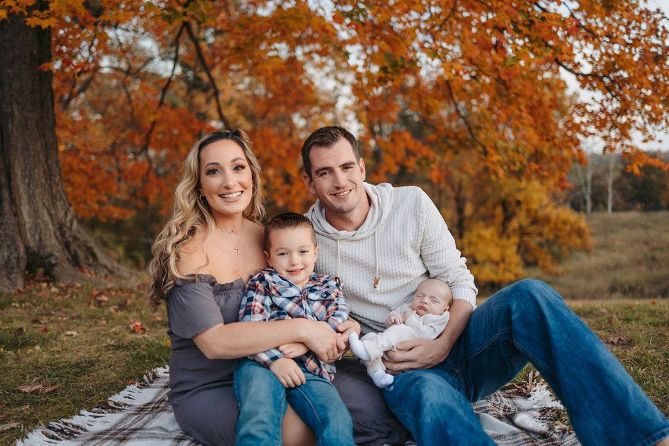
Stephanie got married the follow year. And then, Stephanie’s story took a major turn in one of the greatest stories possible for a cancer survivor. Stephanie became a mother to a baby boy. Fertility is one of the greatest challenges for a cancer survivor to face and she was truly blessed.
Stephanie not only passed her five year anniversary cancer free, but then also passed her next milestone, 10 years! I know that we had the conversation, dealing with the anxiety of getting passed that first year or two of remission, eventually getting to the major milestones.
Well, Stephanie has done it again, giving birth to her second son. Watching her younger son grow up, boy what a charismatic young man he will grow up to be, he will definitely be a great big brother.
Having dealt with my own children, not being there when I went through my battle with Hodgkin’s Lymphoma, it will be some time yet, before her sons realize the true inspiration that their mother gives to all of those who know her story. Stephanie will likely pass her 15th and eventually her 20th year in remission before her sons realize the warrior their mother is.
Not to forget about her husband, but part of the story that has not really been told about him, he has been there from the beginning, and through it all. He is also an inspiration to spouses and significant others who have to watch their loved ones endure the fight of their lives.
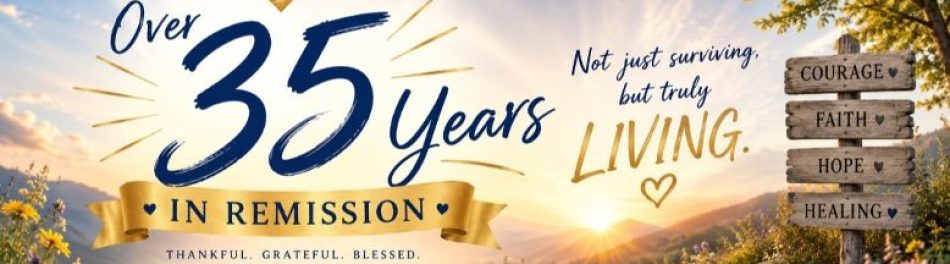
Stephanie, this month marks 35 years ago I was diagnosed. I could not be any happier for someone as I am for you. I told you a long time ago, I hoped for your fairy tale story, and here you are. You have a lot of major milestones to go, just as I keep striving for. You have such a wonderful family who provides such support and love. Your story is truly a miracle that continues to grow.
I am blessed to know you and your family. And thank you for letting me share your story which will definitely give so many, so much hope.
When we go to the dentist for a cavity to be filled, we pretty much know what to expect and how long it will take to get through, the Novacaine, the drilling, and the filling, and that’s it. When it is done, it is done. The cavity has been fixed.
A couple of days ago, I wrote about one of the top two issues concerning Hodgkin’s Lymphoma patients, in efforts to avoid going through traditional cancer treatments such as chemo and radiation. This post is going to be about the other situation. It is also another question that comes up at least once a month across my feeds.
“My mid way scan came back, and I am in remission. The doctor wants me to keep going with my treatments. But if it is gone, why do I need to keep going?” A reasonable question, and using the analogy of the dentist visit above, most do not have to return to the dentist for any more work on that particular cavity. So, if the cancer is gone, why does someone need more treatments?
Science and medicine, in its research of how to treat Hodgkin’s Lymphoma, determine the methods, the medicines, the dosages, and the durations of the treatment plans, that have the best chances to put a patient into remission. As I mentioned in the other post, Hodgkin’s Lymphoma has one of the higher remission rates for cancer. It is because of all that research, that an oncologist will put together a treatment plan that gives the best chance for remission.
So when the treatment works so good, and a patient ends up in remission sooner than anticipated, why isn’t that good enough? Because. The treatment plan is not just about getting into remission. It is about staying there. What will be the best chance for “long term” remission. Certainly reaching the short term goal of remission is huge! But a patient wants to stay there.
If you have ever dealt with a sinus infection, or anything else requiring antibiotics, chances are, you were given a regimen to take for up to ten days. What some will do, is as things look better, or start feeling better, will stop taking the antibiotic because it worked. And within a couple of days, the infection comes roaring back. If you are lucky, you can still take the same antibiotic, or possibly for a longer time, perhaps need a different medicine.
The treatment plan for Hodgkin’s Lymphoma is no different. When I began this journey 35 years ago this month, I had already completed radiation alone which my doctor had not recommended, and though I achieved remission, I developed new disease, meaning I would have to go through chemotherapy, something I desperately wanted to avoid. The plan was to go through a regimen six months of a cocktail called MOPP-ABV, a treatment rarely if ever used any more (thanks to medical advances). This was a brutal cocktail, highly toxic, but effective in treating Hodgkin’s. It had a lot of side effects, back then, these were not really managed, you just dealt with them.
Following the completion of my fourth cycle, my scans came back with the greatest news. I was in remission. And in my head, that is all I thought I was going to need. But not only did my oncologist want me to finish the other two treatments, for the total of six as planned, he actually told me that he would like me to consider two additional cycles, even calling them “preventative.” I thought to myself, he had to be out of his freaking mind!
As I got to the end of my sixth cycle, it was decision time. I had held my own during all six cycles, and my oncologist felt very strong about me going through two more cycles, which he felt would give me my best shot at not only remission, but long term remission, staying there. I heard him. All I had to do was have enough faith and trust, that it outweighed the Hell that I had gone through the previous six months. I decided to go though the additional, preventative chemotherapy which I finished thirty-three years ago.
Though I cannot say what would have happened had I only done the original six, or worse, stopped after the four that got me to remission, what cannot be argued, is I have lived four decades since my treatments ended. And that was no accident or luck. I trusted science. I trusted my doctor. And it paid off.
As I said, this situation comes up often on social media, and I always relate my story. Very rarely do I ever hear back if someone decided to stop after hearing remission, or if that had worked out for them, staying in remission, or relapsing, until two days ago. I was contacted off-post by someone commenting on my reply. He was one who “quit” after his four cycles and being told he was in remission. His Hodgkin’s came back. Unfortunately, he also was not able to go back to the treatment regimen from before, because that is not how you treat relapses. He ended up not only going through more difficult level chemotherapy, but also a stem cell transplant. As he put it, just because he “wanted to be done with it.” He did mention to me, that he often wondered if things would have been different had he continued on, and now uses his situation to encourage others, to stay the course, the full course.
When it comes to treating Hodgkin’s, or any cancer really, there is no room for “coulda, woulda, shoulda.” Follow through on what the experts, the doctors want and need to do, to put you into long term remission. I know treatments are not easy to endure, but believe me, they are a lot better than the treatments that I went through, and definitely better than what my predecessors went through. Best of all, side effects today are now mitigated for the most part, whereas we just had to put up with them.
“Has anyone gone through, or known anyone who has gone through, ‘natural’ treatments and beaten Hodgkin’s Lymphoma?” Across the many social media pages that I follow, this question comes up at least once a month. It is an innocent enough and understandable question to ask, and is likely asked to the patient’s oncologist directly.
But stereotypes, stories, and misinformation, only add to the desire to find something easier to tolerate or be treated with than “what we’ve heard.”
The answer, simply, anecdotally, and scientifically, is “NO.” Before I explain, I want to preface my position. I support the use of anything supplemental or “alternative,” if approved by the treating oncologist. But because of possible interactions with the treatments, strict adherence to the advice of the oncologist is necessary to produce the best chance at long term remission.
I also need to state, I have several friends who study Chinese medicine and other holistic means of treatments for various maladies. Some of the things they have come up with, do provide benefits for their patients. The problem, through no fault of their own, there is no large amount of data to support their efforts as those results from NIH backed studies. That is not to say they do not work. The numbers just are not there to support the risk.
I was diagnosed with Hodgkin’s Lymphoma 35 years ago this month (called Hodgkin’s Disease back then). Over these four decades of my survival, Hodgkin’s has been celebrated for having one of the higher remission rates for any cancer, ranging between 86% to 92%, but with scientifically proven treatments. Chemotherapy, radiation, or both, are the best options for remission of Hodgkin’s Lymphoma. End of discussion.
The question came across my feed yesterday, but also had another qualification, the patient in question was stage 4, the worst stage for any cancer. But across all of the pages that I participate in, I have never heard one person try to be treated 100% “natural” or “alternative” for Hodgkin’s Lymphoma, or even survive. I am not saying that it cannot happen. But as I have said, I have been at this a long time, and I know of thousands of survivors around the world over all of these years. Not one has done it by “natural” or “alternative” treatments alone.
Now while 86%-92% still means that 8%-14% do not survive even from standard treatments, it is more than likely there were other circumstances complicating the treatments.
So what happens if someone decides to ignore a likely 99.9% advice response to take the oncologist’s opinion to proceed with chemo, radiation, or both? One factor that has not been discussed yet in this post, is “time.” It may be cliche, but when it comes to treating any cancer, especially Hodgkin’s, “timing is everything.”
With the exception of yours truly, and the delays I caused by my denial (you can read about it in my book “Paul’s Heart – Life As A Dad And A 35-Year Cancer Survivor”, hopefully being published soon), doctors do not waste any time getting diagnosed, staged, and beginning treatments. Doctors know the importance of getting the treatments started as soon as possible.
So, let’s say, this person will be the first person I am aware of to ignore the unanimous advice to go the standard treatment method, and go “natural” or “alternative.” What follow ups and protocols are being used to determine any progress because likely, if you are not going through standard treatments, insurance will not pay for the monitoring that is typically done? I will play Devil’s advocate, and say that all monitoring will be the same as with standard treatments, just because. But the one factor that cannot be guessed upon, is will it work. And unless there is a major study somewhere, and I am not talking about the conspiracy and false information sites that are out there, there is not likely to be success. How much time will have been wasted, trying a futile “treatment?” And now, how much further or worse has the cancer grown? Likely, a lot.
Look, if you happen to be in the 8%-14% that do not respond to the treatments and you want to try any other means possible, then of course you go for it. But when the numbers are that overwhelming, you need to go with what has been proven and works.
No, chemotherapy and radiation are not easy to go through. I have no problem stating this fact, my treatments are no longer used today because medicine found that they could still have the great results of remission, by using less than what I was treated with. And there are survivors in remission longer than me, who went through worse treatment than I did. But patients have something today that my fellow long term survivors and I did not have back then, mitigation for the side effects to make the treatments more tolerable, and social media for support.
Of course, then the next situation that comes up, being told you are in remission and still have more treatments to go. What do you do? But that is for the next post.
American Cancer On-Line Resources
Internet support from peers, caregivers, survivors, and professionals in several hundred types of cancers and related issues
American Cancer On-Line Resources
Internet support from peers, caregivers, survivors, and professionals in several hundred types of cancers and related issues