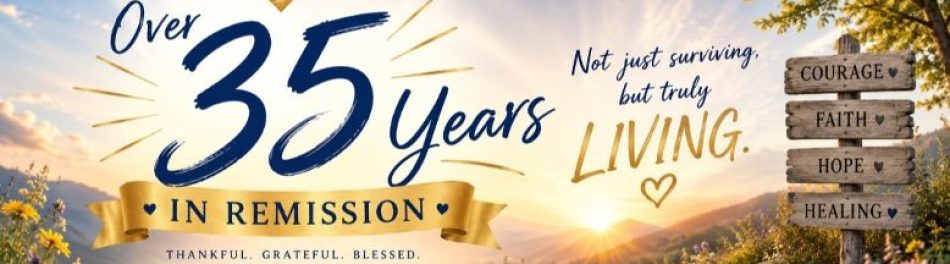
As I have written on my Facebook page, I recently lost someone very close to me. Out of respect to the family’s privacy, I am not including any personal details of their loss and grieving. This post is going to be more about consolation, understanding, and healing, for anyone reading this, but especially myself. In my role as patient, caregiver, and the role of cancer counselor for as long as I have been, one year less than my remission mark to be exact, I have met hundreds of profession of cancer care, hundreds of patients and their families, and have exchanged thousands of emails, texts, and messages all related to cancer.
When I was diagnosed back in 1988, I became the first person I personally knew to be diagnosed with cancer. According to statistics, I know that I was not the only person within my family or social/professional circles to have to battle with cancer. But then again, I was only 23 years old, still a kid, and most likely “protected from cancer” by my family, which I now know today, after having given my family history repeatedly, cancer was much more prevalent than what I originally knew it was. I did not have the internet, email, support groups, and I faced my treatments alone, in spite of being engaged to be married (another post, some other time).
The first hurdle I had to climb, was dealing with an oncologist (cancer doctor). I felt confident that I had chosen an oncologist who had treated someone very close to me, my grandmother. He cured her of her breast cancer, so he had to be good, right? He was an asshole. I walked into his exam room. He was cold, stoic, and definitely not comforting.
What the Hell!!! I was scared to death because I was looking at death and what I needed first and foremost was some comforting, some reassurance, any semblance of a heartbeat that he cared. Already I was put off, and prepared to let my Hodgkin’s Lymphoma take me. But were it not for a special woman, Ilona (pronounce Elona), I would have lost for sure. Ilona was a social worker at the hospital for cancer patients. She had a partner John who was a giant of a man, towering over me in height, but oh so gentle. Between the two of them, they not only kept my hope alive for a cure, but also helped me to meet my needs to get me through that battle.
So now, I want to get to the meat of this post. I want to give some insight to some very special people. Just as Ilona and John did for me, I would like to do for you.
The Oncologist
The most unselfish of all, the oncology doctor knew right from the day he/she graduated, all patients would not be able to be cured. Their hopes of course were to cure every patient that they saw, and they would do everything in their power to make sure the patient had every chance. But they also had to be able to prepare a patient, that unfortunately their cancer would not be curable, meaning death. So just as I found out, my oncologist had every reason to have the “bedside” manner that he had. Though he never spoke of them, I know that he had to have lost many patients, a heavy burden to carry through life.
And it is not just oncologists that face this, but really, think about it, you go to a doctor to make yourself well, and that doctor takes an oath to do just that. What we may see as a personality quirk, may actually be a defense mechanism to deal with the sadness that has to come from their profession. And I will tell you, I have seen doctors shed tears over the many years. The hardest part of their job is not just the actual performance, but the emotions that they must maintain under control, or risk their own sanity and confidence.
Nurses and Technicians
While the doctors make all the difficult decisions, the ones who get elbow deep in the care of a cancer patient, are the nurses and the technicians. These special people are the ones who spend the time with us, listening to our fears, listening to our complaints about side effects, watching us struggle to fight a major life battle.
They spend the most time with the cancer patient, and have the hardest task of keeping their emotions in check. After all, during the entire cancer period, a patient spends more time with nurses and techs than they probably spend with anyone else. And let me assure you, they do care, A LOT! Upon my 20th anniversary in remission, I visited both my oncology nurse (who administered my chemo) and my radiation tech, both who were still involved in cancer treatment in some form or another. I had not seen them since I walked out of the office, declared “in remission”. To them, I was just going to be another statistic, “will he make it to the five year mark?” or “will he come back with recurrence?” or worse. To both of their surprises, I gave them a huge hug, bigger than I could ever imagine, to let them know, “thank you, for the twenty years I would not have had if it were not for” them. We shed a lot of tears, as they were so happy to hear a success story, that happened because of them. But Brenda and Noreen were the benefactors of a happy ending.
There are those nurses and technicians who are not, and chances are, Brenda and Noreen also had sad endings as well. Nothing can be more heartbreaking for someone who has gone through cancer, and understands what any form of caregiver goes through, than to watch a nurse or tech have to deal with a terminally ill patient. No, they did not diagnose the patient, but again, this caregiver is the one who takes care of someone who will not survive. And one of those nurses or techs, will be the final caregiver. I do not envy their position at all.
The Social Worker/Counselor/Therapist
A patient will most likely only seek out help for their emotions only when they need help, in other words, when things are bad. So it is likely that the person we lean on to help guide us through our torrent of emotions is not going to hear too many happy things from us. My counselor assisted me with issues such as dealing with bedside manners of doctors to somehow bargaining with them, as if they had some way of getting me through my battle with cancer. Yet each patient they meet, they must maintain their composure, control their emotions, and accept that there will never be an end to the number of people coming to them for help. Their final appointments with each patient will have different endings, some happy, and too many sad. But just as every other caregiver involved, they must do their best for their own sanity to control their emotional involvement.
Out of all the caregivers I will list in this post, this is the position that I can relate to the most as I have spent nearly my whole survivorship reaching out and helping patients and families deal with emotional struggles of cancer.
The Caregiver
The actual “caregiver” I recognize not as the doctor, nurse, tech, therapist, but anyone who I consider to be anyone who stands by another offering any form of support on a fairly regular basis. This person might drive the patient to treatment appointments. A caregiver might also have to make decisions on the behalf of the patient. Some may simply offer an opportunity to just have some company, so the patient does not feel alone. But a caregiver is just that, a person who gives care, a person who cares. The caregiver could be a family member, friend, neighbor, even a fellow patient sitting next to another just offering words of comfort and encouragement.
Special People
I know I will probably have left some roles out, but these are the roles that I have had twenty five years of experiences with. And they have all played a role in my life as well, all of equal importance. We may not all have the opportunity to get to know our caregivers intimately but one thing I am certain, they do care. Otherwise no one would ever put themselves into a position of emotional loss on a near daily basis.
I made it a point of my twentieth year in remission for my Hodgkin’s, to seek out those that played major roles in my battle with cancer. Because I remember only one thing on my final day, just walking out of that office, and never looking back. I never said “thank you” to those that cared for me. I found my radiation tech Noreen who was still working in radiation therapy, but in a different capacity because technology had made her job so much better and easier. I found my oncology nurse, Brenda, who for eight months injected some of the most harsh and poisonous chemicals into my veins but with the care and comfort had I been one of her own sons. She too was still involved in cancer care, but now as a volunteer, assisting patients. Finally, I sought out Ilona, but who I did find was John, her partner. Sadly, Ilona had passed away just a few years before, in the saddest of ironies, cancer. She spent so much of her life helping others deal with cancer, it is cruel that cancer be the thing to take her life away from her. John and I spoke about her, and the things she had done for me, and for others. I also spent quite a bit of time with Brenda and Noreen to share with them my gratitude for having such a long life, something I would not have had, had it not been for their care. I wanted to let them know and see a happy ending, their hard work and commitment does save lives.
Thank you.