Paul's Heart

Life As A Dad, And A Survivor

Archive for the category “Bullying”

A Day To Be Recognized, Not Celebrated


Publisher’s note – this particular post is a general post, not reflective of any particular situation that I may or may not be dealing with personally.  Furthermore, this post is being written gender neutral, as it is a topic that affects both genders.

Just as I am an advocate for cancer survivors and patients, universal health care, and adoption, I am also an advocate against something called “Parental Alienation.”  Today is the annual recognition of Parental Alienation.
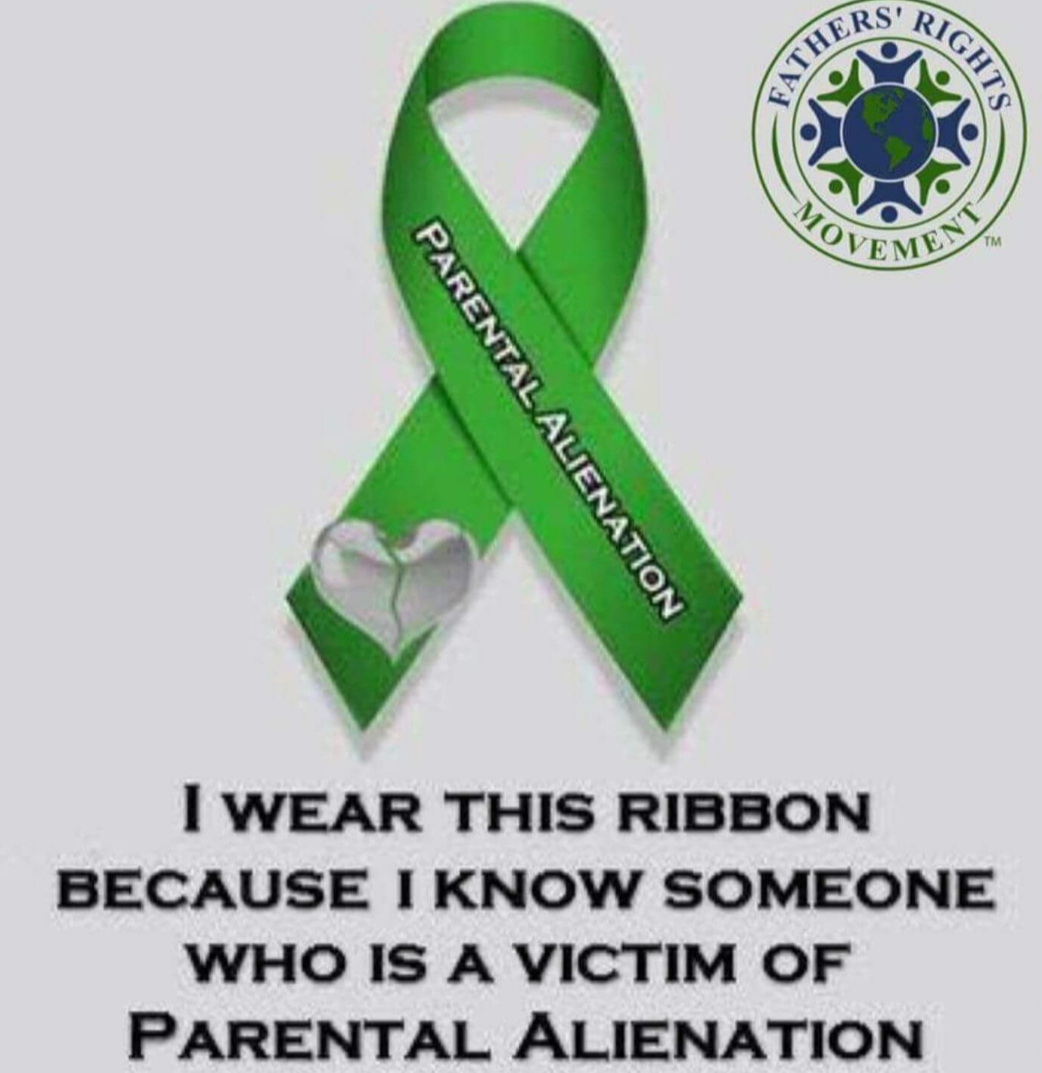
To be clear, this is an issue that affects both mothers and fathers, but also extended family members such as grandparents.  But what exactly is Parental Alienation?  First, it should not be confused with the term “Parental Alienation Syndrome” which is completely different, though it is considered the next level from Parental Alienation.  According to Psychology Today, Parental Alienation is the “psychological manipulation of the children against a targeted parent.”  This is not necessarily a custodial parent vs. non-custodial either.  The action of Parental Alienation is “psychological manipulation” which simply means causing the child to think differently about either parent, usually in a negative sense.  Simply put, talking mean about the other parent so that the child wants nothing to do with the targeted parent.  This type of emotional abuse actually can occur with extended family members as targets as well, such as grandparents, aunts and uncles, siblings.  The individual actually manipulating the child will have one or more targets.

Parental Alienation Syndrome is actually when the manipulation has been completed, and the child, who under normal circumstances would unconditionally love both parents, now tries at all costs, to avoid the targeted parent, even to a level of hatred themselves comparable to the offending parent.

What would cause one parent to go after another parent, and use the child in this manner?  Clearly it is to serve as some sort of revenge, either for a system that the antagonist perceives did not give the desired result, or even if the desired result was reached, the decision was not enough.  The hatred of the target by the other parent, is more than the love the parent has for the child.  That does not mean that the offending parent does not love their child, the offending parent just hates the targeted parent more.

No one gets married with the ultimate goal of getting divorced, well unless you get involved with a pre-nuptial agreement, then I believe you pretty much do not have confidence in your marriage lasting.  I do not have the secret formula to what makes a marriage last “til death” parts the spouses, or when the marriage simply falls apart.  And the reasons that marriages do fall apart are numerous, from issues such as money problems, to even getting married under false pretenses.  But at no point, should this EVER affect the children.

And that is exactly how Parental Alienation works, by drawing the children into the failed marriage.  Only the two spouses are the ones married and divorced, not the children.  The children will keep the same parents as they had when they were married.  However, when one parent is driven to cause as much hurt as possible, children do get used as a weapon to hurt the targeted parent.  Make no mistake, this is emotional abuse, child abuse.  No child, under normal circumstances will hate their parents, unless they are convinced to, and this is Parental Alienation.  When the targeted parent is no longer able to be involved with the child, now by the child’s choice, this is Parental Alienation Syndrome.  In the short run, what this means to the offending parent, “good, I got what  I wanted, my child hates (the other parent) and I know that parent is hurting now because of that.  I have now hurt the targeted parent as much as they have hurt me.”    Think about it, the parent seeks revenge, uses the child to do so, and succeeds.  Sure, the targeted parent has now “paid” for their transgression and nerve for filing for divorce.  But now you have a child, or children, who will have not only parental issues, trust issues, and relationship issues in their future lives.

The offending parent does not take the harm to the child into consideration.  All that matters is what occurs to the targeted parent at all costs.  But just as any traumatic event in a child’s life, whether it be abuse, loss (death) of a parent, auto accident or fire, the child who grows up resenting their targeted parent faces a couple of major issues.  There are all kinds of shocking statistics that point to risky behaviors of children of alienated parents, but one thing is certain, it is not something the child will ever forget.  And just as the offending parent will feel victorious, vindicated, eventually the child will discover the manipulation, and the role that they themselves played, or were played.  And then a whole new set of issues will develop.

So how does a child get manipulated against their other parent?  Involving the child in discussions pertaining to the divorce process from court orders to the issues of the divorce.  Lies.  Talking negatively about the targeted parent.  Wrangling support from outsiders (family and friends) to “verify” the things said about the targeted parent.  Really, anything that causes the unnatural act of turning a child against their parent.  That is manipulation.

And while “parent” is in the term, the act is actually involving the child, there are things done to add to the hurt caused to the targeted parent which is meant to reduce any fight the targeted parent may put up.  Keeping the targeted parent from communicating or seeing the child, not sharing simple things like photos and report cards, not informing the targeted parents of medical issues that arise are all acts of parental alienation, because the purpose is there, to alienate the child from the targeted parent, to erase the parent from the child’s life.

And those outsiders that actively participate or encourage the unnatural act of turning a child against their parent, may actually be considered worse because they are not as emotionally involved as the offending parent, then presumably should have a clearer head, to see the hurt being caused to the child.  Again, do you hate the targeted parent more than you love the child?  Then you are guilty of Parental Alienation.

I am an adult child of divorce.  I grew up hearing awful things about my parent by outsiders.  My parent chose to not deal with all the hatred and manipulation by the others.  And so, as much as I loved that parent, I grew to hate that parent.  And as visits diminished, the hatred grew because clearly, everyone else was right.  And the absence of my parent proved it.  But a tragedy early in my adulthood would open a door that had been slammed shut by me.  Now, I am not the kind of person to hold a grudge, even in this extreme case.  I never did ask either of my parents why they got divorced, and with my father no longer living, I do not want to know, being able to hear only one side at this point.  I have forgiven, moved on, but have not forgotten.

I love my daughters.  I did divorce from their mother, but I did not divorce their mother.  I divorced from my wife.  And that is why it has been so important to me to not allow to happen to my daughters what happened with me, because I know how it feels.  Because our daughters will outlive both of their parents, and most likely have a family of their own, their mother and I will need  to co-exist as mother and father.  There are children that are not as fortunate.  Those children will never get the chance to stop the hurt, never get the chance to forgive.  And that is what today is all about.

My Daughters’ 1st Amendment Rights


The 1st Amendment to our constitution reads as follows:  “Congress shall make no law respecting an establishment of religion, or prohibiting the free exercise thereof; or abridging the freedom of speech, or of the press; or the right of the people peaceably to assemble, and to petition the Government for a redress of grievances.”  These things are guaranteed, freedom of speech, freedom to peaceably protest, freedom of press, freedom of religion, and the freedom to complain to the government.  This applies to ALL United States citizens.  I repeat, this applies to ALL US citizens.  While there are limitations to the 1st Amendment (not being allowed to yell “fire” in a crowded theatre, hate speech, etc.), there are no limits (including age) as to US citizenship.

Children born in the US or on US properties, are born US citizens.  Children adopted internationally, as were my daughters, who are naturalized through processes at a US embassy of the country adopted from, or go through processes of citizenship back on US soil, ARE ALL US citizens, no matter if 6 months of age, 12 years old, or 40 years old.  But I want to stick with the fact, that children are considered “citizens”, which means that they are also guaranteed their 1st Amendment rights.

There is no age limit to be able to speak freely.  Yes, they must be 18 to vote.  Children in most states must be at 16 years old to drive a car.  Adults must be 21 to drink alcohol and children must only be 18 to smoke tobacco products.  Gun ownership has its own age rules and it is only getting more confusing.  But to stay on track on this post, there is no age limit for the 1st Amendment.

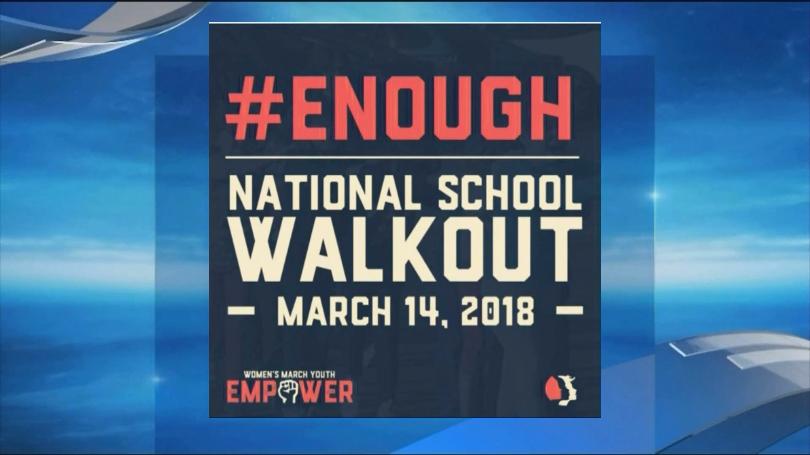
Tomorrow, March 14th, is the first of three planned “protests” to bring attention to something that has existed for decades, but brought to national attention twenty years ago as a boiling point that should never have been reached, violence in schools that led to the massacre at Columbine High School in Colorado.

While many people want to point fingers and blame at weapons of choice, the thing that cannot get lost, while the spotlight is on the most current event, is that for twenty years, our country, our government, and even we as citizens, have done nothing to reverse the direction that violence in schools have taken.  Even the slaughter of kindergartners and 1st graders at Sandy Hook was not enough to get more of a usual response of “thoughts and prayers”, talk about it, forget about it, repeat.

But for some reason, there is a different feeling coming from the senseless tragedy that occurred a month ago in Parkland, Florida.  As usual, the adults are doing the same thing as always, “thoughts and prayers”, blame, our government reps talk about it, and as usual, it appears we are once again at the same point as always, ready to move on, to wait for the next massacre.

What does not help, is that our President took to two televised opportunities, one, meeting with those affected by violence in schools, and the other in a meeting of senators to challenge them to come up with a solution or solutions that he would approve, acknowledging how dire things have become.  He promised families something would be done.  The president called out representatives who could be afraid or intimidated by the National Rifle Association.  It seemed like things were finally going to be going in the common sense direction.  Strict and enforced background checks, increased age limits for long guns to match handguns, banning bump stocks.  We all saw the intent and heard the hope from the president.

But he lied.  Either he had no intention all along, or after meeting with the NRA, he “changed” his own mind, which is kind of ironic considering he had just called out several senators on television for not standing up to the NRA.

The bottom line, here is where we are at following the tragedy in Florida, back at the beginning of the next cycle, waiting for the next act of school violence.  And I am purposely writing it that way, violence.  Because I do not care what weapon is used.  We as adults are letting our children down while we worry about ourselves and what we want.  In the mean time, more children have died in school violence.

The definition of insanity is doing the same thing, over and over and over and over and over, and expecting a different result.

I was bullied all throughout elementary and junior high school so I understand violence in school.  I graduated in 1983, probably one of the last years that school violence was not put in the national spotlight.  Fights and other acts of violence were not dealt with using weapons for the most part.  But a few years later, my high school had metal detectors installed after weapons had been discovered being brought to school.  Now, many schools not only have metal detectors, but Student Resource Officers or policemen.  Is it really not that obvious, that violence had increased to the point that armed police officers now patrol our schools, instead of finding a way to deal with the violence itself before it gets to the point of an actual event?  At this point, without addressing dealing with the violence, dealing with the weapons of choice is a moot point.  And while we as adults continue to spin our wheels, protecting our own interests, our youngest citizens tomorrow will exercise their right to speak an peaceably protest.

For 17 minutes tomorrow, March 14th, many students, none forced to do so, will exit their classrooms, and assemble outside, to remember the 17 victims in the Florida school massacre a month ago.  Yes, it will get a lot of media attention.  And that is the point.  The adults, our government have already moved on.  Parkland is now history.  But it is not history, and tomorrow children will remind us that we have not done enough, and the children have not forgotten.

Seriously, as a reader of this post, are you one of the lucky ones who knows what it is like to have gone to school without fear of being shot or stabbed?  Or are you young enough to never know that feeling of being safe?  That is how today’s children go to school.  They have no idea what it is like to go to school without a legitimate fear of being killed.

The school district where my children attend school, is taking the approach of providing a safe, structured, and controlled opportunity for its students to participate in the national walkout tomorrow.  The district has dedicated space to protest, time to do so, and without fear of punishment for leaving class time.  The district is not pushing citizens for exercising their free speech.

The same cannot be said for some other districts such Lewisburg, PA that will serve students with a detention (fortunately that will not be a permanent mark on their record, and the district can still be perceived as being tough on dissidents while standing on the 1st amendment rights of the students), or several districts  in states like Texas who will actually serve suspensions to students who walk out for this protest.  If there is one good response to this particular action, colleges have actually said that participation in the National Walkout tomorrow, and if suspended, most colleges will not hold that discipline against the student applicants.

And of course, outside of the schools, and away from the government, there are the rest of us adults.  And I believe that we all want our children safe.  And  I also believe that most of us adults believe in the rights of the students to assemble tomorrow.  And for those that do not, do so for any possible reasons.  Those that still believe in the “children should be seen not heard” (in other words, have no voice).  There will be those who worry that the fire will continue to be stoked with more fuel so that we continue to talk about violence in the schools, and for some, that means a fear of gun control which I have intentionally avoided talking about in this post.  Of course, the reality, especially for high school seniors, currently 17 or 18 years of age, are going to be voters.  And that is a lot of new voters.  Voters who are now paying attention to the inaction of our government.  Voters who see the money lined in the pockets of our politicians.  Voters who see not the cause of the increased violence in our schools, but definitely see leaders who should be doing just that, lead, and find a solution so that while we protect airports, sports arenas, court houses, we protect our schools with the same efforts.  It is ridiculous that we worry about a bottle of water, or a sandwich going through TSA at an airport, but cannot provide that level of concern when it comes to our children in school.

So, I have encouraged both of my daughters to participate tomorrow.  Realistically, a solution will not happen by the next day, week, or even months later.  But children are willing to do what adults are not.

#ENOUGH

What Exactly Is A Deadbeat? A PSA For Those Who Do Not Really Know The Answer


From a grammar standpoint, I am the last person who will ever critique anything, whether it be spelling, detail, or any particular aspect meant to have an impact on something.  But I do have a peeve that I do believe is only fair.  That is, when people use words that they either do not know the true meaning, or use them in an erroneous manner, all for the purpose of making them appear more intelligent than they really are.

One particular word that gets treated this way, “deadbeat”.  So, as I normally try to help and support those with cancer related issues, adoption related issues, disability issues, and so on, I want to help straighten out the confusion over the actual word, “deadbeat.”

“Deadbeat” is commonly thrown around in reference to divorce circumstances, especially when it comes to support issues.  But the fact is, the word is definitely inappropriately used.

DEADBEAT is someone who willfully and persistently fails to perform an expected task.  Some websites elaborate and perhaps dilute the actual meaning by referring to “deadbeat” as lazy, lacking ambition.  The term is meant to criticize or insult by what the accuser making the statement thinks that they know about the particular situation.  The key to defining what a “deadbeat” is, is it willful behavior?

First, let us set a couple of ground rules.  “Deadbeat” is a gender neutral term.  It can apply to both male and female.  Next, being a “deadbeat” is not just limited to a monetary commitment, but rather any kind of act that is committed willfully and intentionally.  A person can be a “deadbeat” in reference to custody by willfully violating a court order of custody.  So, from this point on, I will only refer to the general neutral terms, spouse or parent, as both are capable of this moniker.

Next, we have to clarify situations that are all too generalized, resulting in the erroneous use of the term “deadbeat.”  For the purpose of this post, I will refer to the act of paying child support, since that is when the term is most often used.  Is every parent who is either unable to pay support or not in full, a “deadbeat?”  Absolutely not.  And again, you have to look at every situation individually, if it really is any of your business.

A parent could have lost their job.  An incorrect support award may have been ordered, pending an appeal.  A major health crisis may have occurred.  Even a simple technical error in computer systems failing to register payments.  It all boils down to, “was it intentional?”

Perhaps the easiest way to determine if it was on purpose or not, again, if it is any of your business to figure out, is, what kind of parent is the one creating the lack of fulfilling the obligation?

There are parents out there who WILLFULLY ignore their children.  They do not even want to acknowledge that they have children, who do not even see or wish to see their children.  A parent in this type of situation may just be more likely to be called a “deadbeat” because there is no desire for a physical relationship with the child, hence, why should the child support be necessary.  To actually label this type of a parent as a “deadbeat,” definitely does not do justice because the hurt goes beyond just not paying the support, but clearly causes harm to the child.

Then there is the parent who WILLFULLY withholds a child from the other parent, often times over failure to fulfill their support obligations.  But again, with the key to being a “deadbeat” being a willful act, who is truly the “deadbeat” in this situation?

And finally, there is the parent who does all that can be done legally, in spite of set backs, in spite of health, in spite of sabotage by others, and other factors that are no fault of the offending parent, who keep in communication with their child(or children), who do what they are able to visit with their children, again in spite of the interference and harassment by others.  A parent who never objects to paying their support obligation or amount, even if unable to in whole or partially.  Is this type of parent “deadbeat?”  Hardly.

Those that willfully and intentionally refuse to pay, usually find means when coerced by the legal system.  Threats of sanctions such as license suspensions, passport seizures, and even jail are usually enough of a deterrent to convince the offender to pay, and pay right away.  In other words, they had the means.  It was an intentional act not to do so.  Yes, that is the “deadbeat.”

But it is the parent, who no fault of their own, may be unable to pay the amount in full or even partially.  And it only gets worse from there.  Again, remedies are in place to enforce the support, but as the saying goes, “you cannot get blood from a stone.”  So what good do remedies do, if the means are not there?  Sanctions, without the ability to correct, means that the situation can only be expected to get worse.  And it does not take long until the results are insurmountable.  How does a parent earn money, when a license is suspended and cannot drive to work?  How does a parent earn money, when incarcerated for arrears?  How does a parent keep or get employment with an incarceration to earn money to pay their obligation?  They do not.  And the cycle will only keep repeating.  Exactly, where does the “willful” part come in, that this type of parent should be called a “deadbeat?”  It does not.

Let us take the last paragraph one step further.  It is one thing with the above paragraph for the situation of falling into arrears to just happen naturally.  But when the situation is accelerated and escalated due to  the vindictive and vengeful behavior of a scorned spouse, exactly, where does the “willful” part come in on the part of the person obligated to the support?  It seems to me, the only “willful” part is coming from the spouse due to collect the support.

I have many friends, all in different situations and positions of this discussion.  We are all respectful of the individual situation.  We have a parent who does not want anything to do with their child.  There is a parent who wants to spend more time with their child, and the other parent refuses, worst of all, for no justifiable reason other than “just because I said so.”  And there are many of us who do everything within our power, within our ability, to remain as strong a part and influence in our children’s lives.

As an adult child of divorce myself, being divorced with children as an adult is not any easier.  But one advantage that I do have, is that I know what I do not want to happen with my children emotionally.  I know the importance of having both parents remain in their childrens’ lives.  I personally know the difference of what one missed phone call can make, and the affirmation of each visit made.

I hope this helps to clear things up.

Post Navigation