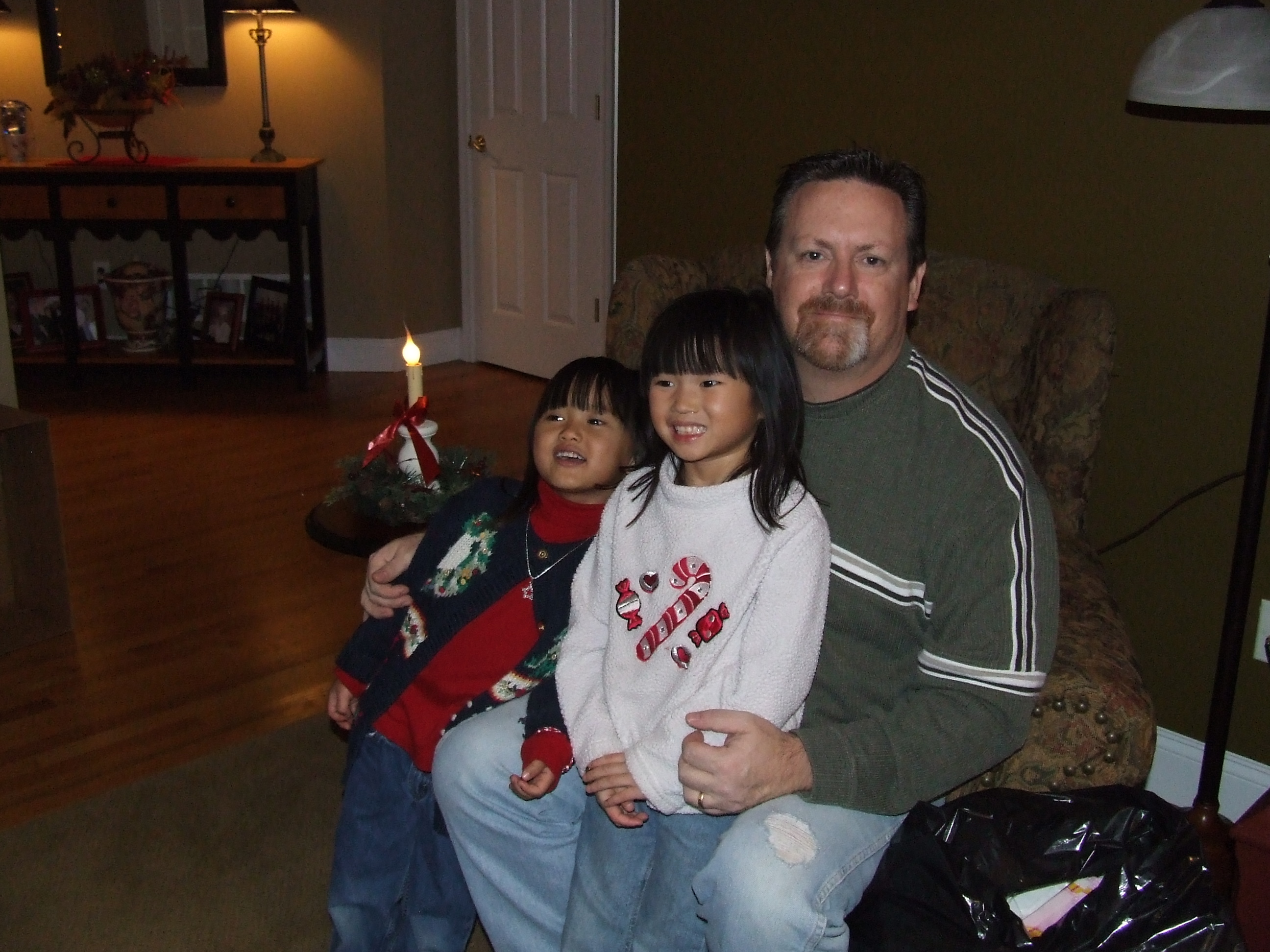
With the exception of two short periods of time, nearly all activities with my daughters have been with all of us. There were some individual things at school or with friends, but for the most part, it has always been the three of us. The first period that I referenced, my older daughter, got all of the focus as I was waiting on the arrival of her sister, a process that took nearly two years.
But for the next sixteen years, it was the three of us. With her older sister away at college, and making her own plans, this year my younger daughter, for good or bad, has been able to receive probably 90% of the focus from me. All the years between, I feel I did a good job, sharing “me” and my attention equally between both, making sure that both of my daughters needs were met, and wants to could be taken care of whenever possible.
With my older daughter, all of my fatherhood decisions were “on the job” training. With my younger daughter, decisions came out of experience, things I learned from the first time around. It is safe to say, that I am certain that both learned everything that I felt was important to succeed as adults. My younger daughter has benefited from the experiences of her older sister, with any adjustments that I needed to make along the way.
My older daughter, well on her way to establishing herself is preparing for her next year in college. My younger daughter is preparing for her first year of college. It is hard to believe that nineteen years of fatherhood has blown by so quickly, as I focus on the decisions that need to be made for tomorrow, with the images from yesterday, that I hold close to my heart.
My daughters and I were having a conversation about their late uncle, who passed away from ALS (Lou Gehrig’s Disease). It has been nearly eleven years, and I still miss him. As my older daughter understands and reminded me, “I know he was like a brother to you, not just a brother-in-law.”
Through Mike’s battle, he taught me many things. But one thing stood out, probably having the biggest impact on my life. Admittedly, I still have a hard time executing that lesson.
At the time of his diagnosis, I had been struggling with the diagnosis of all the different late side effects being caused by my treatments for Hodgkin’s Lymphoma. I was dealing with a swallowing issue, unbeknownst to me, caused by radiation treatments for Hodgkin’s Lymphoma. The mechanics of the whole thing is a separate post by itself. But the bottom line is that I was slowly losing the ability to swallow, to the point I could not even get water down. I often found myself choking unable to get anything down my throat.
A few months before things got really bad for me, my brother-in-law, had begun developing his own unique symptoms, his speech slurring. Many of us would joke that he had one too many “Jack and Cokes.” He was at a loss for what was happening, because it definitely was not caused by any drinking. Testing would reveal and confirm, Mike had ALS. The disease is discovered from either muscles twitching or getting weak, swallowing, or even, slurred speech.
As Mike’s speech issue and eventual swallowing progressed, he soon found the need to rely on artificial intelligence to assist his speech. At the dinner table, we soon discovered a problem, in stereo if you will. We both were having serious issues swallowing our food, caused by different reasons.
But if there is one flaw in my personality that I know that I am aware of, it is perspective. It can work for me, or it can work against me. No matter what I am dealing with, I will always believe someone is dealing with something worse than what I am dealing with. And with my brother-in-law, that was definitely the case. As I sat across the dinner table from him, me not wanting to eat for fear that I would be the one to actually choke at the table, Mike struggling to get anything down himself, I blurted out, “so Mike, which one of us is going down first?” After a few awkward chuckles, I continued, “I’m sorry Mike. I have no room to complain about this. What you are going through is far worse.”
Mike replied, “but that does not make what you are going through any less real, or severe. The only difference is each of our prognosis. That does not make your pain any less real, or relevant. Go easy on yourself.”
I would like to think it was at that moment, that after twenty-two years, I finally learned to do just that, but after thirty-three years, I still have not. Mike’s message is one that I share with any of my fellow survivors who have a moment, when one of their late term issues just happens to be overwhelming them, and they feel in the grand scheme of things, compared to other of our survivors, they may just have it better and therefore should discard their feelings. No, they should not. The feelings that they have are real, and have a huge emotional impact on their survival.
Look, during these three decades of survival, I have said goodbye to so many fellow long term survivors. A shorter lifespan, due to all the trauma that my body has been put through is expected by many of us, but by no means dwelt on. But that is a reality. Emotionally, survivorship takes its biggest toll, because that is when we are most likely not to give ourselves the slack when we need it most, especially if there is another survivor going through something we perceive as more serious. As Mike said, “it does not make it any less real, and deserves attention if necessary.”
A few weeks ago, I happened to crack two of my ribs, just sitting in my chair. I bent over to pick something off of the floor. I heard it, and worse, I felt it. And though I am known for having a fairly high pain threshold, because others have it worse than me, this is one time pain actually has my attention. This injury is likely related to osteopenia that I developed as a long term side effect from my treatments. But where is my focus? On my other fellow survivors. I consider this a minor inconvenience as I will be restricted from certain activities as my ribs heal. Though as I worry about my other survivors and their health issues, that does not make my injury any less real.
An interesting story came across my newsfeed this week. It was about a step-mother, who mentioned that her husband, had 50-50 custody with his children, an arrangement that had been working for nearly three years, as it was written. The step-mother was seeking opinions from others, about the potential to seek additional custody, as the children appeared under duress, stressed, and saddened as they returned to the mother after recent visits.. The step-mother felt that the emotional anguish demonstrated was cruel for the children, and felt that additional time with their father might help alleviate that.
My first thoughts were, “wow, your husband has 50-50 custody of his children? That’s awesome!” The original draft of my custody, had me going from a full-time Dad with no domestic issues whatsoever, to being able to spend time with them 20-80 which was completely unacceptable to me. I was able to argue for some additional time, but nowhere near 50-50 that I felt I should have had offered to me.
But there is one thing that I can totally relate to this person’s post. And I will do it two different ways. First, as I have mentioned in the past, I am an “ACOD” – adult child of divorce. My parents split when I was three years old. As I grew, visits with my father became fewer, by his choice, then eventually mine. By my choice, it is likely a combination of things I heard growing up about him, along with his actions of not showing up as expected. Of the visits that I do recall with him, I do not remember being upset at all. In fact, I did not even talk about them with my mother when I returned. I just returned to what I was doing prior to my Dad picking me up.
As an adult however, now divorced with children of my own, it has been a much different story. I went from kissing my daughters good night every night, waking them for school every morning, and greeting them as they got off the bus every day. We had dinner with each other every evening. We laughed, we played, we swam, and went for ice cream. Other than my health issues, there was never any question of our Father/Daughter relationship. Then I filed for divorce.
Of course the dynamics of the family change dramatically in a divorce, the parents no longer living with each other. It was not soon after the decision was agreed, that I would leave the house, however, that a comment came from my daughter’s mouth that caught me off guard. “I’m not the one who left their family(referring to me).” This was not a comment that should be coming from a pre-teen child, even in thought. Clearly she had heard it from another grown-up within ear shot. To which I quickly and calmly corrected her, “no, I did not leave our family. I am still with you and your sister. The divorce is just between your mother and I, not you, your sister, and I.” She was not being scolded as it was not her fault for what she overheard, but she did seem confused, the statement I said, made sense to her.
As an ACOD, I had it in my head, I did not want my daughters to have similar feelings I had when it came to my father. So it was my intentions to do all that I could to remain involved in my daughters lives, whether by video, by phone, or in person. Sure, it may not have always been convenient. But they were never going to know the level of loss that I experienced.
The first few custody exchanges went without any major issues occurring. Which I believed allowed my daughters to experience a new “normalcy” not much different than when we were all together. I would return them to their mother, with wonderful memories of the time just spent together. And current emotions were usually mine (because I no longer had those every night, every day experiences), which I kept hidden the best I could, as they walked away from me, until the next time that I saw them. They seemed content in those early moments, regardless of the unfairness of the visitation order.
Then something started happening. Without going into the details, there came interference with the visits, several times, resulting in the visits not being conducted. I never allowed my daughters to see my emotions which were very highly upset as I struggled to get some sort of cooperation. But when a visit was finally allowed to occur, when it came time to return, I was not the only one struggling with my emotions, but now my daughters also, more visible, in the form of tears.
I would assure them that everything would be fine. We would see each other again soon enough, which unfortunately did not always hold true, in fact, given the recent history, there was no guarantee they would be given to me. Their tears were not necessarily for the farewell from the wonderful times we had, but I knew, though we never said the words, the tears were because we never knew when the next time would be. Interference had increased, and visits ended up not occurring. I was helpless to do anything, because I was not the one in control. All I could do was reassure that more visits would come.
As my daughters reached their teen years, these incidents decreased, and so did the tearful goodbyes. My resolve to spend time with my daughters, something that was given and natural from the days they were placed in my arms, was stronger than ever. My desire to be the Father they had always known, had never changed. Even during the pandemic years, the tears eventually ceased because I was able to convince them, everything was alright.
For me, it is now a different story, because they have finally reached adult age, graduated from high school, and now, my younger daughter is going to be heading to college. There are no more tears from them, but now plenty from me, backing up in my ducts. This is the circle of parenthood, what it is all about. It is a natural progression, if you allow it to happen.
In the case of the step-mother, it is easy to transfer feelings from someone to another, or feel a certain cause for that feeling, and then decide the solution needs to be changed, even if not necessarily for the better. With the step-mother, the child may be hurting, longing for what used to be, or perhaps wanting more time with their Dad. But seeking additional time, when it is already set at 50-50, and both parents support the rights of each other and the children, those tears are not about more time for the parent’s benefit.
My time, twice now, as an ACOD and as a divorced parent, is passed. And though I recognize, there are plenty of special and intense situations also known as high conflict, regardless of how one feels about a former spouse, it is not natural or healthy to involve a child in that conflict. Like I said, there are special circumstances. But for too long, it is those special circumstances, that led almost all courts, not just in the US, but around the world, to have the starting point of custody to be favored towards a mother, with no science or evidence necessary. Courts are now recognizing the unfairness of this process, and slowly, states in the United States are now making 50-50 the starting point, and if custody is to be contested, then evidence needs to be presented, and hatred is not evidence. What a difference this could have been for my daughters had this been possible for me, to spend equal time with both parents.
For the step-mother, there is something that is upsetting for the child, not necessarily wanting to spend more time with the father, or wanting more away from the mother. The child could be struggling with the fact, that both parents appear to be getting along, and if so, why can’t they still be together? Is it possible the child feels there is something they could do to improve the situation. It causes no harm to ask the child, why they are upset, and then provide them the comforting answer that is necessary that allows the natural relationships between mother and father to continue.
American Cancer On-Line Resources
Internet support from peers, caregivers, survivors, and professionals in several hundred types of cancers and related issues



 Paul's Heart