Paul's Heart

Life As A Dad, And A Survivor

Archive for the month “September, 2022”

The Impact Of Support

One knock on me, that I have had my entire life, at least once I hit my teen years, is that I make myself the last of priorities. Sure, you will hear me give the “airplane lecture… ‘put your mask on first'” frequently, but I rarely if ever do that myself. In school, friends constantly found that they could come and talk to me, and I would listen, just listen. Anything said to me, was kept in confidence, because if someone was confiding me, it was likely because there was some level of emotional hurt that they were dealing with and I did not want it made worse. But I wanted to make sure that they knew they were not alone.

I did not give any advice back to my friends. To be honest, I did not know how. An odd thing about how I was raised, rather the environment I was raised, we did not talk about our emotions. We did not show our emotions. I was taught to care about others before myself, empathy, the ability to care about others and what they may be going through.

This may seem like a good quality to have, but there is a huge difference between having empathy, and being an empath. Understanding a struggle that someone is going through is different from actually feeling that struggle. An empath will likely not set any boundaries, actually putting their own mental health in strain. What makes being an empath real bad, is not knowing when or how to turn “it” off.

As a kid, I was perhaps a lot more sensitive to others and with others. It really comes quite naturally to me to want to help, and to be there for others. It is what I have been taught.

But what happens when the table gets turned? The shoe is placed on the other foot? Readers of “Paul’s Heart” and so many of my closest friends have never seen or heard a “Paul” that has been private, keeping everything to himself. You have to go way back into my teen years, and early 20’s to see that at one time, I was quite private.

And then came the diagnosis of Hodgkin’s Lymphoma.

I went to my appointments alone, including the one when the doctor told me I had cancer. I went to my treatments alone. I could not lean on my family, because that is not what we did. Even the one I considered closest to me, my fiance, barely acknowledged what I was going through. In the beginning, I actually offered her an opportunity to leave, instead of getting married, as I knew our married life would be much different than she had dreamt. I did not even hear from my father, with whom I was estranged, later to discover, he could not muster the strength to see me perhaps face the same fate as his mother, who died from cancer of the gallbladder.

Back in 1988, there was no internet. Hell, I did not even own a computer. Some, with well intentions, tried to inspire me with “someone they knew” or knew of, that had Hodgkin’s Lymphoma and had beaten it. My uncle had mentioned someone back in the 1970’s, and I had discovered a former football player for the New York Giants, Carl Nelson, had beaten Hodgkin’s. This was going to have to be enough. It wasn’t.

I broke down. Wandering through the hospital, I came across an office that provided emotional support to cancer patients. Once inside the office, I was greeted by John. As he came out to greet me, I could see he was tall (everyone is typically taller than me), but he barely cleared the doorway. I have no idea how long I spent with him that first visit, but I know it was a long time, and for the first time in my life, I reached out for help, and not only did it make it matter, it made a huge difference. Between John, and my oncology nurse, Brenda, I would rely on them for all of the emotional support that I needed to get me through my treatments.

Are you ready for the coolest thing? I got to reconnect with both of them, after 32 years. And not only that, my daughters, who were not even born during the time I battled Hodgkin’s Lymphoma, having only heard of that part of my life, got to travel back in time, and meet two of the most important people I consider the reason I am still here today. Both of my daughters knew I had cancer. But meeting John and Brenda made it very real to them to meet two who saved my life.

I think I can speak for both John and Brenda, this was a joyful reunion. As I have mentioned previously, there are many endings that do not end happily ever after that I am sure both of them have experienced. I am one of their happily ever after stories, though not perfect (two divorces and a slew of health issues).

Relationships are the one support we expect to have when we face our darkest challenge. I am not the only one to experience this either. And times have not changed. But that is not to say, that it cannot happen. One of my biggest inspirations of cancer survivorship actually comes from someone who only has 1/4 the survivorship that I do, and has one of the brightest futures ahead of her.

You can read about Stephanie’s amazing journey which I have written about many times on “Paul’s Heart” over her brief survivorship. One of the biggest factors of her survivorship, is the amazing support that she had in her battle. Stephanie will not shy away from speaking how difficult it was physically and emotionally, but she was surrounded by family and friends in large numbers. But it was someone who had come into her life, following her diagnosis, that would be her strongest supporter. Now married several years, and a super-handsome and super-happy young son, Stephanie, along with her family and friends, has an amazing support network in her survivorship.

Unlike my days, where all we had was electricity, today there are countless resources for support. You can still find face-to-face support in the form of trained counselors and other therapists, or via the internet. I myself was trained as a certified peer-to-peer counselor by the American Cancer Society soon after I was done being treated. Who better to relate to the cancer experience than someone who has actually gone through cancer?

Though I did not have access to the personal support like so many patients and survivors do today, in my survivorship, I have personally met so many, not just online, but in person who have had to face some of the unique health issues attributed to our treatments, something that not even medicine is on the same page.

It is not always easy to rely on others, especially strangers. You might have a spouse or significant other who might feel threatened or unappreciated with you having outside support, “why aren’t I good enough?” It has nothing to do with someone personal being good enough for that particular need. I wish there was a way to convey that it is the personal correlation of the experience that can only be appreciated by someone else who has gone through it.

But another complication with close relationships, resentment. It can be a relatively new relationship, or a marriage of forty years. While Stephanie has admitted how strong the relationship is with her husband, like everyone else, they have had some challenges, but, they are strong enough, and open enough to face everything together. This is not always the case for others. There could be resentment, or an attitude of “I didn’t sign up for this,” or even fatigue of being the caregiver. I have seen relationships endure in spite of these struggles and I have seen the occasional horrific dissolution of marriages, nasty enough, that the caregiver filing for the end of the marriage actually resorts to using the very health issues against their spouse, that they felt they could no longer support.

Peer support does not come without its pitfalls either, though for the most part, it is without the daily domestic issues faced by couples. As I mentioned earlier, I have met so many other survivors and patients. This means that I have said goodbye to so many as well over the years, either from the Hodgkin’s itself, or issues related to the late effects. Every person that I have met, whether online or in person, we have that personal connection. We know that we “get it” when it comes to understanding the things that we face. And our lives are always touched in such a positive way for whatever amount of time we got to know them. Many times, it is those memories that push us, to push each other when we need the emotional kick in the pants, or just someone to listen.

Much to the chagrin of many in my life, I have made the decision to make my life public. I have been this way since my diagnosis. I want others to know that cancer can be taken on. I want others to know that there is help for whatever part of the cancer journey is being faced. I want people to know, that others experience similar situations, that while your brother, mother, next door neighbor, co-worker may not understand, there are those that do. The help does not have to be the internet, it can be in person. Most importantly, and I cannot stress it enough, the most important thing you can do, when faced with a trial such as cancer, is lean on others. Sure, there will be times that you feel alone, maybe because that is how you may be being treated. But it doesn’t have to be that way. Find some, lean on someone. It makes a difference.
Could There Be Such A Thing?


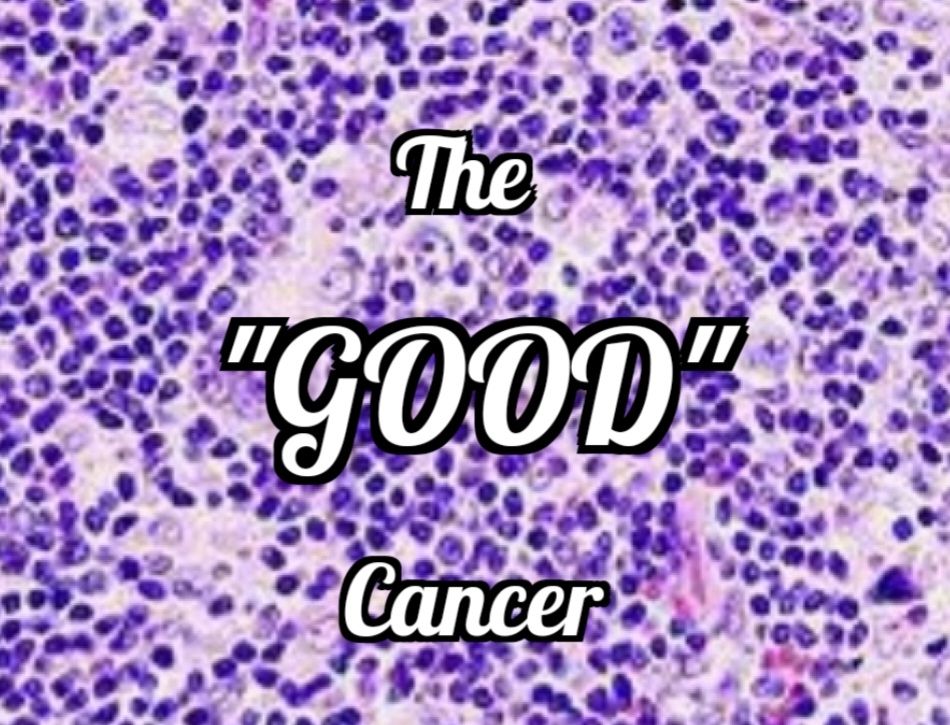
What kind of response are you having right now, after just seeing those three words, “the ‘good’ cancer?” For context, the picture underneath the words, is a slide showing what “Hodgkin’s Lymphoma” looks like under a microscope. While a lot of my readers are fellow Hodgkin’s survivors, many are not. In fact, it is likely that many have not had anyone more than a relative having to deal with cancer. Perhaps, some may have been lucky enough not to have been exposed to the world of cancer at all.

I think it is a safe bet, that I know no one who would ever call cancer “good.” Wait, let me re-phrase that, I know very few who are doctors that would ever call cancer “good.” Now you are probably wondering, “why would a doctor call cancer ‘good?’ If anyone should know cancer is bad, it should be doctors!”

Yet, as a Hodgkin’s survivor myself, I actually heard this sentence myself from my oncologist back in 1988, “if you were going to get a cancer, this is a good cancer to get.” Put yourself in my position, sitting on the exam table, and I am being told, at the age of 22, that I have cancer. Back in 1988, all I knew of cancer, was that people died from from it. I was in shock, unable to speak, yet I wanted to scream back at him, “good cancer? Are you fucking kidding me? How about no cancer? That would be great to hear. Not that I have a ‘good’ cancer!”

In fairness to doctors, especially oncologists, most have to deal with death, a lot. In some instances, they can become numb to having to deliver bad news, because if they emotionally attach themselves, they likely would not have long careers. Some doctors, like mine, had the personality and delivery of a metal bed pan. Again, you can only relate to the shock if you have ever had to use one. It was shocking enough to be told I had cancer. But sugar coating it for me, made my blood boil.

I know that I am not the only one who fought Hodgkin’s to be told this, most of my fellow survivors that I communicate with have been told the same thing in one form or another.

Once emotions settle down, one can understand why they call Hodgkin’s a “good cancer.” It has one of the higher remission rates in the low to mid 90’s (percent). And there are other cancers that get referred to as “good cancers” as well. Chronic Lymphocytic Leukemia (CLL) has what is considered a low death rate, with treatment often delayed under a “watch and wait” situation resulting in the “good cancer” label. Thyroid cancer is also considered highly treatable, hence a “good cancer.” I cannot speak for survivors of CLL or thyroid cancer, in regard if they had been ever told they had a “good cancer.” It is likely there are other cancers considered “good” for various reasons.

But should a cancer patient be told that they have a “good cancer?” Does it matter whether it has a high remission rate or low death rate? While I have survived Hodgkin’s 32 years now, the treatments used to give me that remission, have left me feeling as if I were treated like a lab rat, having left me with over a dozen issues that medicine was unaware of that could develop decades ago, and in some cases, not correctable or the risk too great to attempt. And not every survivor develops the same issues. Some relapse, even multiple times or develop a second, third, or fourth cancer. Some, pass away before completing treatment or soon after, such as “Michael”:

Michael

No, if you have ever been diagnosed with cancer, regardless which type, there is no “good cancer” that has zero side effects from treatments and 100% remission. And there is no way to know if you will be the lucky one that faces either situation. “Good cancer” means nothing to us other than making us feel like we should minimize our situation if not as dire as facing a terminal diagnosis. Nothing will make a cancer patient feel worse, than our emotional fears not being taken seriously because our feelings have been invalidated by the words “good cancer.”

If I could offer this to current and up and coming medical professionals, do not use the words “good cancer.” Instead, offer the encouragement of the statistics that show the remission potential. Let us, the patient, determine that the information is good for us. Instead, learn the resources for support, medical and emotional, that are available today that were not available decades ago and share them with us. This would be a huge help, a good help for cancer patients. Lastly, tell us that you will do everything you can to get us through our diagnosis, with the best knowledge, the best efforts, and the best support. We know not everyone will survive. We can determine from the statistics that numbers may be on our side, but it is the doctors and nurses that take care of us, that we need to be good, not the cancer.

Hodgkin’s Lymphoma Awareness Month… #33 For Me


September is National Hodgkin’s Lymphoma Awareness Month. Here are some facts. This coming November, will have been 34 years since I was first diagnosed with the rare form of cancer, called Hodgkin’s Disease at the time (I guess someone felt it was less scary to drop the “disease” and put “lymphoma” in its place). Hodgkin’s Lymphoma is also considered one of the most curable forms of cancer for decades, with a remission rate of up to 94% according to the American Cancer Society. The barbaric diagnostic methods done to me back in 1988 are rarely used anymore, such as the staging laparotomy and lymphangiogram, because of advances in technology. It would be awesome if I could end this post right here. But there are two other facts pertaining to Hodgkin’s Lymphoma that need awareness, and get next to nothing.

As mentioned, Hodgkin’s Lymphoma has a high remission rate (if you like to use the word “cure”, you are free to do so). That means, you should be expected to live a long life. Well, cancer treatments way back when I was treated and beyond, were not studied for “long term” or “late term” side effects, because the priority was to put you into remission and honestly, probably never expected survivors to live long enough to develop any other issues. And here is the kicker, there was no plan to follow up Hodgkin’s survivors beyond five years (I am limiting this comment to Hodgkin’s as I must admit to not knowing follow up guidelines for other cancers, but the cynic in me wants to say it is likely the same.).

Well, as a reader of “Paul’s Heart,” you know that survivors of Hodgkin’s Lymphoma can live a long time, decades long. And that means that I have lived long enough, to discover the late developing effects of both the chemotherapy and radiation therapy that were used to treat me.

If you have ever gotten a vaccine, you have likely received an information statement about potential side effects. Before my treatments began, I was given a similar warning, as written in my chart, the potential for a secondary cancer (such as leukemia) and pericarditis (a swelling of the heart muscle). And that would be all well and good, but remember, this was based on using five years as a survival statistic. This is what they knew could happen within five years.

Boy did medicine miss that mark. Here is the list of just my diagnosed late developing side effects, attributed to my treatments (in no particular order of importance):

  • left anterior artery damaged (one of the main arteries of the heart) – open heart surgery
  • right coronary artery damaged (another main artery of the heart) – stent placed
  • aortic valve damaged – artificial valve placed
  • mitral valve damaged – waiting for correction
  • diagnosis of congestive heart failure
  • restrictive lung disease (no treatment available)
  • multiple unidentified spots on my lungs (watching for development to cancer)
  • lower left lobe of lung described as “dead”
  • Barrett’s Esophagus (pre cancer of the esophagus)
  • Zenker’s Diverticulum (an issue with my throat that causes other problems with my digestive tract)
  • carotid artery damage – stent placed
  • radiation fibrosis and muscle loss/atrophy in my upper torso
  • osteopenia
  • facet joint arthritis in my lower five vertebrae of my spine
  • and multiple health events and immunity issues caused by these conditions and being asplenic (no spleen) from my diagnostic days)

Wow, did medicine miss the mark in 1988 with what could happen to Hodgkin’s survivors. Surely medicine has learned that survivors need care beyond five years, hasn’t it? Nope, well not really, or not good enough. In 1988, I had no internet, hence no support groups to navigate my way through treatments and survivorship. In the late 1990’s, I learned of the internet, and something called a “list serve” (an email list), that had me in communication with other survivors, only a couple of hundred of them, who seemed to be dealing with unexplainable issues, that could only be attributed to their treatments for Hodgkin’s Lymphoma. In 2008, with my first heart surgery, caused by radiation damage to my heart, I learned of so many others who had similar health problems, yet nowhere near the potential numbers of survivors who have no idea why they are experiencing what they are. And worse, dealing with a doctor who does not know the treatment past of their patient or ignorant to believe the relationship between the treatment past and the current malady, or because the patient does not know it is relevant.

Okay, here comes another fact. According to the American Society of Hematology as of 2011, there were 31,500 Hodgkin’s survivors in the United States. I personally question that number’s accuracy since again, there is not any real lifetime follow up plan as there should be. But even go with that number, why seemingly, is it likely that less than a thousand Hodgkin’s survivors are even aware of this potential, or worse, actually experiencing issues? That’s right, on one particular peer group of survivors I belong to, there are 934 of us, out of at least 45,000 survivors. Web sites of cancer organizations now at least list possibilities about late effects, but THERE IS NO PLAN FOR SURVIVORS!

As one friend and fellow long term Hodgkin’s survivor named Gloria put it, “I remain beyond words appreciative that Dolly (another long term Hodgkin’s survivor who passed away several years ago) connected me with this well established resourceful tribe of folks, who like me had “successful cures” for our bouts with childhood or young adult Hodgkin’s Disease but now 20-40 years later, found ourselves having subsequent cancers, heart & lung diseases, radiation fibrosis and other not do so fun conditions that no one could’ve seen coming nor expected.

According to oncologists, due to advances in treatment, our treatment related maladies should be a blip in medical history as what screwed us up, cobalt radiation, isn’t used anymore.

While I fail to agree, what this really means is for our tribe of first generation long term survivors, there are no predecessors nor history to consult. Our tribe has had to figure out for ourselves what tests we need and what conditions to watch out for as we navigate our way into old age. The Hodgkin’s long term survivor FB groups and Hodgkin’s International, which grew out of the online organizing, have literally saved my life by publishing guidelines and recommendations that appear nowhere in the conventional oncological world where they stay so busy with the newly diagnosed they have no time for long term survivors.”

Gloria could not be more spot on, which is why I asked if I could use her quote from another online post. Some of us are fortunate to have found doctors that do “get it” as far as our issues. But out of the less than a thousand of the dozens of thousands of long term Hodgkin’s survivors, an even smaller number have access to those doctors. Our “tribe” as Gloria refers to, actually spans the globe, whose survivors actually learn from us, only to get frustrated with the lack of care and knowledge in their countries, whether it be England, Taiwan, New Zealand or elsewhere.

Gloria is also correct, and again with due respect to the doctors that do care about us, there are too many who are just too busy treating newly diagnosed, or refuse to be told by their patients, information that can possibly save their lives. The fact that our bodies are so compromised from this damage, shortening our lifespans considerably (as in averaging my age for mortality), we are to be grateful enough for having lasted 30, 40, even 50 years. So why bother medicine to make things better, right?

Before I go, there is one more thing that I must bring up, again, another fact. As mentioned at the beginning, the success rate of 94%, that means 6% do not survive. This is a frustrating statistic. Because having a successful cure rate, has caused an apathy to find any new treatments that could push to a 100% cure. Why is this such a big deal? Because while the toxic treatments I was exposed to are no longer used, treatments today still are toxic and still occasionally cause life threatening side effects. And in spite of this, oncologists do not use the tools or protocol to at least prevent the progression and development of these issues. And this is known and documented (in my series back in January of 2017 the links posted below, YOU WANT TO READ THIS REGARDLESS IF YOU ARE A LONG TERM SURVIVOR OR A CURRENT HODGKIN’S PATIENT):

As Gloria pointed out, we survivors finally have an organization established to help, support, and guide fellow survivors in Hodgkin’s International, ( https://www.hodgkinsinternational.com/ ). Unfortunately for the most part, only if you are part of our “tribe” are you likely to even know about it. And this is why September is so important to Hodgkin’s Lymphoma survivors. We do not get the attention that breast cancer gets, or lung cancer gets, or colon cancer gets. But our issues of survivorship are real nonetheless and need the awareness.

Post Navigation