Paul's Heart

Life As A Dad, And A Survivor

Archive for the month “March, 2021”

Just How Long Should You Hold A Grudge?

There was a time, a long time ago, I would just not let things go.  As a young boy, I had been pushed around so much, that I grew up making it clear, it would never happen again.  Going from one end of the spectrum to the other, was not the solution either.

When someone does something wrong to you, it is natural to either want to seek revenge, or hold a grudge against that person.  A grudge is a way of not letting the offender off the hook for their transgression.  Many times it gets tangled up with the concept of forgiveness, rather lack of.  Both can have the same impact on your health emotionally, but are definitely different.

When it comes to forgiveness, while the one who committed the offense has the actual responsibility to offer the remorse, it is still the recipient who likely carries the ill feelings long after the event has occurred.  This can lead to many emotional issues such as depression, conflict, anger, just to name a few.  Forgiveness does not mean forgetting what happened, but you stop giving it the weight sitting on your emotional life.

When it comes to someone holding a grudge, the entire issue falls on the individual holding on to, and carrying out the grudge.  Carrying a grudge is the equivalent to carrying out revenge.  Where revenge often leads to a back and forth, with each side getting even, a grudge is one sided, and usually continued until the recipient relents, or dies.

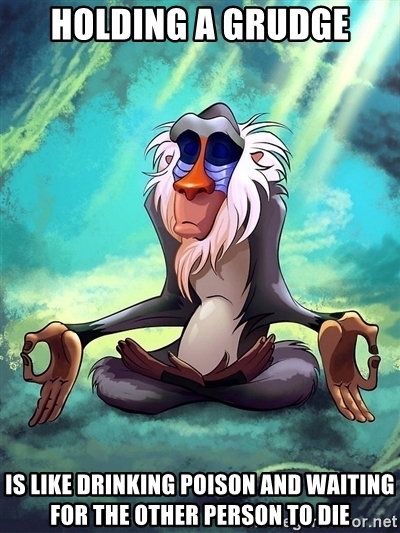
The problem for the recipient, is that they know that they have done nothing wrong.  And therefore actions committed against the recipient just lead to more head scratching.  It is the person with the grudge, who instead just continues to build the anger and frustrations because an end is not coming, or at least soon enough.  This does not hurt the recipient, it hurts the person with the grudge.  Hence, the meme at the top of this post.  And next to my favorite expression, “I would not piss in your mouth if your teeth were on fire,” I love this expression, “Holding a grudge is like drinking poison and waiting for the other person to die.”

And that is the best analogy for the downfalls of holding a grudge.  I am in no way saying that a person should not deal with something that went wrong or was handled wrong.  But there has to be an end at some point.  I could easily hold this position from my childhood decades ago.  There are numerous people I am currently friends with today, that were unimaginable back then.

I must admit, I have an advantage in this thinking.  Once known for having “knee jerk” reactions to conflict, I am now often described as “comatose” even when it comes to a traffic issue such as someone cutting me off in traffic.  Though I developed this thinking early on as a cancer survivor, I soon found myself slipping back into the old ways of not letting things go.  But as I faced other health crisis, one after another, I had finally convinced myself, the change in my thinking I had to do.

If whatever is happening, does not have an impact on my goals, and I really have only one goal in my life at this point, spending as much time with my daughters as I can, I let it go.  It just will not matter as much as the love I have for my daughters.  And it really is that simple for me.  What you do with your life has no bearing on mine.

There was a time, less than a decade ago, I might have felt differently.  Not anymore.
 

Studying After The Test


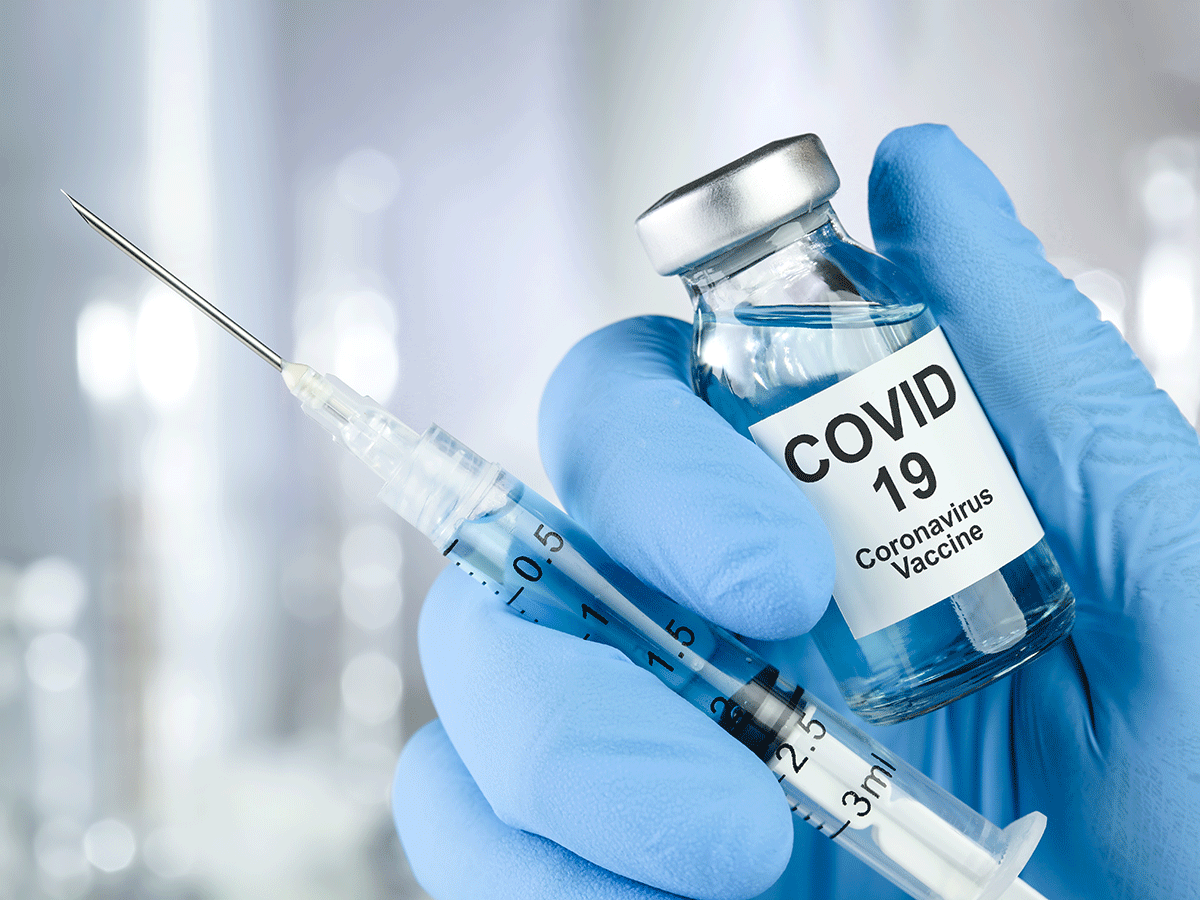
We have all been waiting for the encouraging news when it comes to vaccines and availability against Covid19.  Now to be clear, the three vaccines that we do have, that were discovered in record time, are not clinically proven.  They have not gone through the entire study process that science normally takes.  Our country simply did not have the time wait to get these shots into arms.  And because of that, these vaccines, research “not completed” yet, have been given “emergency use authorization,” allowing the well-hedged bet, a great risk to take.

At least for many.  Those in that group, based on the limited studies, were normal, and healthy individuals.  So, as long as you were in good shape health wise, you will be good to go.  As for the rest, well, we should be okay too.  That will be figured out eventually, but in the meantime, everyone is being encouraged to get the vaccine.  How important is this vaccine?  The last time, we dealt with something so tragic, without a vaccine, this is an image those in generations before me will never forget:

Polio was a virus that attacked the spinal cord, causing paralysis, transmissible from person to person.  Not really known for its lethality, the images of the twisted bodies of survivors from polio, are those that witnesses will never forget.  The last transmissible case occurred back in 1979 due to the fact that we have a vaccine for it (this according to the CDC).

So, with a rapidly contagious and lethal virus, which killed over two million people world wide, over 500,000 Americans, understandably, treatments and vaccines were needed sooner than later.  We are at the “sooner” now.

Here is what we know.  Two of the vaccines have 95% success or higher in preventing hospitalizations and death, and the third though having a lower percentage, still, when compared to other vaccines, is still very successful.  But here comes the bad news.

First, the studies have not shown whether the vaccine will prevent anyone from “carrying” the virus.  In other words, you might not get it, but you could get someone else near you sick.  The other factor, the length of time that the vaccine is only “known” to work for, is three months.  After those three months are gone, there is no study for showing how much longer the vaccine will last.  That is based on the data right now.  Right now, the signs are promising.  But we just don’t know.

This is assuming you are one of the healthy people like those studied so far.  But what about those who have compromised immune systems or pre-existing conditions like several issues that I have.  There are no studies done… yet.

Here is the good news.  An article released last month by the University of Birmingham (in England, not the US dammit), has begun the OCTAVE trial, funded by the Medical Research Council, to study immune responses to the Covid19 vaccines by those with compromised immune systems, including those with cancer.

I stated a few weeks ago, the difficult decision that I made not to currently get vaccinated.  After speaking with several of my most trusted doctors, who were conflicted among themselves what I should do, and would I benefit, that I was left with my gut instinct, based on what I knew about my health history.

Historically, because I have no spleen, I have a difficult time building antibodies without having booster shots of vaccines.  And it does not appear to make a difference which vaccines.  Some that I have had, once thought to be lifetime, I end up with multiple boosters.  And here lies the problem.

With no studies done yet, there is no data on my ability to get a booster, let alone be able to tolerate one (or more).  There is no protocol to test for the antibodies to get a booster.  And finally, there is no protocol to actually get a booster if you were to indeed need one.  What I do know, is I am likely to be in this situation, and it needs to be studied before vaccination becomes an option.  For that, I will say “thank you England.”  At least you are doing something.

The US is not standing by idle.  Those studies that have not been completed so that the vaccines can be officially approved?  They are still on going, either in the 2nd or 3rd stages.  Data will come producing important information like “how long will immunity actually last?”  Another important piece of information needed, that has not been discussed, and trust someone who knows because he has been there, being experimented on, data needs to come out on potential long term side effects from the vaccines.  Sure my treatments 31 years ago cured my cancer, but they knew nothing about the side effects I would deal with decades later.

Clearly, I am not a scientist, so my decision, I am not an anti-vaxxer at all, is based on a hunch.  That is, until the American Society of Hematology published a paper toward the end of the year, addressing questions about the Covid19 vaccine.  For those unfamiliar, hematology is the study of blood, but to those of us who have a history of cancer, we know this study very well.

https://www.hematology.org/covid-19/ash-astct-covid-19-and-vaccines

This is the link to the actual article.  But in summary, there were two questions that stood out to me.  What vaccines are approved for immunocompromised patients?  Why might some patients not respond?  The entire paper is quite interesting to read.  But in the end, until the data is conclusive, the advice is still the same.  It is up to the individual to decide based on their need.

Some need the vaccine to be at work.  Of course there is the need to get kids back in school.  There is a strong desire to get back to some sort of normalcy socially.  And some, will need the vaccine simply not to die.

It is not an easy decision for me, and not one I have made lightly.  And yes, while some still like to argue, “but they can’t seem to get their answers right or straight.”  Yes, that is what happens when we are dealing with an unknown.  There will be mistakes along the way medicine looks for the perfect way to deal with Covid19.  Until then, just as success came with prevention for Polio, measles, and others, science will find a way out of this for us.  But it has only been a year.

Heartfelt Words From A Fellow Long Term Cancer Survivor


I shared Jessica’s story a year and a half ago here on Paul’s Heart.  It was titled “Jessica, The Mermaid That Beat Cancer 4 Times.”  She is referred to as a mermaid for several reasons, most notably her love for water, and the fact that she works in water related physical therapy and fitness.

Jessica’s story is a compelling one, as it began when she was just eleven years old, with the diagnosis of Hodgkin’s Lymphoma.  You can go through the search engine to read the full story that she wrote herself here on Paul’s Heart.

But Jessica is back, with a new guest posting.  Recently, she penned a heartfelt letter to “a doctor”.  This letter is written by a cancer survivor, Jessica, to “any” doctor who faces patients like her, myself, and so many others.  She expresses so many frustrations that we all have when dealing with doctors who either just are not familiar with our health issues, or unwilling to learn about them.  But instead of me explaining the letter, hear it from Jessica herself.

Dear Doctor

Dear Doctor, ( an open letter from a survivor)
You don’t know me. Yes, you’ve read through my medical records and I suppose you have been shocked, amazed, overwhelmed or rolled your eyes at the immensity of my profile and how difficult it will be to have me as your patient. But you are seeing the diagnosis I’ve had. You are looking at my pathology reports. You have noted all my surgeries and my late term side effects from my four bouts with cancer. But you don’t know who I am. You don’t know how hard I’ve fought and the fears I have had and the many glorious moments I’ve been grateful for nor do you realize the tremendous anxiety I have gone through after endless biopsies and cat scans and blood tests. You don’t know me. You assume that I should just be grateful that I survived. You don’t know that with survivorship comes tremendous overpowering stress. With survivorship you learn to live a very different life, one that can be moment to moment, event to event, doctor appointment to doctor appointment. Maybe I will have three months where I can truly live in the regular world that other humans who haven’t had a life threatening disease live; being somewhat carefree and not afraid of seeing a lab coat or a message from my doctor on my answering machine. You don’t know me.
When I enter your office you come in with my paperwork in hand. You are astute at your craft. But you don’t know how to talk to me. I am a survivor but contrary to your belief “ you’ve been through this before so you should be used to it by now”, you are wrong. Every visit, every test, every “talk” I become more weary. Yes, I am thankful for life but my life is precarious, I walk on a pond that has a thin veil of ice over it. I’m unsure if any step I take will make me fall through and into the murky water. You don’t know me. When you share “ you’re one of the lucky ones, my cousin had Hodgkin’s Disease and her ovaries were fried from the radiation” isn’t something to joke about or light hearted humor. You don’t know me. Giving me pity and saying “ you poor thing, I don’t know how you do it” isn’t what I want to hear as I sit trembling on my the exam table waiting for the doctor coming in. You don’t know me. Hearing you tell me that “ if it was me I would have probably given up a long time ago” makes me feel like a freak and that my fight in your eyes wasn’t worth it. You don’t know me. When you approach me but don’t recognize my pain emotionally you are not being a quality clinician to me so please don’t share with me that you are “doing your best”. You don’t know me. When you enter the room with my life on paper and say “ wow, this is like war and peace”, you make me feel guilty for my survivorship. You don’t know me.
So please Dear Doctor, when you take me on as your patient think a little more about what a SURVIVOR goes through, what it truly means to be a survivor. Your words towards us as a patient should have the same strength in them that we as survivors have to continue with on our journey. You don’t know me, but I’d like you to.
Sincerely,
A cancer survivor

Post Navigation