Surviving Sepsis
This is definitely a post you will want to share.
Heavyweight champ, Mohammad Ali. Muppet creator Jim Henson. Superman actor Christopher Reeve. Academy award winning actress Patty Duke Astin. Actress Tanya Roberts. Model Anna Nicole Smith. Singer Etta James. Actor Jeff Conway. Former president George H.W. Bush. They all share one thing in common, all passed away from complications related to sepsis.
I have three very serious triggers when it comes to health: cancer news, cardiac news, and sepsis news. Why? Because I have personal experience with all of them. This is the part where I also clarify that I am not a doctor, and I am relying on my own personal experience with the things that I am going to say.
The sports and racing worlds were rocked last week at the sudden passing of Nascar racing champ, 41 year old Kyle Busch. Though initially the cause of death was not stated, probably for no other reasons than waiting for final test results, his cause of death has now been stated by his family as severe pneumonia and sepsis.
Immediately, social media warriors came out with their moronic comments, “did he get the Covid vaccine?” (how are we still dealing with this stupid and false question yet?), “incompetent doctors,” and so forth. These stupid comments were coming out before even saying anything about Busch’s death. Several social media personalities are calling out that “something is not right”. Rather than learn about a condition, it is much easier to just give conspiracies and assumptions more fuel.
To be clear, I am not a racing fan, but I am drawn to news, when something occurs that I can relate to. As explanations began leaking out, that the young driver was not feeling well, having something like a cold, and that he had requested a shot (of what? it was not stated) following the race he had just won, it was the next symptom that triggered me. I know, because it happened to me. I had been there and done that. The difference between me and the social media warriors, I kept my opinion to myself until the official word came out. Makes the score Me = 1, Social Warriors = 0. It accomplishes nothing to say something just for the sake of saying something or to jump out in front, and then be wrong.
Busch was reported to be coughing up blood. The most common cause of this is an infection, such as pneumonia, which has also been stated he had with his cause of death. As many of us are probably prone to do, we blow off respiratory and cold symptoms, and just chug through. We are also reluctant to go to the hospital or seek medical care, preferring to just ride it out, or just “get a shot.” Soon after, it was reported that Busch had died. This was no cold. I knew that. I told those around me, I am guessing he had pneumonia and did not know it, and then went septic. Delays in emergency medical care are usually fatal. I say “usually”, because…
Back in March of 2012, I won’t give the exact date as it is a personal date to me, I was taken out of my house at 3am on an ambulance stretcher. I woke up suddenly in immense pain, and began spewing vomit relentlessly and violently. I was hallucinating. And then I passed out. The only thing else I remember, was being rolled out of my bedroom, passed my two young daughters, looking horrified that something had happened to me.
I do not know how long I was out, but when I came to, I was told that I had pneumonia, and was septic. I knew what both meant, I just couldn’t believe it, because when I went to bed that night, I felt fine. I had an exhausting week, working 60 hours, I had school board campaigning that had to be done for the upcoming election, I had a school parent fundraiser to prepare for that weekend, and my daughter’s birthday at the end of the week. I didn’t get to sleep a lot, and my diet had a lot to be desired, as in, I desired to eat, just did not get to. But when all was said and done, following the birthday party, sure, I was exhausted, I ate some food, and went to bed around 11pm, without any ill feeling of what would come four hours later. And then it hit me, four hours later, no warning.
The wild thing is, I had not learned my lesson, nine months later I would have another diagnosis of aspiration pneumonia, this time diagnosed as “double pneumonia.” Yep, I had it in both lungs. I was not septic this time, but my same stupidity of denial and grit could have easily led to it. I went to work that morning, feeling like shit, drove there, got to the parking lot, and then said to myself, “I can’t do it.” I drove back home, crawled into my bed with my winter coat on, curled up under the covers, which is where I was found 8 hours later. Back to the hospital.
This behavior is not good. Trust me, I know it. But when it is all you know, this toughness, at all costs. Besides my pneumonias, all three of my heart surgeries and my carotid artery surgery, ALL related to my cancer treatment history, and I still do not react properly and timely.
There are four types of pneumonias: the common ones, viral and bacterial, and then two others fungal and mycoplasma. The viral one would easily have been suspected, as Busch claimed to have a cold, so he could have had anything from RSV to Covid, or even just a cold that got out of control, a viral pneumonia. For me, mine was bacterial, aspiration pneumonia. What is aspiration pneumonia you ask? Aspiration is when you inhale or swallow other than air, into your airways, common with people with reflux, food, saliva, etc. Have you ever drank something too quick and it “went down the wrong way” causing you to cough uncontrollably? That is aspiration. Your lungs are not meant to have anything other than air. In my case, not only do I have reflux, I also have something called a Venker’s Diverticulum in my esophagus, which as a result of my radiation therapy for my cancer, causes food and liquid to get trapped in my esophagus. If it stays there trapped, guess what happens? The body breaks the food down there and becomes bacteria, which gets inhaled into my lungs, and becomes aspiration pneumonia.
Because I was unaware of this happening, and feeling as I “normally” did, I continued on as if nothing was happening. And this should have been a fatal mistake from what I was told. It got so bad, according to my doctor, bloodwork confirmed, via the lactate acid level test, I was septic for over 48 hours. I should have been dead, not having gotten the necessary IV antibiotics I needed.
You need to understand how quickly sepsis starts and spreads. It needs a source, the original infection. Once the original infection gets too bad, and again, this could be a sinus infection or a cut, and the body’s natural immune system cannot keep up, the germs or bacteria or toxins of the infection break loose and enter the blood stream. And if you remember anything about health class in school, the blood stream goes to the heart, and from the heart, pumps out to the rest of the body. Imagine if you have ever seen a fire spread, or a hurricane devastate a coastline in real time, this is what sepsis does, and quickly. The body continues to get overwhelmed, causing widespread inflammation throughout the body, blood vessels get damaged, blood clots form. And once this happens, blood and oxygen get blocked, causing organs in the body to fail. This is called septic shock. Again, this happens all so very quickly. Sepsis is not the infection, but rather the reaction to the initial infection, whether it be pneumonia, a cut, a bite, or a cold.
And understand just how common sepsis really is, yet rarely talked about. According to the CDC, nearly 2 million people every year develop sepsis. To put some perspective, rememeber the numbers of Covid diagnosis? I will go smaller. Hodgkin’s Lymphoma has about 50,000 new diagnosis each year. Of those diagnosed with sepsis, over 350,000 die. This is a lot of deaths, and yet, sepsis does not get the attention it deserves and needs. I will bet anything most reading this post will not know how to watch for it.
Time, or TIME as the acronym is spelled out, begins the moment the doctor suspects sepsis. By then, sepsis is already so far ahead, the patient racing towards death if treatment not given soon. Busch was already not feeling well nearly a week earlier, and at no time was sepsis suspected. Could it have been? Perhaps. But unless you specifically bring up, “hey, I want to be checked for sepsis,” medicine isn’t just going to volunteer to look for it.
So I understand what happened and how to Busch. And it is sad, he was only 41 years old. Like I said, men, and women, do a lot of denying, a lot of “pushing through,” and depending what is happening, can be wrong, fatally wrong. And it is in moments like this, when it is fresh, we should be educating everyone on Sepsis. Because it is more common than we realize. A paramedic friend told me, so many people die of sepsis in the hospital unknowingly, because it is not something normally checked for. According to the AAMC, sepsis is the 3rd leading cause of death inside hospitals. Hospitals do not assume you have sepsis or will develop it. They are waiting for symptoms.
So realizing that the dead cannot talk, how about those who have survived sepsis? Singer Madonna. Actor Billy Porter. Actress Ashley Park. Survival in the hospital when being able to treat is 80% and drops rapidly without.
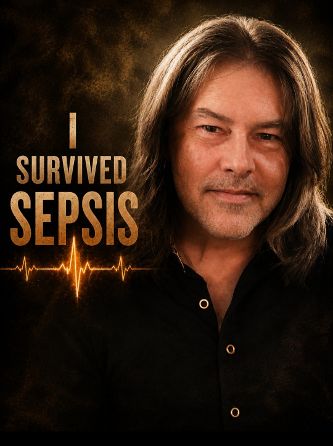
No one with the ability and resources wants to talk about it? Okay, I will do it, as I always do, one person at a time, always with the hopes it makes a difference to at least one person. As I said, I have survived sepsis, and I know others who have. I also personally know some who have died from sepsis.
Awareness, Pneumonia 101. This by no means will be a full tutorial in learning about pneumonia and sepsis, but it will be more, and easier to understand, so you can be better to watch out for.
I have already mentioned the four types of pneumonia, and at least how you develop aspirational pneumonia. As for the others, there is community acquired (catching a virus from someone else), hospital acquired, ventilator associated (why doctors do not want you on a ventilator for long), and health care associated.
Just as there is for recognizing a stroke, there is an acronym for helping to recognize someone with sepsis. But again, the key is, you have to recognize it, not blow it off or tough it out. The acronym is TIME.
T = temperature, usually very high
I = infection, tough to recognize if we cannot see it, or feel sick
M = mental decline
E = extremely ill (refer to what happened with me above), crazy level of pain
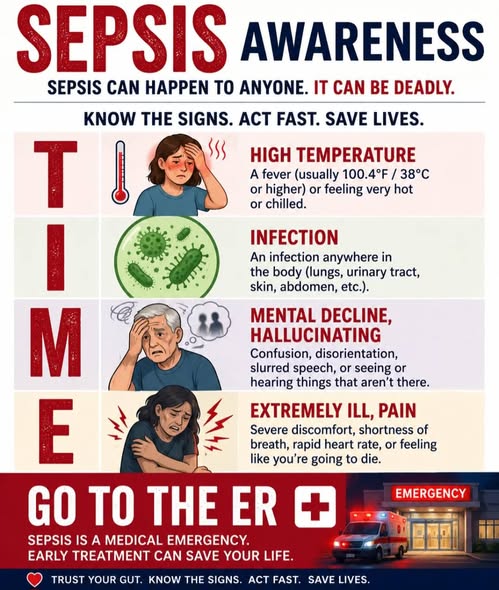
(image AI generated)
Let me tell you, the pain was ridiculous. The vomiting would not stop. And I definitely saw some “weird” stuff in my head. I was in bad shape, and clearly had been for some time. This is just one of several episodes I danced a little too close with death.
Busch did not know or suspect he had anything more than a cold. The diagnosis of pneumonia is simple enough. Simple use of a stethoscope to hear “crackling” in the lungs, sometimes you can hear with your naked ear pressed against the chest, and a chest x-ray will confirm pneumonia. Diagnosing sepsis is a little more complicated, and unless they are looking for it, will go overlooked. There are these tests: CBC (complete blood count), blood cultures, organ function (because your organs start to shut down when sepsis progresses), imaging tests, and as mentioned, the lactate acid level testing.
Once diagnosed, it will be only the highest broad spectrum IV antibiotics that will save a person from sepsis. And the only place to get that done is in the hospital. And NO, and I want to be clear, IVERMECTIN WILL NOT TREAT SEPSIS!!!! I can’t believe I even have to say that.
So now you see why Busch’s death is really so tragic besides his age. He knew he was sick, just not how sick, and got worse, rapidly. And whoever was responding to him, for “the shot”, was also wrong, wrong in that decision, and wrong for not insisting Busch go to the hospital.
When a tragedy like this hits, we need to talk about it, not wait “because it is too soon,” or worse, not even talk about it. Sepsis can be prevented, just as strokes and other medical crisis. But only if we know what to look for.