Paul's Heart

Life As A Dad, And A Survivor

Happy National Cancer Survivors Day 2018


Today marks my 28th National Cancer Survivors Day.  As you can see on the counter on the home page, I am approaching another huge milestone in a little less than two years.

Never in my wildest dreams did I ever think I would have cancer, let alone survive it, especially this long.  Back when I was diagnosed, I knew no one who had ever survived cancer except for my stepsister, everyone else had died.  But cancer would become a major part of my life, as others that I knew, would face their own battles, and look to me for support and encouragement.

Today, I am in touch with thousands of other cancer survivors.   Some newly in remission, some, decades, as many as 40, 50, and 60 years in remission.  They do exist.

One year, I am actually going to include the names of every cancer survivor in a post, but for now, I would be to afraid I would forget someone’s name.  So, just know this…

Today is your day, our day.  And if you know someone who has taken on cancer and is celebrating today, give them an extra special hug.  No matter the cancer, it was not easy getting to this point.

Congratulations everyone reading this.

Thank you for your continued readership and support.

Paul

Remembering Our Fallen


Growing up in a small town, Emmaus, Pennsylvania, every Memorial Day, most would gather for a military processional that would conclude in a specially dedicated memorial garden.  There would be speakers, a moment of silence, and conclude with a 21-gun salute by the honor guard representing the various branches of our military.

It was a sad day, though as a child, I really could not grasp the true meaning behind the day.  But the fact that it was normally a damp and dreary day, nearly every year that I can remember, seemed to fit the mood.  We would leave the memorial service with a hand crafted poppy flower.

The tradition of the “poppy memorial” now goes back nearly 100 years and is attributed to the World War I poem, “In Flanders Fields.”  It is believed that a field of poppies were the first flower to grow in the cemetery for fallen military during World War I.

Memorial Day for me has never been about picnics, days at the beach, or the unofficial start of Summer.  Sure, I do partake in these more enjoyable activities, but first and foremost, Memorial Day for me is about remembering those who fought for this country and gave the ultimate sacrifice.

I learned about war from history being taught in school.  I was born just before the Vietnam War, so I clearly have no memories of that conflict.  The first war that would actually catch my attention would be the Persian Gulf war, where the United States took the position to help liberate a middle east country from a neighboring dictator.  Since then, there seems to be a new war starting every year.  Though we as Americans can have opinions as to whether or not we belong in an international conflict, that is not what Memorial Day is for.  Because one is certain, no one enlists with the hopes of going to war.  And whether we have enough information to deem for ourselves if the war was worth it, whether we belong in that conflict, does not change the fact that each and every one of our service men and women deserve our respect and support.

The very first military personnel I knew, were both uncles.  One served in the Air Force, and the other served in the Navy, for decades, including time in Vietnam.  As an adult, it became too common however, to know someone who would end up being sent overseas to fight for Democracy and humanity, whether it be a friend, a co-worker, or now a nephew or niece, or even your own child.

War has seemingly always been a part of our history in the United States.  Since 1965, when I was born, here is a list of most, if not all the conflicts:

  • Vietnam
  • the Cold War still in full force
  • the conflict at the demilitarized zone of Korea (yes, we are still dealing with the actions of North Korea)
  • Dominican Republic civil war
  • Cambodia
  • Bolivia
  • Zaire
  • Iran hostage crisis
  • Gulf Of Sidra
  • Lebanon
  • Grenada
  • Libya (still dealing with today)
  • Panama
  • First Gulf War
  • Somalia
  • Bosnia
  • Haiti
  • Kosovo
  • Sudan
  • Afghanistan
  • Iraq
  • Pakistan
  • Somalia
  • Uganda
  • Syria
  • Yemen

This list is staggering.  And again, while we can have our opinions whether the wars were worth our involvement or the sacrifice of or service men and women, today, we MUST honor and remember those who gave all.  And for those who have come home, we MUST take care of them and improve the VA system.  It is unacceptable to have those who fought for our freedom, not get the care or the assistance that they need to survive what will stay with them a lifetime, something that we who have never served, can even imagine what they are dealing with.

So please, before you head to your picnics, parties, or beach, take a moment to remember what Memorial Day is truly about.

No, I Don’t Glow… But I Should


I remember back in my childhood (late 60’s to early 70’s), getting warnings from my grandmother “Don’t sit so close to the T.V.” or “Don’t stand in front of the microwave.”  Today, we get warnings about excessive cell phone usage and brain cancer, as well as the big “sun exposure”.  These things all have the same concern in common, radiation exposure.  While there are things that are assumed that can happed due to exposure,  there are still many things unknown.

Then of course, there was the core problem at Three Mile Island nuclear power plant about an hour from my house.  A movie titled “The China Syndrome” chronicled a potential nuclear disaster.  Our world would experience just how serious nuclear crisis at power plants could be with Chernobyl and Japan.  And of course, there is the potential an previous use in warfare.

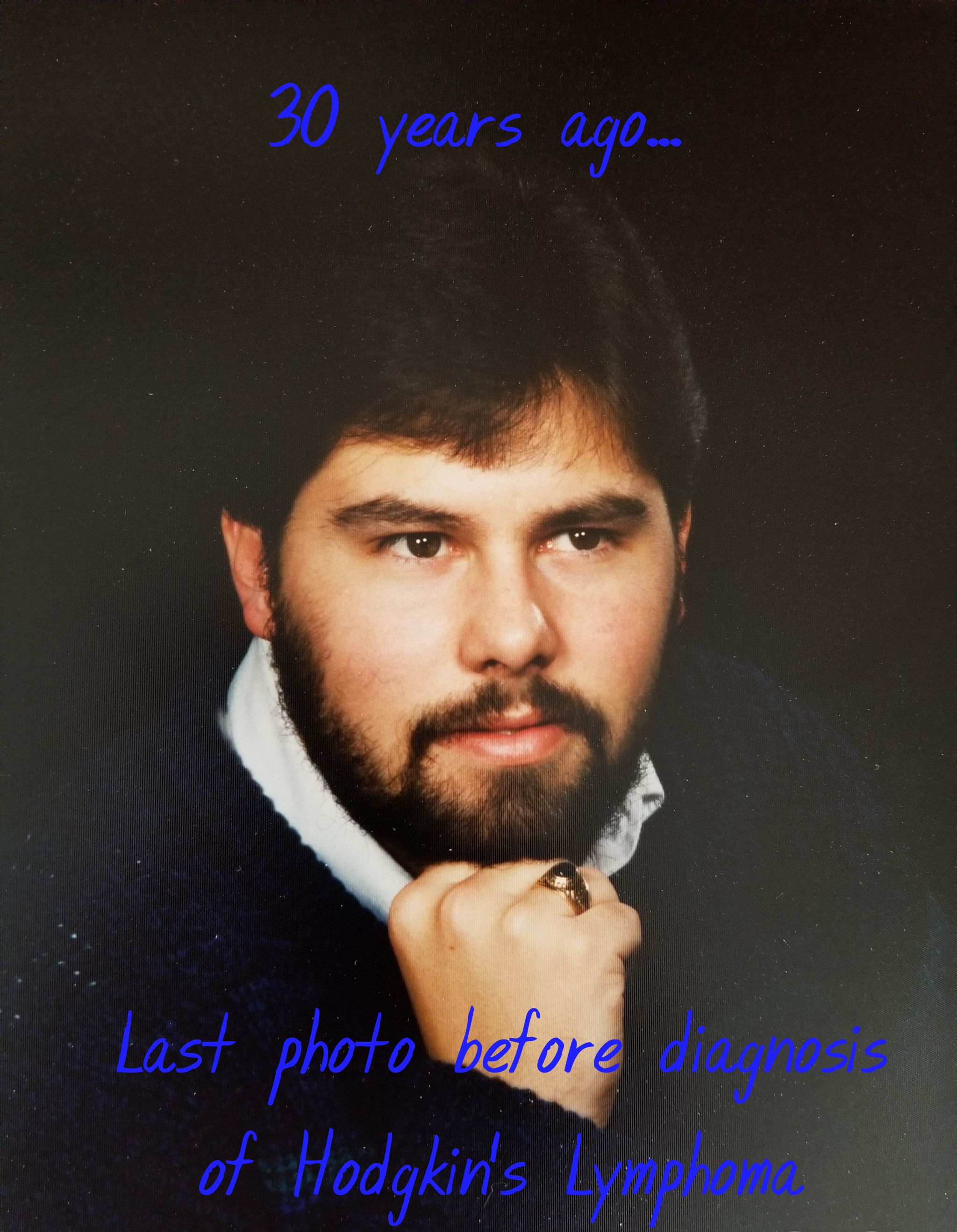
But under a controlled situation, it was learned that certain cancers could be cured, in particular, the cancer that I am now 28 years in remission from, Hodgkin’s Lymphoma.  And today, the dosages of radiation are much less, and more precise than what I, and many, many more were treated with.

This is a picture of a linear accelerator.  Not the one that was used on me thirty years ago, but similar.  With pinpoint precision, this machine shoots the ionized radiation to the specific tumor or cancer site.

To really appreciate how far treatment with radiation for cancer has come, I will refer you to treatment with Cobalt, something I have only heard of, from fellow survivors who were treated in the decades before my more modern treatments.

I was treated with the linear accelerator, however, unlike the fine-tuned procedure, I was treated with “scattered field.”  So, what does this mean?  Once the radiation entered my body, it scattered beyond the areas meant to be treated.  As I mentioned, radiation treatment was not just about the method, but also the dosage.

The comic superhero “Incredible Hulk” was created when Dr. Banner was working on a treatment with radiation.  He made the decision to test the process on himself, which of course went wrong, and as a result, the side effect, whenever he got angry, a metamorphosis occurred in his blood, changing his appearance and physiology to a creature of super human strength.  The problem was, Dr. Banner could not control or reverse what had been done to him.

In February of 1989, I laid on the table in the room with the linear accelerator.  On my first day, I laid down on the table.  “Tatoo” markers noted the spot to line up the cross hairs of the machine.  Lead blocks had been placed over my breast bone to protect my heart and spine.  In all, I would go through thirty of these treatments, lasting about a minute in duration.  Except, that did not happen.  The machine malfunctioned with me on the table.  I could not help but wonder if I was going to make the transformation into a giant, strong, green, super hero.  I was not given much time to think about that, because with the machine repaired, the treatment commenced.

Side effects for my treatments, were minimal, potential for pericarditis (inflammation of the lining of the heart), and perhaps a secondary cancer.  Truth is, long term studies were never done.  And with many Hodgkin’s survivors living beyond the magical five year mark, many would develop side effects that would end up teaching medicine, there was more that needed to be learned.  And in 2008, I would join the other guinea pigs in the research of long term side effects from treatments of cancer.

This is a picture of my death, or what should have been.  Radiation that I had received twenty years before, had remained inside my body, continuing to do damage internally.  My particular condition is called a “widow maker.”  Radiation scarring to the left anterior descending artery was about to be the cause of a fatal heart attack.  And without being followed up for my heart, something that was never a concern, I should be dead.

Instead, I am now followed up by some of the top doctors in the country for this cumulative damage from both radiation and chemotherapy long term effects.  And my body is riddled with these issues with more than a dozen other diagnosis.

But before this new health surveillance began, my doctors needed as much information as they could get about what, and how much I was treated with.  For the purposes of this post, I am going to just deal with the radiation.  It was revealed that I was exposed to 4000 grays of ionized radiation over the course of my treatment.  What does this mean to the average person without knowledge of radiation?  The limit of exposure today in general, are approximately 100 grays per year.  PER YEAR!!!  That means that I was exposed to 40 years worth of radiation in a 30-day period, well beyond a life-time limit.

To put this in perspective, I have two conversations to share.  The first, was with a friend who happened to work at a nuclear power plant who was curious about my exposure to radiation therapy.  By the end of the conversation, he was in tears when he heard about the level I was treated with.  Neither he, nor anyone who works in the nuclear industry is really ever to be exposed to the 100 grays per year exposure.  He knew, and I knew from his expression, this was something quite serious.

The other story, occurred during radiation training while working for my former employer.  We were required to take this training every year.  At the end of the session, the instructor would open the floor for questions.  I have to admit, I already knew my answer to my question, but as many around me doubt the seriousness of my side effects, there was a shock value to bringing my exposure limits public.  My question pertained to “half life” of radiation, simply put, how long radiation lasts inside of your body after exposure.  It amounts to the time it takes for half of the radiation to be gone.  Needless to say, the half life of exposure to a dental or medical x-ray pales in comparison to the radiation I was exposed to.  But I wanted to ask the question.

Me:  Hypothetically (I was being nice), what would be the half life of being exposed to 4000 grays of ionized radiation?

Instructor:  That would be impossible.

Me:  I know, but that is why I am asking hypothetically.

Instructor:  That would be impossible.  No one would ever be exposed to that level.

Me.:  But I was, twenty years ago.

Instructor:  awkward and heartbreaking silence

Yeah, I knew from his reaction, I am going to be dealing with this the rest of my life.  I have other radiation damage that will one day need attention, once it becomes more of a risk than the surgery to correct it:  mitral and aortic valves, both carotid arteries, muscle and bone damage, lung damage including spots on my lung, currently unidentified but being watched to develop into lung cancer.

It is for this reason, many of my fellow long-termers and I call radiation “the gift that keeps on giving.”  I just wish I could save someone with the radiation modification of my body like a super hero.  And no, I do not interfere with televisions, microwaves, radios, or garage doors.

Post Navigation