
Paul's Heart

Life As A Dad, And A Survivor

Archive for the category “The Heart”

Managing Meds


pill5

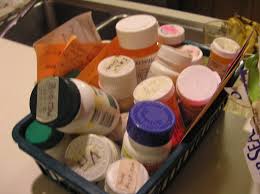
It happens in an instant.  You can spend your entire life, having taken nothing more than vitamins, but with a trip to the emergency room, or a diagnosis of a serious illness, as if you did not have enough to deal with, you will most likely be introduced to the world of prescription medications.  So, now you will not only have to deal with possibly a life-changing situation, but now, you will probably be concerned with side effects from the new medications, as well as learning how to take the many new medicines that will become part of your every day life.  You will have to learn the timing of taking these medications as “absorption” of the drugs is just one of the situations that can have an impact on the effectiveness of the medicines.  There are foods that need to be avoided, and some actually increased.  Times in between taking certain combination medications.  There are many other issues that can impact “when” you take a medicine.  And for someone who has never taken a prescription medication for the long term, even one drug, having to take a regimen of drugs, and scheduling when to take them, simply put, can be overwhelming.

For me, my life turned upside down in 2008 with my heart surgery, a result from radiation damage for my Hodgkin’s Lymphoma back in 1988.  All of a sudden, I was taking 7 prescription drugs, along with several supplements for calcium and vitamin deficiencies.  For the most part, my meds were all single dose per day, except for one of my most critical drugs, for my heart.  That was taken twice a day, but I was having a hard time remembering to take that second dose.  It was determined that I could take a similar drug, with extended release action.  Regardless of the consumption being ideal to the medical world, I took all my pills at the same time, as part of my bedtime ritual, this way I would never forget to take them.  And for me, it has worked.  Again, not the way the doctors would like me to take the meds, but my body has done okay (just) with this method.

But then, one of my medications needed to be increased, and I was forced to once again, go back to having to take a med twice a day.  And having concerns how to remember, I did something I saw only elderly do…

Pill1

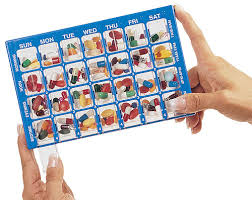
I bought a pill box organizer.  I was still able to take my pills at night, but to make sure that I remembered to take my pills in the morning, I always had my car keys sitting underneath the box.  There was no way that I would forget.  The system works when someone has all their mental faculties.

But what happens to individuals who have no one to care for them, and yet, must be trusted to remember to not only take their medications on time, and the correct dosages?  And follow all of the other instructions with each prescription?

My father’s situation was not just a typical example, but unfortunately all too common.  A combination of effects from two strokes he suffered during surgery to remove his lung cancer, complicated with cancer cells spreading to his brain, my father, not only completely independent his entire life, but also the caregiver for his wife permanently injured in a car accident, he was unable to monitor, and administer not just his pills, but his wife’s also.

We had hired caregivers, round the clock, but my father was notorious for sending them home.  His attitude was, his house, his rules.   I wanted to kick his pride right in the ass.  But even when the caregivers were there, they were not allowed to administer or even remind him, to take his pills because that was not part of their job description, officially or legally.

So, in the beginning, of this stage of my father’s life, I drove an hour, each direction, just to manage his medications, and my stepmother’s.

pill2pill2pill5

I had to arrange two different boxes, and then somehow, figure a way to make sure that my father did not mix the two up.  I had to take a sheet of paper for each of them, write their name on it, and the name of each drug, dose, and how many times a day on it.  Then fill each container for both.

Within a week, I got a call from my father, that he had extra pills left over from earlier in the day.  I made the drive up to his house, and found out this did not just happen once, but several times.  I had to come up with a different solution.  I could not afford to stay with my dad, nor could I make daily 2-hour trips every day.
pill3

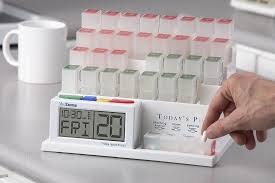
After research, and some assistance from FB family members, I found out about an alarm clock that had multiple settings, just for the purpose of taking medications.  I could program it, and it would go off, reminding the patient to take the medications at that time.  The only thing was, I was relying on my father to remember why the alarm would be going off.  But for now, it was the best solution yet to deal with the mileage that I was putting on my vehicle just for managing his medications.
pill4

Then I learned about something new, courtesy of my father’s pharmacist.  Most chains now have a delivery service.  The pharmacy gets the prescriptions, and prepacks them into the organizer, and then delivers them, normally at no extra cost. I want to make note, I was not trying to get out of the weekly chore or travel of managing my dad’s meds, but I knew as time went on, my father would need our efforts more as his condition got worse.  But for the time being, this system worked well, even my father who was not a big fan of trying something new, liked the idea of having the pills delivered already prepared.  Combined with the alarm settings, the system worked until the time came that my father approached his next level of care.

For those of you reading this post, if you are in this situation, I know how stressful, scary, and intimidating it can be.  I wanted you to see that there are options available to help you if you are thrown into this situation.

Playing The Cancer “Card”


cancer2

Imagine, it is hard enough to deal with a cancer diagnosis, struggle through the steps of the staging process, tolerate the brutal side effects, and manage the days after treatments have ended, worried about if the cancer is permanently gone.  For long term survivors like me, who have health issues to deal with, cancer has been the least of our worries.  But as if fighting our own bodies and mindsets were not enough, most of us in our lifetime will hear this phrase at least once, “playing the ‘C’ card, eh?”

cancer3

You pretty much have to intimately know the person making the comment to figure out if the words are meant lightly or critically.  Regardless, the insinuation that a cancer patient, or anyone dealing with a serious issue, would use their illness to acquire special favor or assistance.  I know speaking for myself, as I struggled with my cancer, and survival, the last thing  want is anyone to feel sorry for me, and at many times, to assist me or “baby” me.

I wrote in a previous post about co-workers who felt I was getting special favors at work, while I battled my cancer.  I dealt with other co-workers who, just because they saw me walking my neighborhood a week following my open heart surgery, felt I should be back at work.  I have a whole list.  My case is not unique.  We strive so hard to be treated normal, and without pity, that without external signs of what we are dealing with, we are not allowed to feel bad ever without being accused of using the cancer card.

1426107776976

Unfortunately however, I think our society has become desensitized because of so many who take advantage of systems.  We have all seen it.  A shopping center parking lot, someone is using their parent’s car which just so happens to have a handicap tag on it, and so, feels entitled to use the handicap parking space.  No one will notice, or no one will care, right?  Especially the one illegally using the handicap tag.  And then there are those we feel, who are not justified in even possessing tags like pictured above.  But if there is one thing I have learned, even after witnessing someone with a handicap placard being used on a pick-up truck, with “monster truck” sized wheels, there was a reason that placard was there.

Even Disney has adjusted their policies on allowing those with certain special medical needs while waiting for lines.

There is no scheme involved when a cancer patient or anyone else dealing with a severe health issue, needs to ask for a break, some assistance, some understanding.  This does not mean that we are playing any kind of “card.”  It simply means that today just might not be one of our best days.  And if you were to ever have to go through exactly what I am going through at that particular moment, you would understand that.

Cancer patients have very important needs, especially as far as exposure.  With immune systems challenged to the point of having no immunity system, there are many precautions that need to be taken so as not to be exposed to anyone have the common cold, or being exposed to someone who has refused vaccinations.  Fatigue is another major issue, especially during treatment, and in the weeks, possibly months following treatments, where a person just is not able to keep up.  In spite of having all their hair back, weight back to normal, and other things that remind you of how the person was before cancer, does not mean that there still are not issues being dealt with.

I possess a handicap placard.  And it does occasionally get used in certain circumstances.  Typically weather related when the temperature is too high, or the humidity is also.  The impact on my lungs is severe.  And as opposed to being held hostage inside my home, I do like to get out, and that means that the sooner I can get from my car to a building, and vice versa, the least time I have to spend recovering from gasping from air.  But by simply looking at me, you would never know this, unless you knew me.  There are other issues I deal with, but you only need to know this one example for the purpose of this post.

cancer1

So, for those of us, who deal with issues that require us to take extra time, ask for help, or just not be able to do something, it is okay.  And if we are accused of playing a “card”, so be it.  We have nothing to be ashamed.  But for those who feel the need, even in jest, to say “oh, playing the cancer card” or “oh, playing the heart card,” you cannot control how we receive that comment, and depending on what we are dealing with at that moment, we could end up feeling a lot worse.  And I do not think most people want that.

Navigating The SSDI Process


In my last post, I wrote about the decision I had made a long time ago to work during my cancer treatments, and then also later in my life following emergency heart surgery, and the many issues that have followed it.  I mentioned that it was important to me to have the daily work distractions so that I did not sit at home worrying about the illness battles that I was facing.  Only to my shock, dealing with the petty jealousies of co-workers, and often harsh treatment by management, did I realize that removing myself from that environment, even if only temporary until it was deemed that I was able to return to a normal.  But sick pay would only last so long, and I would not have qualified for unemployment benefits.  And face it, I needed some form of income.

In 1956, an amendment to the Social Security Act of 1934 was made to include benefits for those deemed “disabled”.  The law was fairly plain and very restrictive.  You had to be between 50 and 65 years old, totally disabled, and there would have to be a six month waiting period – the reason being, if you were going to be able to return to work fully, then you were considered temporarily disabled and therefore you would not qualify for benefits.  Your condition had to be terminal, lead to your death, or be of “long and indefinite duration.”

I am not an expert in SSDI (Social Security Disability Insurance).  I have heard the frustrated process by so many other long term cancer survivors who really, I have no idea how or why they were put through the process that they were, because their conditions were so extreme, it should have been a no-brainer.  But last year, I had no choice myself, but to go down the SSDI path.  While no one disputes the number of diagnosis I have as disabilities, how severe many of them are, how many will grow worse over time, or the risks that a fatal event could occur, that does not guarantee any kind of SSDI benefits.  But due to corporate downsizing by my former employer in 2014, I was about to lose my job of over 17 years, of which my employer had accommodated my many physical work restrictions as required by the Americans With Disabilities Act until then, and as available work became less and less, they could no longer accommodate my restrictions, setting me on the path of disability instead.

Let me be clear.  I am not seeking any kind of pity.  But by the same token, I did not ask for all of these awful things to happen to me (see “Pages” for my side effects that I deal with).  And the one time I dared to state to one of my doctors who treat me today, “maybe I deserve all of this shit as my trade off for surviving my cancer.  After all, if I had only lived the five years, I would not have had all this stuff to deal with.”  Yes, I actually said that.  And then he tore my ass apart with a tirade that would have been more appropriate to come from a drill instructor at boot camp.  At that point, I would never allow myself to think I deserved all the medical issues I have today, but rather need to learn to accept them and live with them.

factsheet3

And so, as the picture above shows, it is fairly vague, but it should not be that hard to determine someone who qualifies for SSDI, yet so many people get denied those benefits. In my 25 years in the cancer world, I have yet to ever meet anyone who has been approved for SSDI on the original application, though I am sure it has had to happen.  But it was my own process which I began last year, which I have now begun to learn just how hard it is to get SSDI.

In summary, I deal with cardiac issues, lung issues, spine, muscular, gastrointestinal, neurological, endocrine, and PTSD related issues.  As many of other long term survivors I know, I anticipated being denied on the application, though a close friend to me, felt I would definitely be one to be approved because of how severe everything is for me.  But I was denied.  I had submitted every medical document I had, letters from all of my doctors testifying to my prognosis and the disabilities themselves.

So the next step was to secure an attorney “pro bono” (they only get paid if I win my appeal), who would have experience in filling in the blanks that caused the denial.  This was usually the step that would successfully overturn the denials for my fellow survivors.  I was asked for any “new” or current evidence, which of course there had not been any in the last two months, which with my health, I was glad.  But when I expected a more thorough review of my case, instead what I got was pure WTF! (what the heck…cleaned up).  My reconsideration was denied on the basis of my original denial – I could communicate, I could handle normal stress, and I could take care of myself.  The stress thing threw me for a loop, and the local Social Security Office was going to see how I handled abnormal stress, which is a huge concern for me.

Eventually I would have a supervisor come out and talk to me, to try to calm me down, to explain the process.  He supports my case and my reasons for getting SSDI, and feels that at some point, I will get approved, but it is not up to him, I have to go through the process.  I am paraphrasing, but here is how I took the explanation.

I was denied on the original application because I did not meet the definition of 100% disabled.  Now by looking at the law that was written in 1956, is said nothing about being 100%, just that it would have to be for a long duration or leading to death.  But something happened in 1959, the law changed after a law suit was filed resulting from a denied application, and the applicant lost.  Before I get to that, it was explained to me by the supervisor, that it is still up to the person reviewing the application, but if it is denied, the person reviewing the application most likely denied me based on the letter of the law as of 1959.  And then the supervisor began to explain to me, the changes in the SSDI Act in 1959.

Dave Baldridge of Kentucky, a coal miner, had his career terminated by his employer due to what his employer even agreed, was a disability related to his working in the coal mines.  But the government disagreed, and Baldridge pursued multiple actions of appeal only to eventually lose.  While many today win their appeals, with better representation and better demonstration of their disabilities and their ability to have gainful employment like they had when they were not disabled, it was the decision of Baldridge’s case that led to nearly everyone being denied SSDI on the first step of the application process.

A dreadful and disgusting example the supervisor gave me of someone who is sure to be denied SSDI?  An Iraq war vet who gets his leg blown off during battle does not meet the 1959 definition of completely disabled.  While no one will argue that he is disabled, the SSA will claim he is not 100% disabled and therefore should be able to find gainful employment.  But what happens when you cannot find that employment?

Alright, so it is disgusting enough how many cases we as human beings feel would be legitimate cases for SSDI actually get turned down because of this outdated law, it was during the first step of the appeal process which baffled me completely.  This was the stage where many of my other fellow survivors dealing with their effects would end up having their appeals won.  And I figured with everything that I had submitted, that I would end up being approved also.  But again, I had been denied.  An here is what had happened.

The supervisor explained to me, that in spite of all the documentation I submitted, and definitely supported my arguments, the person reviewing the application probably never even looked at the documents, because based on the information on the application alone, I did not meet that 1959 definition.  My attorney requested all the information again from all my doctors, which the SSA already had.  But for some reason, the paperwork did not arrive in time, before the reconsideration was ruled, and again, I was denied because no new information had been submitted in time for the consideration.

I blew a major gasket.  THEY HAD ALL THE MEDICAL INFORMATION ALL THE TIME!!  I SUBMITTED ALL THAT PAPERWORK WITH THE ORIGINAL APPLICATION!!  The supervisor understood my frustration at what I definitely considered splitting hairs.  Had the SSA officially received the second set of documentation that they already possessed the original, there was a likelihood that my case would have been dealt with then and there.

And so, just like Baldridge, my case is headed for trial.  And the amazing thing is, that in spite of all the appeals that have been won by going through the lengthy and tedious and costly appeal process, the ruling in 1959 is still what drives this process instead of updating the law.

We pay for this benefit when we work.  That is one of the requirements, you had to have worked for a certain time.  Which I have been employed for over 34 years.  And through no fault of my own, I have multiple disabilities that restrict me from getting gainful employment.  I have been very clear on this blog the amount of physical restrictions I have when it comes to working.  And they will never get better, only gradually get worse.  In some cases, some will need to get bad enough to deal with that the risk of correction outweighs the risks of a fatal medical event.

So after all this, my point is this… to those of you who are going to be dealing with an illness or disability that is severe enough that you expect to not have an income or health benefits, start the process as soon as you can.  You cannot afford to add the stress of appeal after appeal fighting for what you will hopefully be awarded.  The stress you will face will only aggravate your condition and make things worse.  I tried to align myself with doctors and other people who have experience in submitting applications, but it may actually be better to go right through a disability attorney directly who have more experience with this law.

This is an incomplete post.  You’ll have to stay tuned for how this turns out.

Post Navigation