Paul's Heart

Life As A Dad, And A Survivor

Archive for the category “Side Effects”

Health Care’s Worst Offense


nurse1 nurse2 nurse3 nurse4

I want to state a couple of things before I get to my post.  I 100% support my primary care doctor, and all of the specialists taking care of all of the late side effects I deal with, from my battle with cancer.  When I reach out to them, they not only hear me, they listen to me, and they take care of me, promptly, and most importantly, correctly.  And there is one reason that my care works.  Because I do not waste their times with issues that are clearly not a medical emergency, AND, when I have a situation, I explain the issues without drama, just facts.  When they are contacted by me, or about me, they know something is definitely wrong.

Next, the nurses that I interact with, are also top notch.  They are the initial contact that I have with my doctors, and are able to determine what needs immediate intervention, and what can be delayed upon first availability of the doctors.  And many times, situations can be dealt simply with just the patient/nurse communication.

Finally, for the most part, the emergency personnel that I have dealt with in hospitals, have done well by me.  I carry enough identification on me, to alert anyone who has to deal with my issues, that I am not an “average” person, but rather there are a lot of unique circumstances about me, that have to be recognized before the first procedure is performed on me.  You will not often hear about the good things that emergency personnel do for patients, often times just the bad.

Emergency personnel have so many personal concerns to deal with about their jobs, long hours, health hazards (especially contagious issues), and even unpredictable behavior of patients.  And to make matters worse, the majority of hospitals and clinics are just simply understaffed and overworked.

But there is absolutely no excuse for me to have read a Facebook post that I read this morning.  A fellow long term survivor posted that she went to the emergency room early Wednesday morning with a high fever and shortness of breath (SOB).  This kind of post gives me flashbacks to the times that I had to deal with septic pneumonia.  In any case, her struggles got only more bizarre, as “specialists” argued about who can do what as far as diagnostics, and then arguing who would be in charge.  The post was more complicated, but just imagine if you will, I imagine it to make less sense that following Dr. Howard, Dr. Fine, and Dr. Howard.  With her past treatment history, an urgency needs to be stressed because of the possibility of congestive heart failure (CHF).  A symptom of “wheezing” seems to restrict the care to being directed to a pulmonologist, but as many of us with long term issues know, CHF can produce the wheezing and shortness of breath.  Bottom line, for those of us who have had issues related to our past cancer history, we know how to argue for our care.  And this is the frustrating part, getting medical personnel to listen to us.  If the personnel have not been taught about us, they need to learn.  And if they are not getting any kind of training post residency, they have no choice but to listen to us, but in many cases they will not.

My last trip to an ER, got the following response.  My wrist pointed to my wallet, which had all of my issues documented, most importantly, the phone number to my doctors at Memorial Sloan Kettering.  I urged the triage nurse to contact MSKCC, and within 10 minutes, my health history as a long term survivor was faxed to the emergency room doctor, and I was treated appropriately.

Three days have gone by now, and the earliest it looks like the writer of the post will see any kind of relief, as far as either talking to a specialist, or testing for CHF may not occur for another three days as it is argued who will take charge.  And the frustration is understandable, as the patient goes to the RN to argue for her care.  But the shocking thing is the response by the nurse, as if the nurse was being bothered by the woman fearing for her life.  Like I said, I know hospitals are understaffed, especially when the majority of the care is left up to the nurses to provide.  And no one appreciates that more than someone who has had his share of hospital stays in recent years.  But there is no excuse whatsoever, to not have empathy for a patient who is scared, literally afraid of dying.

I have known my share of long term survivors who have suddenly lost their lives, with unsuspecting causes, only to be revealed that a raging infection had taken place, unbeknownst to the medical staff.  I know too many long term survivors who have had “routine” procedures done (that a normally healthy person could go through), only to suddenly die from unexpected complications.  But the fact is, cancer survivors who have been exposed to the extreme toxicities of chemotherapy and radiation, we know when our bodies do not feel right.  We know when something is going wrong.  And we will do our best to help any medical person to diagnose us, and save us.

But you have to start listening to us.
Scanxiety


scan1

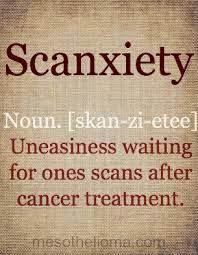
If there is one feeling possibly worse than the possible diagnosis of cancer, it is the anticipation of a pending PET scan (the current standard for declaring a patient is in remission, or is still in remission).

I try not to publish two posts in one day, but a have several Facebook friends who are going through scans or receiving news about the results of their scans today through the upcoming weeks.  So, as one thing I have tried to justify my survivorship as a long term cancer survivor, I want to offer this hope.

scan4

Many people reading “Paul’s Heart” are also members of on-line support groups as well as Facebook pages.  These support areas can be cancer specific, or cancer general.  And these can be a great tool from support to information.  But there has to be an awareness of balance if you subscribe to any of these groups.

scan2

Here is the logic you need to understand.  If you did not have cancer, would you be on a support web list? Of course you would not.  If  you are dealing with cancer, would you be on a support list?  Most likely.  Unlike when I went through my treatments for Hodgkin’s Lymphoma, I never had the internet for support.  But then, what about the period of time, once you have heard, or expect to hear the word remission?  Would you still plan on participating on these support sites anymore?  There is a good likelihood not.  All we want as a cancer patient is to be done with it, once and for all.  Only the few, like me, stick around.  But for the most part, only people that need help, will seek help.

One of the biggest fears resulting from “scanxiety” is that a patient will not get to hear the word remission, or worse, hear the word relapse.  And these are real possibilities.  They do occur.  But if you participate in internet support groups, there are chances you will hear a lot more about relapses, than you will hear about long term cures.  And why would that be?  Someone who has been cured, like mentioned earlier, will most likely want to move on.  That patient has no need to be on an internet support group.  But the patient who is still dealing with cancer, or must deal with it again, will be on the internet.  So again, using logic, just because you cannot see all the long term cures, does not mean they are not there.  But in fact, they are there, in great numbers.  Over 12,000,000 of us.

scan3

I do know how many of you are feeling right now.  In over 25 years, I have met thousands of cancer survivors, many of which I still hear from.  I know what each and every one of you feel, as you do the  mid-point scan, the post treatment scan, and all the other scans after that.  It does get easier.  You have to believe that what you have gone through is enough.  And here is where some tough love is going to come in… and if by some chance, you are still dealing with it… what are you going to do about it?  You are going to keep fighting because that is who you are.

If you have just completed scans recently, or will be getting them done soon, my thoughts are with each and every one of you.  I hope you all get to hear the word remission, or at least, the disease is decreasing.  From there, following the news of remission, will be the six month anniversary, the first anniversary, the fifth anniversary, the 10th, and then like me, the 25th!

Try not to be overwhelmed by what you see others going through.  They are going through their own battle.  You have one thing to do, get through that scan and get on that road of remission.  Speaking of which, a closing line I am known to use with people who reach remission…

“As I continue down the road of remission, I will keep looking in my rear view mirror to make sure that you are still following me.  And if you are not on that highway yet, hurry up.  Once you get on it, it’s a great ride!”

Cancer – Facing Fears Of Relapse


fear3 fear4

The line from Indian Jones that everyone remembers, “Snakes, I hate snakes!”  Always followed up in other IJ movies, “why does it always have to be snakes?”

This morning I was asked, “what are you afraid of?”  The individual was quite shocked at my reply, “nothing.”  Sure, there are things I do not like, there are situations that concern me, but being afraid, fear, is an often paralyzing circumstance.

fear1

In the cancer world, and this is just my opinion, I do not think the feeling of fear is as strong at diagnosis, as it becomes post treatment.  Of course, we do not look forward to a diagnosis of cancer, but I think the majority of us faced with this situation will make up our minds, “I am going to get through this.”  We may not be crazy about some of the diagnostic tests that we get put through, but there generally is no fear at work.

Oddly, fear hits cancer patients, and survivors, usually after treatment ends.  And it can be a crippling fear, the fear of relapse, or recurrence.  And this is perfectly normal.  After all, it was one thing to take on the beast once, and beat it.  It is another to worry that it could come back.  And if it came back, knowing what we went through the first time, and to deal with it again, would use stronger methods of treatment that we could not be certain we could tolerate, or worse, not work at all because perhaps our cancer was not curable after all.  This is a legitimate feeling.

So, how do you deal with it?  I could tell you it gets better, just that simple.  And of course you would probably roll your eyes hearing me say that because that simply will not erase your concern.  But I will tell you, it does get better.  I am proof.  I went through the first follow up scan… to the six month mark… to my first anniversary… to number five.  And to be honest, even 25 years out now, the possibility exists that I could still face it again.  But the nerves of that first scan, soon faded months later, and then completely within a couple of years.

fear2

I have faced a lot in my 25 year survivor period, and the two years battling cancer.  And I could easily let fear influence my prognosis.  But I do not.  I like the above phrasing of the letters from the word “fear”.  I will use another instance of my life where I actually apply the phrases of “fear” to get through my trials.  And it works no matter what situation I have faced, or will face in the future.

As if cancer were not bad enough, I faced open heart surgery in 2008.  If fear would have any appropriate time or place, this would be one of those instances.  But…

1)  I “faced it.”  I was going to die without the emergency bypass.  Fear had no place in the decision making.  I wanted to live.

2)  I “explored it.”  I checked out my surgeons, options.  I studied what could potentially happen to prepare for the surgery, and for life after the procedure.  I made sure everything was in place for my personal life, should anything happen.

3)  I “accepted it.”  I was either going to get through the surgery, or I was going to die.  It was that simple.  Only two results.  I was going to survive and move on with my life, in which case everything matters, or I would die, and then what exactly could I do about that?  So the idea was simple.  I was going to get through it.

4)  I “responded.”  My surgical team and post care team were the best.  I put all my faith in each and every one to deal with the risks, and especially pain management.  I could control nothing that they were in control of themselves.

I have used this philosophy many times in my life, and not just for illnesses.  And accepting what I must face, instead of being afraid of it, is what gets me through every time.  Even as I approach my sixth decade of existence, there are still things that I have not had to face in my life.  And I will face everything the same way as I have succeeded before.

I currently have friends who are still going through treatments, dealing with relapses, and some who are knocking on that door of the word “remission.”  And these are definitely scary times.  But in time, one day turns to one week.  One week turns to one month.  One month turns into one year.  One year turns into five years.  Five years turns into ten years.  Ten years turns into twenty-five.  And so on.  And each day you face those fears head on, you succeed because you know you have to.  And it does get easier.  I have been there and done that.

Yes, I know you want the treatments to end.  Yes, I know you want to hear the word remission.  Yes, I know you do not want to hear “new disease” or “relapse.”  But the fact is, it can happen.  But what will you do about it?  You will fight it just as hard as you did before.  And you know how to do it, and get through it.  There is no room for fear.  You face it, explore it, accept it, and respond.

Post Navigation