Paul's Heart

Life As A Dad, And A Survivor

Time Is Running Out


One month is done into the new school year already. My one daughter is approaching mid-terms in college. My younger daughter about to approach mid-term of her quarter of her senior year of high school. As their Dad, I play a separate role for each.

Throughout their elementary and middle school education, I could be described as a very involved parent when it came to their education. Not to be confused with “helicopter parenting,” I simply made sure that homework was completed, quizes and tests were studied for, and best efforts were always encouraged, and achievements were recognized and praised.

Once my daughters reached high school, they each developed their own unique study habits. I turned over all of the responsibility of their schooling to them, with the exception of important deadlines pertaining to milestones, the college application process, and of course, graduation. Not one to have any place to ridicule their methods and means as students and their study habits, I did not have great study habits either, they have done nothing but produce great grades.

The school district has a very well constructed communication tool to keep parents apprised of the status of their childrens’ grades and other personal information. All I had to do at that point, is just sit back and watch. Every now and then, I would be approached by either of them for help with a specific assignment, whether it to spellcheck, or provide information. Both knew not to come to me for math, at least the “new math”.

With my college student, I no longer have that ability to see how she is doing. I can ask her how here classes are going, and I get simple answers, “good.” Instead of seeing her daily progress, I am now just an observer and must wait for the end of the semester to hear of her results. I am just an observer.

But with my high school senior, I still have a little more time of usefulness as a role model with her education. As her senior classes seem more geared to current events of the world today, whether it be business, economics, or politics, I am watching her develop as an independent thinker, something I think a lot of people fail the ability to be.

Part of her Summer assignment for her AP Government course, was to select five topics, and then find three news stories with different leans; extreme right, right, center, left, extreme left. She had to summarize each and compare it with all of the facts that she had gathered with each topic. Her first impression while undertaking this assignment, is she now understands why so many adults cannot get along with each other. The confusion for my daughter, is that when only facts are considered, solutions should be able to be found. Of course she realizes that each media resource she looked at, many have a political lean or agenda, aligned with a certain party or sub-party. Again, another observation on her part about the generations ahead of her, by ignoring the facts, too many put a party affiliation over issues that really matter to people.

She will turn 18 years old next year, and I am proud to say, I will be two for two, with registered independent voters, such as myself. My daughter will not be swayed by one particular news source, but a variety, and only when all the facts are laid out, she will make her decisions.

Another assignment she has been assigned, to argue either that “greed is good for the economy” or “greed is bad for the economy.” The assumption that we have gone from a society based on capitalism to one of greed, simply by “trickle down economics”, going back to the Reagan presidency. Simply put, make the rich more wealthy, and then they will eventually share it with those below them. Only in the forty years since the concept, that has never happened. NEVER. With the values I have taught my daughter, greed being bad, I encouraged her that she would be able to make an easy and well defined case that greed is bad for our economy.

I have to admit, with the exception of the new math, I have enjoyed assisting my daughters with their schooling when asked. I know that as adults, they have been well educated, and can have intelligent and informed conversations with people, not based on media influences. But this time is going to end when she graduates from high school, and like my older daughter, totally independent with her future endeavors.

As I see many of my friends who have just begun sending their children to school, I find myself thinking, “oh how long ago that was.” But it wasn’t. The time really flew by.
The Days After


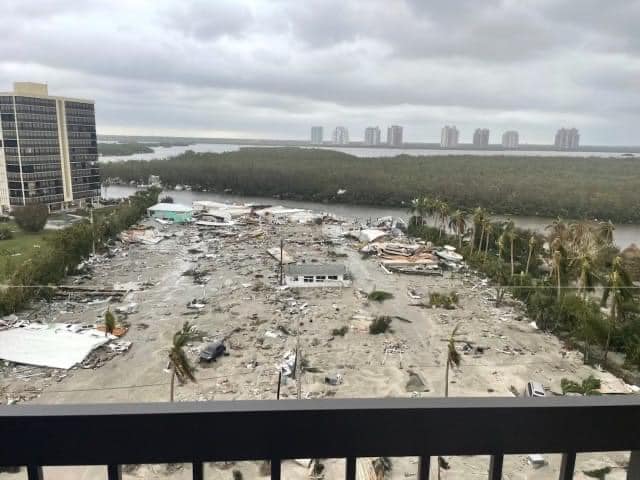
The first few days following a major hurricane can be described in any number of ways, likely depending on how much the devastation has affected a person individually. Shock and sadness are a given as the loss sets in that our once daily lives in paradise are changed forever, perhaps, irreparably. It is easy to feel overwhelmed at the amount of clean up and repair in the days ahead, not even knowing where to start. And when our mind stops whirling like a cyclone from all that must be done, either common sense or survivalist tendencies kick in. It is this behavior that can either help, or make things worse.

There are two main things that those in the path of a hurricane, or the devastation of a hurricane, will need, gasoline and bottled water. The demand for both is an immediate switch that gets flipped, with the first words uttered by a weather forecaster, before suppliers have a chance to prepare. Artificial shortages are created, leading to panic of the possibility of not having what is needed. Someone with a calm demeanor can rationalize, that if we just purchase our goods at our normal rate, we should be able to get by until increased supplies arrive. Instead, supplies are empty of both within hours, and from there, supplies of both are not able to be kept up with. As the storm passes, all anyone knows is that there is no gas and no water. Lines form for hours at any gas station able to operate, and grocery stores, ration out water supplies as they become available. Then come the days after.

There are several behaviors that come forward in a time like this. First and most obvious, the curiosity of the devastation. As soon as you step outside of where you rode the storm out, you can see the immediate impact. But without power, cable, and wifi, we want to know just how bad it really got. This actually ends up being a bad decision for several reasons. One, with downed lines and trees, these dangers, especially if submerged in water, can be deadly. Second, “looky-loos” as they are called, often get in the way of rescue efforts, in worst cases, needing being rescued themselves. And of course, there is the unnecessary waste of gas just “riding around.”

Which of course, leads to the next issue, finding gas, or even an operating gas station. Relying on the “gas buddy” app could be misleading with people putting in false information. But the first thing you had to do was to find if a station was working, which if you saw a nearby traffic signal working, was an encouraging sign. Likewise, there would be a lengthy line of cars, many there for seven to ten hours, having hopes of being lucky to buy gas. It is inevitable that throughout this process, there would be at least one jackass somewhere, cutting into the line, causing authorities to respond as tempers flare.

Grocery stores, would open as soon as they could, if able to, usually with the help of a generator. But as good as sign as this was, anything in the store that was refrigerated would be tossed and unsellable. You would be able to buy bottled water as long as supplies lasted. I can tell you that as of today, four days after Ian, all shelves locally are still completely empty of fruit, vegetable, and dairy products. But as supplies come in, they will be gobbled up and hoarded by those afraid it may be too long before they get a chance to buy more. So this supply will remain near zero.

Traffic is a major safety concern, as many intersections no longer having operating traffic signals, with a six lane road intersection. It is a “courtesy” situation, everyone is expected to stop at each light that is not working. Six lanes of north and south traffic intersecting with six lanes of east and west traffic, all trusting each other to be courteous and take turns, until someone just says “fuck it” and ignores the unwritten respect. Then it becomes a free-for-all and then humans are placed in the intersection to direct traffic. This is another reason authorities do not want unnecessary vehicles on the road. But you know society, “I have a right to be on the road.”

There are several local businesses who may have been able to survive with little damage, enough to still be able to be open. Many will work to serve food to first responders and emergency workers. Others will try to prepare foods for locals, unable to cook or even have a place to stay. Unfortunately, there will be those who look at the open sanctuaries as an opportunity for “life as usual – ‘I’m out for a nice dinner” and end up being demeaning and disrespectful because the restaurant may not be able to offer a full meal, service may be slow, because workers still have their own mess to deal with damage wise back at home.

Finally, this is a heavy tourist area. And once the fall rolls around, along with hurricanes, so come all the vacationers, snowbirds, and seasonal homeowners. Things are bad enough for us as locals with the devastation and shortages, but curious or entitled travelers will soon arrive, compounding our problem. On social media pages, you can already see locals emploring everyone to stay away, at least for the the time being. If you need to come down, to check out property, and it must be done personally, fine. Plus, with groceries already at a minimum, gas in short supply, we do not need the thousands and thousands of visitors right at this moment compounding our needs. But the reality is most will come down to pick up their seasonal traditions of eating at coastline restaurants, boating excursions, and many more activities that make this such a great place to live.

But as I experienced with Irma five years ago, and the great everglade brush fire two years later, those here for recreation are not shy expressing their displeasure with having their fun times interrupted by inconvenience, expecting everything to be normal before they arrive. But the truth is, it will be a long time before anything is considered normal. And if that is how they want to spend this season, and they know this upfront, then fine. They have no right to complain how slow recovery is going, or how short supply things are, especially if they are adding to the problem.

Like I said, you can either stay out of the way, help, or add to the dilemma. It does not take long to see who is who.

The “I’s” Definitely Have It


I have been through many hurricanes in my lifetime. Five years ago, I experienced my first encounter with an “eye” of a hurricane, courtesy of “Irma.” All of my experiences were different, from wind and rain damages. As far as my memories of each, and the days after, they are all distinct to each storm; “Gloria”, “Floyd”, “Irene”, and super storm “Sandy”. All of these storms had differing impacts and affected daily activities from clean up to functioning without conveniences of running water, electricity, and cable. Life after “Irma” gave me experiences I could have only imagined, such as driving at night, with absolutely no lighting, traffic lights and street lights, not even the ambient lighting of businesses along the roads, just pitch blackness, with no concept of where I even was.

But “Ian”, now the second storm to hit the east coast of Florida in five years, has left me with a whole new level of feelings of heartbreak that I have not experienced with the other storms. As far as “Irma” was concerned, it was a much more scary hurricane, in that its anticipation, and roar as it passed overhead, really had me feeling it was not going to end well.

“Ian” on the other hand, was not as bad a storm for those of us further inland, but for those along our coast, using a gauge of location to a main highway, all those located on the coastal side of that route, needed to evacuate due to an expected storm surge, likely over ten feet, which could potentially push Gulf water miles inland.

Just as with “Irma,” now that power and cable is available, we “locals” can now see the devastation that has been left behind. Homes flooded. Boats having floated from their docks, many now dumped in lawns and parking spaces. Cars have been washed away, many now settled and huddled together in various locations.

Again, it is not the destruction that is really affecting me. We expect that. And our hearts go out to all of those who lost everything except for their lives. Hopefully, just as with the other storms, the rebuilding of lives will begin.

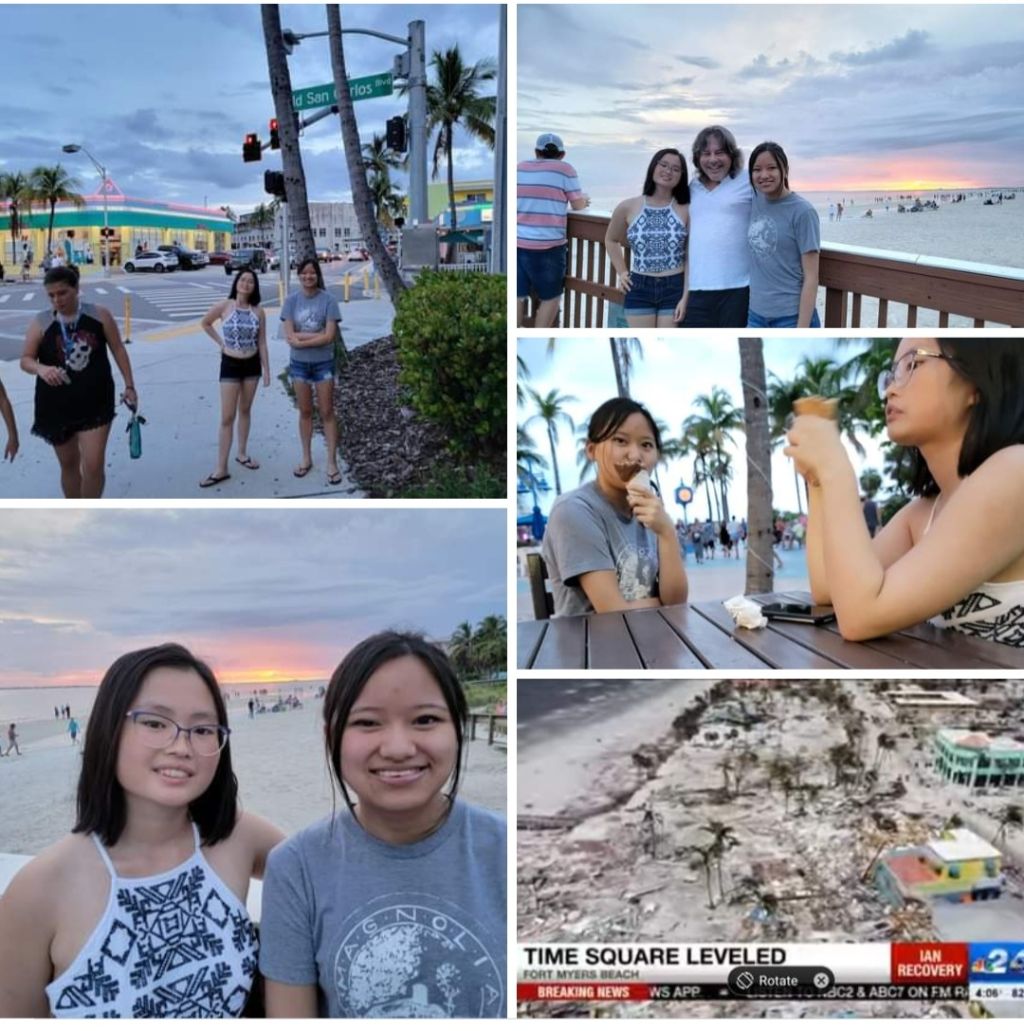
The one thing different for me with this storm, is that just over a month ago, while my daughters were visiting me here, we visited many of the locations, now either destroyed, or totally gone. The pictures above are from Fort Myers Beach, just completely flattened with is landmark pier destroyed. One of the most beautiful pictures at sunset with my daughters came on that pier, this past August. We enjoyed some ice cream in the shop just next to the pier. All that is left is a photograph and the memory. The destruction of a major causeway, beginning at the location of a restaurant we just ate at, will serve as a constant reminder to where it will be a long time again, before we can travel, with access to the beautiful islands now cut off. Video of the angry tides from “Ian” thrashing the buoy at Mile Marker 0 in Key West, my daughters now look at the reporting today from the news, and can personally reflect on a happier time at these famous spots.

We all thought “Irma” would be the worst storm we had ever experienced. We were wrong. “Ian” will go down in the books like “Katrina” and “Agnes.” Places will be re-built, and hopefully casualties will be kept to a minimum. I am not sure when I will get to see all the beautiful spots again, or even if, as it is going to take a long time to build back.

But for now, for those of us who were fortunate enough during this storm, we need to do what we can to help, whether it be by donations, or soliciting local businesses with patience and understanding, that someone serving us, might have just lost everything. A stranger’s kindness can go a long way in times like these.

Post Navigation