Paul's Heart

Life As A Dad, And A Survivor

Archive for the category “The Heart”

The Power Of The Living Directive


There are two things that make us squirm to talk about, death, and how to prepare should something go wrong during an illness or injury.  We go through life assuming, or perhaps just wanting to ignore the realities, because, “that kind of talk is for old people.”  I know that is the way that I thought, even having gone through cancer.  I was immortal, or at least for as long as I could tell, for decades to come.

That thinking changed obviously in 2008 with my heart surgery, and the realization that it was likely I would face many other challenges to my health.  I could no longer make it about my age for my reason to put off the discussion of preparations.  I got lucky the doctors saved my life while I was in the grips of a silent killer, a “widow maker” cardiac event.

For the sakes of my children, I needed to not only have a will for if I died, but a living directive if something would go wrong with any procedure or any kind of event.  Time was not going to wait for me to get old.  For me, it was fairly simple.  I made it very clear, no artificial means to keep me alive, and not to let me be in pain.  I have had to make some changes in both will and living directive following my divorce, but I have kept everything pretty much the same.  I am not a complicated individual.

For others, this may not be the case.  When my father was in the process of being diagnosed with lung cancer, he made the decision to make me his medical proxy.  He did it for two reasons.  One, my extensive history and experience with medicine (in spite of not being a doctor), he knew I would be able to explain things to him clearly, as well as help him to express what he needed to have explained.  The other, having watched both of his parents suffer in their ends, he believed in me, that I would not let the same thing happen to him.

This came at a personal cost for me, because, being in that position, I could not allow myself to feel any emotions that might jeopardize anything my father wanted to happen, or not happen.  This loss of emotion admittedly makes me realize I can have quite a cold personality in situations like this, almost robotic.  But when my father was in his best mind, he made it clear to me, what he wanted, and what he did not want to happen.

If you are hospitalized, or having to go through any medical challenge like cancer, you are likely to face these life and quality of life decisions.  As I said, I have things in place.  But recently, I came across some information, once provided to me years ago, called “Five Wishes.”

This pamphlet is a very well thought out document, to help plan out the “what if” so that there is no mistaking what a person’s wishes are.  I know my personal physician has disagreed with my directive in that I have made it too simple, too black and white.  But it is how I feel.  Don’t get me wrong, I do not plan to be in that situation anytime soon.

Five Wishes is a form of living will that talks about your personal, emotional, spiritual, and medical needs.  The one thing that this form makes the author aware of, is that there are still some states that will not recognize the document or your wishes.  That is a big deal.

The first thing necessary to do, is like my father chose, someone to make decisions in the event he was not able to do.  This is a big deal because that representative has to put all personal biases and beliefs aside to respect the wishes of the patient, no matter who it is.  And that is a big deal, it does not have to be a family member either, as family members, not me in my dad’s case, can be too emotional when it comes to decisions.

I will tell you, the hardest part for me to get family and others to understand, was when the time came, to stop giving him access to certain maintenance medications (like for cholesterol, etc.).  Because legal decisions had to be made in his care, handled by my stepbrother, insurance changes to allow my father and stepmother to be in the same care facility, and the fact that he was going to die, made these medications unnecessary.  But other challenges would come if a serious illness like pneumonia were to develop or some other issue.  It was difficult for others to understand, there would be no treatment, to prolong his inevitable passing.  A simple concept, not to allow him to recover from one illness, to eventually suffer as the cancer spread causing more pain than what could have spared him.

There are a lot of other responsibilities that this advocate must take on.  Keeping the emotions in check is not only necessary, but unavoidable because of all of the responsibilities.

You should decide what efforts or treatments are done to keep you alive.  This is where my doctor and I sort of disagree.  The two most common terms you quickly become familiar with are DNR (do not resuscitate) or being put on life support.

With Covid19, this becomes a very difficult reality for me.  I have made it clear, I do not want to be kept alive on life support mechanisms.  But if I were to contract this virus, because of my frailties, there is more than a good chance I would end up on just that because of what the virus does to the lungs, which mine are compromised.  It then becomes a choice if the life support is used to save my life, versus sustain it.  But my directive says what it does.  Therefore, I need to avoid this virus at all costs.  Needless to say, a fatal end caused by this virus, your five wishes mean nothing.

Two other aspects or wishes pertain to the humane aspects of this directive, comfort or quality of life, and what is expected from others, especially loved ones.  From medicines to control pain, to location of where the passing might occur, and the overall atmosphere of those around the ill person.

The final wish deals with the patient themself, and what they want their loved ones, family, friends, and in most cases, their caregivers to know.  These can be kind words, actual gifts, perhaps asking for personal differences to be resolved before passing, and of course, post end of life plans.

No, this part of life is not easy to talk about, let alone go through.  And there is no minimum age that is required.  Though definitely as you get longer in the tooth, it definitely becomes a priority.
Living With Survivor’s Guilt


Have you ever had one of those moments, either walking or driving by someone or something, and your head snaps back because you thought you saw something but were not quite sure?  That is what happened to me yesterday.  I was flipping through television channels, a skill that I have mastered, knowing I only have to spend less than a second to know if it is going to be something that I might be interested in.

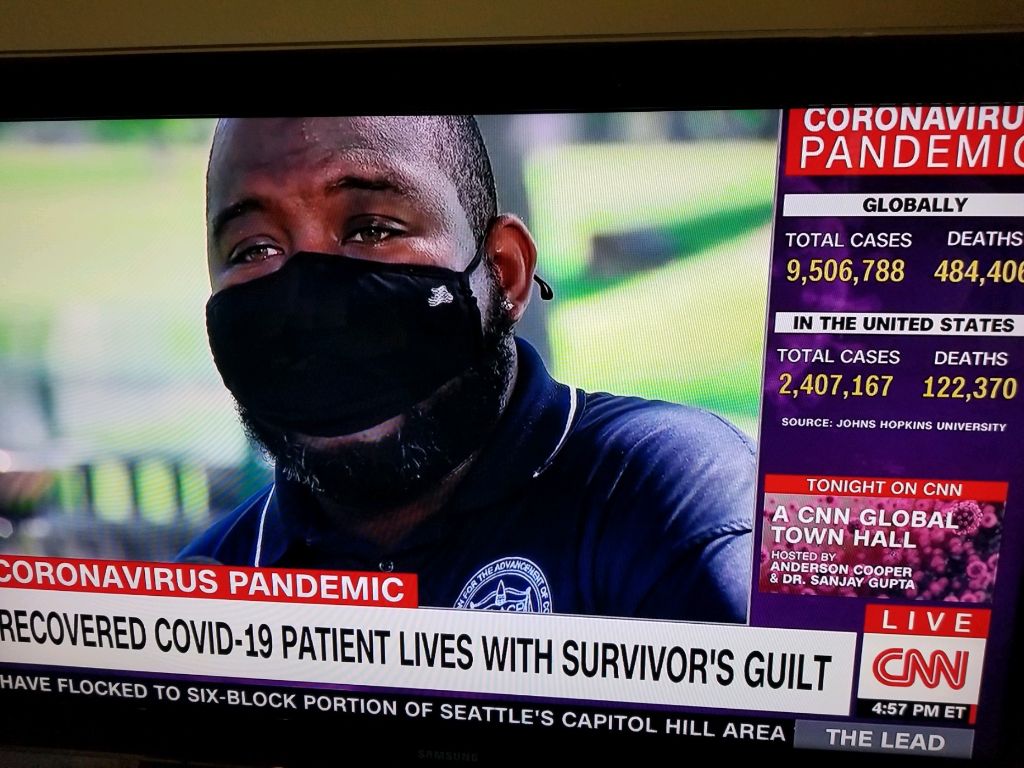
The man pictured above had survived the worst that Covid19 could do to him short of dying.  He experienced the Acute Respiratory Syndrome (ARS, the pnuemonia diagnosis normally fatal) as well as sepsis, which by itself is fatal.  At the age of 37, he spent weeks in the hospital.  In his interview, he says, “the hardest part for me is seeing how many people die from Covid19, why did I live?  And everybody else died.”

This emotional issue is called “Survivor’s Guilt.”

There are two myths about “Survivor’s Guilt.”  The first, often this term was used for those who had served in the military, previously called “shell shock”, “battle fatigue,” among others.  But at some point, during the 1980’s, some events in our history resulted in people having survived natural disasters dealing with emotional survival issues especially when there were mass casualties were associated with it.  And then, upon the completion of my cancer treatments, though not diagnosed officially until 2008, I developed what was definitely called “Survivor’s Guilt.”

Myth number two, just because someone experiences “Survivor’s Guilt,” does not mean they wish that they had not survived, want to die, or are ungrateful.  Quite the contrary.

I first can trace my Survivor Guilt issue, to the first cancer patient that I counseled following my cancer treatments.  She was a fourteen year old girl at the time, and she had the exact same cancer that I did.  I have her story, called “Jennifer’s Story” on the page section of my blog.  But in summary, she would not survive her Hodgkin’s Lymphoma.  She would never hear the words remission.  And as I visited with her over the three years, I often sat across from her mother while visiting with Jennifer, wondering what might be going through her mother’s mind as I sat there, cured of the same cancer her child would die from.

Jennifer was the first experience I had with survivor guilt, and I would have many more experiences like this over my thirty years.  And it would not just occur with Hodgkin’s Lymphoma directly, but the first half of my thirty years of survival were issue free, whereas so many I knew were dealing with harsh late developing side effects, but not me.  Some would die as well from those issues.  And then of course, I would join that club of long term survivors with late effects, and deal with at least four issues that were serious enough to cost me my life if not dealt with promptly and correctly.  And yet, here I am, while other survivors did not survive theirs, and of course, still other Hodgkin’s survivors as well not making remission.

“Why do I live, when others die?”

Make no mistake, I am definitely glad to have survived all of these years.  I have been blessed with two wonderful daughters and watch them grow, and I even count on being able to see many of their adult years.  I believe that I have a good team of doctors and specialists, and just as important, a support network of survivors that no one could have imagined back before the 1990’s and the internet.

I just wish that every one  that I crossed paths with, could have had that same opportunity as me.  And I cannot make those feelings stop.

It took a therapist specializing in cancer survivorship to explain “Survivorship Guilt.”  I spent years in therapy for this, to discover that there were other issues associated with my cancer journey that complicated things.  And then there was life as well and the many issues that came up.  Soon, my cancer issues and survivor guilt often found themselves taking a backseat to employer related discrimination issues, other family member medical issues, family deaths, and divorces.  Sure, those not going through cancer, deal with all of those issues on a daily basis, some deal with all, some maybe one or two of the issues.  But when you throw in cancer, survivorship, and it effects, it really complicates things, and that is when peer survivors and professional therapists make a difference.

But wait, “do you mean seeing a shrink?”  Right, that stigma and stereotype, only crazy people need to see a psychiatrist.

I promise you, there is not one survivor I know, or have ever known, who has had the counsel of a therapist that would have matched the stereotype or deserving of the stigma.  Some of my fellow survivors find it sufficient just to relate with another survivor, but some have feelings much stronger, and I encourage anyone who feels that way, needing more than their peers, their friends, even their significant other, to seek out a therapist.  It really makes a difference.

I still have my survivor’s guilt after thirty years.  I have said goodbye to so many.  But I have so many that remind me every day, that there is a reason I am still here.  Because I offer them the same support, and remind them of the same things, that there are so many that depend on our survival.  Until any of us possess the power to make the sun rise and set, form ocean waves, or make snow fall, we just have to accept that things happen the way that they do, just because.

But there is going to be a new large population of people who are going to survive this horrific virus, Covid19, and because of how contagious it is, many are likely to lose loved ones and friends.  And like the gentleman above, left to wonder why them, and not the others.

As a country, we need to do better to offer better emotional help not just to those with the obvious issues, but also those who survive traumas whether it be war, a car accident, a natural disaster, cancer, or a pandemic.  There are too many of us that struggle with this to just be forgotten to deal with on our own.

Seeing Is Believing


Medical records.  The most important thing about you, that you should always have at your disposal.  I am not talking about your annual check-ups or flu shots necessarily, but then again, always a good thing to keep up to date on your health.  I am talking about when you face an important challenge to your health.

Up until recently, it was difficult and at times very expensive, in spite of it being your right, to obtain a copy of a hospital visit without jumping through all kinds of hoops, and signing a form to finance the expense of obtaining the pages of your file (yes, I know, that is an exaggeration but at $.25 a page for something that is rightfully mine?).  Today, many hospitals across the country are now using a computer program to do what we had to do physically when seeing another doctor, sharing our records.

This new technology has helped to share our information between medical providers, but it also has given us, the patients easier, and less expensive access to our records.  Sure, you will not get the actual play by play, but you will at least get the summaries of your status and most results.

But how important is this?

When I had my open heart surgery in 2008, and it was discovered that it was attributed to the late developing side effects from my cancer treatments eighteen years earlier, I enrolled in a “survivorship clinic” at Memorial Sloan Kettering Cancer Center.  There were only a few of these clinics in the country at that time, where as now much more available at most major cancer centers.

One of the first things that I was asked to submit, was my cancer files for my Hodgkin’s Lymphoma.  Not thinking anything of it, I reached out to the hospital that treated me with radiation therapy, and my oncologist office that treated me with chemotherapy.  I ran into a problem.  I was able to locate my radiation therapy records, most likely due to the fact there are regulations pertaining to radiation exposure and keeping records.  But it turns out, my records with my oncologist, who I was no longer seeing, were destroyed.  Or as the office receptionist put it, “were burned in a fire.”  My initial thoughts were empathy thinking that their office had experienced a tragic loss from fire, then I realized she probably meant that they purged records of older patients by incinerating them, believing that there would never be a need for them.  And the fact that I was now asking for those records, she did not want to risk legal action by admitting they had intentionally destroyed my records.

So with only half of the information, my doctor took that data, and combined with his own research, using a very resourceful system of the Childrens Oncology Group, who had established a standardized guideline of follow up care, as well as exposures and risks, and was able to estimate, what dosages I received and of what.

From there, it was just a matter of running all of the tests necessary to figure out what I was likely dealing with.  The picture above just mentioned preliminary estimations of what was already known.  There are now an additional two pages that go with that page.

I learned back in 2008, I needed to maintain my own records.  Sure, all the doctors had their own records, and normally, access to them was not an issue, but at times, time consuming.  Of course today, computer systems now provide multiple levels of access to health records.  But it will still not eliminate the need for any patient, cancer or not, to keep track of their own records.

You do not know if you will have to deal with a provider who is lazy or have an issue with their ego, and pay any attention to your history, that they want to do everything themselves.  I have run into those situations in the past.

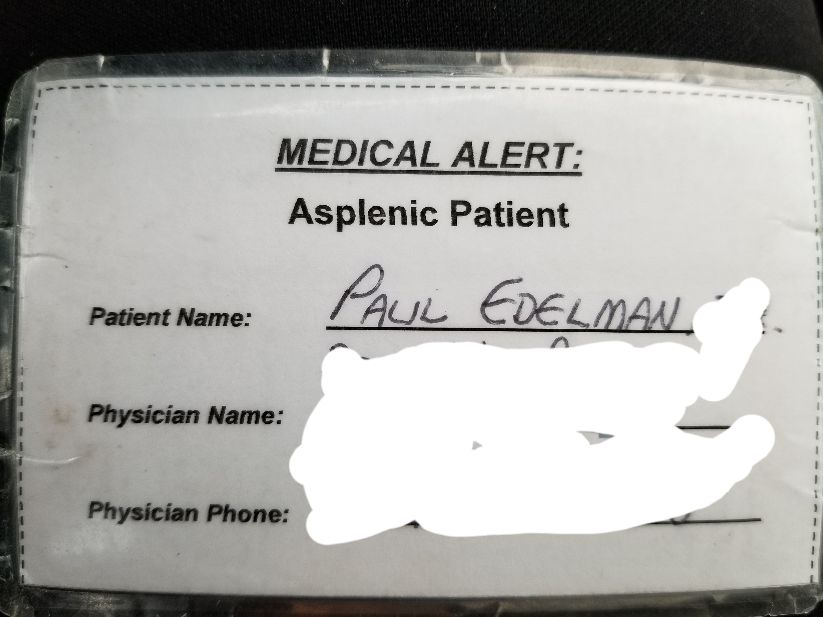
I have a simple system currently, though could be condensed, and I am working on it.  I have a back pack, very cumbersome, that has all of my records since 2008.  I wear a med alert bracelet that has simple directions on it, to look in my wallet for small laminated cards, that has each and every diagnosis I deal with, as well as the doctors to contact for assistance with my care.

And because one of my most serious issue, is not having a spleen, it is important that if I happen to have a first responder or nurse that does not understand what it means when they deal with me, these cards explain what to do.  Of course, I still rely on them following these directions.

As I have gotten older, and also divorced, my children, who will be of adult age, will likely be the ones responsible for my care if the needs ever arise.  I have reduced my back pack down to three of the binders you see pictured, in the event of an emergency and no computer access, as well as a thumb drive.  But these records keep track and assist as all of the late side effect issues that I have as they progress.

Like I said, you do not need to keep track of all your records such as visits for colds and flus.  But anything that was important, not just cancer, but vaccine records, biopsies, broken bones, any studies that you have done, it is in your best interest to make sure, if you have not done so already, make sure that you have your hands on your own records as well.  And if you do not have access to them anymore because they may have been destroyed, research and do your best to recreate them.  Some records are better than none.

Post Navigation