Paul's Heart

Life As A Dad, And A Survivor

Archive for the category “Side Effects”

And The Beat Goes On

Of all the issues that I deal with from my treatments for Hodgkin’s Lymphoma over thirty years ago, my heart has consumed the majority of the focus. Obviously, the heart beating is the most important factor in our life. My first heart surgery was an emergency double bypass for what is nicknamed a “widow maker” blockage (the name speaks for itself) of the main artery to the heart. Then, eleven years later, a second heart surgery to place a stent in another major artery of the heart.

It is the third heart surgery, just over four months ago now, that psychologically had managed to jar my thinking. The diagnosis was “congestive heart failure.” The widow maker had it occurred would have been an instant event, and without immediate intervention, as my original cardiologist put it, “was not a question of ‘if’, but ‘when'” I was going to die. But in the years that have passed since then, I had never seen the words “congestive heart failure.”

Being as involved in cancer and survivorship support, I have heard of CHF, many times. And really none with any positive outcomes. From those I knew, if you were diagnosed with CHF, there was really only one eventual possibility to survive it, and that would be a heart transplant. Heart transplants are not an easy thing to get done as it is. But it is literally unheard of in my world of Hodgkin’s survivors. Because of the chronic, progressive, and permanent issues, we are typically not candidates for heart transplants. The odds of survivorship are insurmountable. We may be getting closer to that option, as last year, a fellow survivor fought hard enough, and advocated enough to finally find a doctor willing to perform the transplant. Alas, there was a complication pre-surgery, which then disqualified her for the transplant. She died soon after.

It is easy to get lost in the words “heart failure.” Simply put, it means that the heart is not beating as it should. It is not however, always as bad as it seems. There are certain levels of heart failure. For the purposes of today, and this post, I am referring to the heart valves. There are four: aortic, mitral, tricuspid, and pulmonary.

What leads to heart valve disease can vary. You can be born with valve defects. Infections are also a cause of heart valve disease. Heart attacks and other cardiac events can cause damage to the valves. Other factors can include diabetes, obesity, high blood pressure, and high cholesterol, all contribute to heart valve disease. And then there are causes, created by curing other illnesses. Such is the case of treating cancer. Exposure to chemotherapy and radiation therapies can cause progressive and cumulative damage to the heart valves. I can speak to this personally.

Unless you are under a cardiologist’s care, it is difficult to recognize when you are dealing with heart valve issues. But the symptoms are there. The trick is to recognize them. Some symptoms can be quite subtle and almost unrecognizable, such as lightheadedness, more tired than usual, or even feeling “off”. A little more attention-getting could be an irregular heartbeat you feel, or a flutter, perhaps even chest pains. And the most noticeable, swollen ankles and SOB, shortness of breath. Though I had been aware of my valve issues for more than a decade, my health history required a lengthy “wait and watch”, to determine the right time to repair the affected valves, as my breathing issue got worse, I could tell the time was getting close. Something needed to be done.

There are various means to fix bad heart valves from open heart surgery to methods using trans catheter means (through the leg), much less invasive. And that is the experience that I now have.
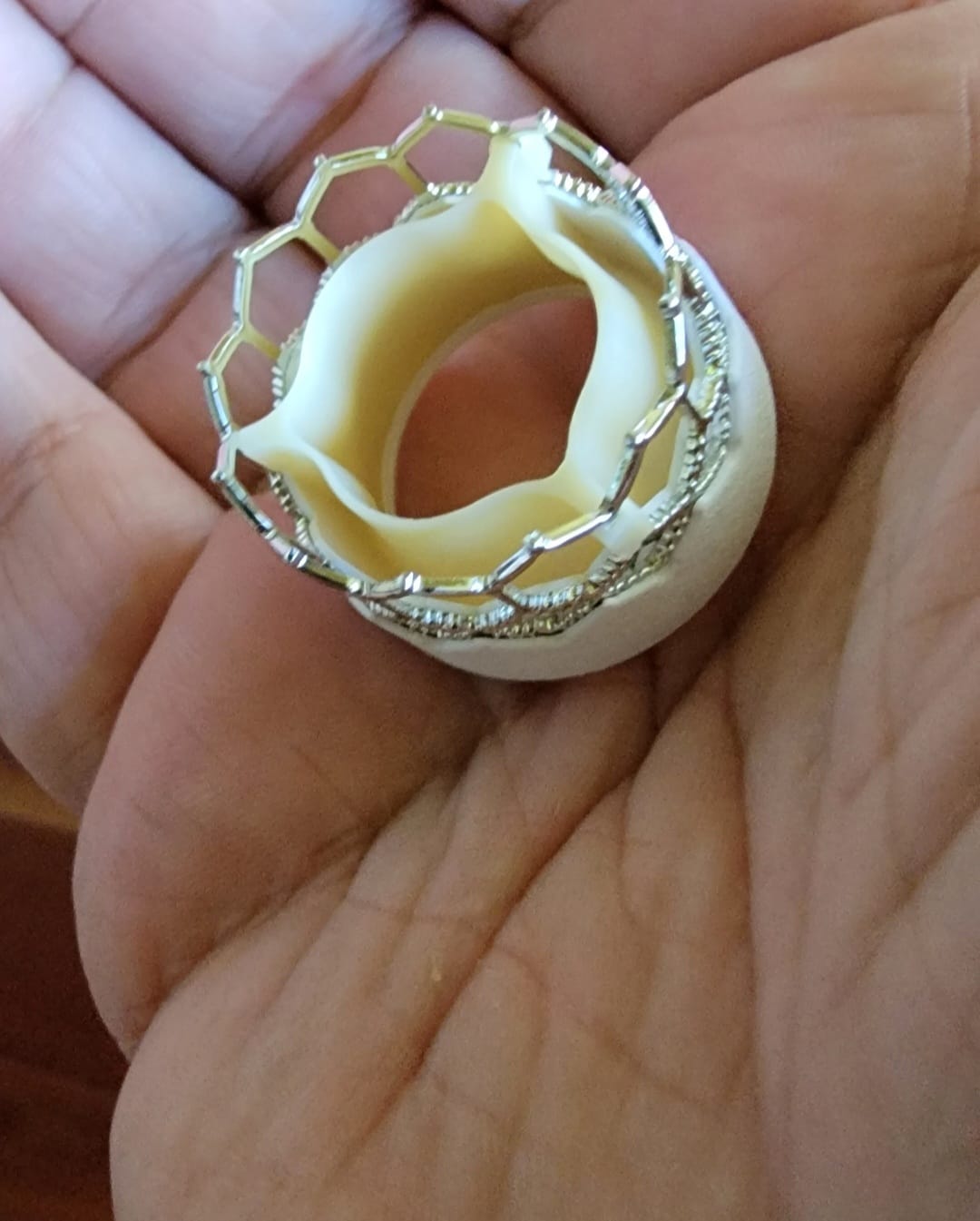
What you are looking at is a replica of my new aortic valve. And it is amazing to know, it is close to its actual size. This is what is known as a bio valve (artificial). The other option is a mechanical valve which results in a much more monitored after care and precautions.

Whichever valve is used, the result following the procedure, provided your symptoms were severe enough, is immediate relief. After more than a decade of feeling this way, four months later, my heart is still working great, well, better than it was. I still have other issues with the heart that have to be addressed, and my other non-cardiac issues, but for now, I am enjoying every step I can take without collapsing from the lack of proper blood flow. And you do feel the difference.

So today, is Heart Valve Disease Awareness Day. You might just be surprised who is celebrating today. Celebrate with them. You and they have that chance.

A Moment Sinking In


I do a lot of writing. There are several destinations where my thoughts end up. Yesterday, I was approached by yet another organization that I have just become intimately connected to.

This photo, is a replica of an artificial heart valve, that is sitting in my hand. I should be more specific. This is a replica of an artificial heart valve, that has been placed inside of the aortic valve inside my heart. Now, while I think I can be described as having a large heart, I am confident that the actual valve that was placed inside of me, was much smaller. I do know this. On an x-ray, it is visible to the eye. Cooooooool!

The company that manufactured this valve, asked for a small essay on what life was like before the surgery for me, and life after. To be honest, I had never really given it much thought. This surgery was just yet another surgery to correct progressive damage caused by the treatments for Hodgkin’s Lymphoma thirty two years ago. This was actually the 3rd surgery to my heart. The first, a double bypass of the LAD (left anterior descending artery), a main artery of the heart, back in 2008. The second, a stent placed in the RCA (right coronary artery), another major artery, in 2019. Unlike my bypass in 2008, the other two surgeries did not require open heart surgeries. With the risks that Hodgkin’s survivors have with open heart surgeries (bleeding to death one of them), having more than one, increases the risks. The amazing thing is, just ten years ago, these last two surgeries I underwent, were not even options for patients with my type of history.

As I was limited to a thousand words, I had to stay focused on what I needed to say about my aortic valve.

Well, I first found out that the aortic valve was going to be a problem, back in 2008 during my bypass surgery. In fact, the RCA was also discovered to be an issue at that time. Two other valves would also attract attention. Because of the lack of experience of my cardiologist, and understanding my treatment history, it was just assumed that all of the other issues would correct themselves with a perfectly functioning heart following the bypass.

Today, we now know that cumulative radiation and chemotherapy damage, does not just “go away.” It does get worse, just how much. But another factor played in to the decision to just do the bypass. Any of the surgeries that I have gone through are not permanent fixes. How long each one will last is not known, only speculated. My age in 2008, was 42. As the nurses reminded me as I was laying completely “exposed” on the operating table in all my glory, “he’s so young,” age has a lot to do with determining what can be done, when, and how many times. The decision back then was made, to sit back and watch. Over time, the valve did get worse. And some time over the last year, got much worse, very quickly.

I did not need the annual echocardiograms to tell me that. I could feel it. I could see it. My legs and ankles had begun to swell quite a bit, common for a heart that is not pumping like it should. And then there was the SOB, shortness of breath.

On a trip with my daughters to “Graffitti Highway” in Centralia, Pennsylvania, home to the large underground mine fire, we took a walk along the now closed former main road through the town, decorated with spray paint, which is how it got its name. At some point, my daughters realized I was having a hard time catching my breath, as I had to stop repeatedly to restore it.

Last Summer, that valve got much worse, to the point that I was no longer able really to go ten feet inside the home, without being out of breath. Tests would confirm, the time was now to replace that valve.

As I mentioned earlier, in a procedure that was not possible for myself and my fellow survivors, doctors were able to use a method called TAVR, to go through my leg, and insert that valve, the replica pictured in my hand, into my failed aortic valve.

When I awoke, the relief was instantaneous. As soon as I was able to sit up, a fete that prior to the surgery often left me struggling for air, I was now able to breathe easily. I cannot remember the last time I was able to breath this way. My recovery was going so well, I was actually discharged the next day. According to my research and fellow patients, I was anticipating at least a four to five day hospital stay. But not the next day!

From there, just as I had with my prior two surgeries, I followed my doctors advice, to get active, at least go for several walks. I completed my third round of cardiac rehab with flying colors. After struggling for thirteen years, because the job was not done completely back then, I felt a sense of normal (at least as far as my heart goes).

I now feel more than confident, that my long term goals of my cancer survivorship, have an even better chance now, to see my daughters grow into adulthood. Every year is another milestone. And it is definitely happening. A major milestone will be hit this June with my older daughter.

So, I finished my essay acknowledging how great life was again, now that I did not feel that my heart was going to fail me.

I do have two other valves in my heart being watched, but are nowhere near the level of action yet. And it is likely, my bypass, stent, and this new valve, will all have to be dealt with again, quite possibly as some sort of cataclysmic event several years from now. And then there are the other issues of the systems in my body, dealing with late effects from my lungs, my spine, my esophagus, my thyroid, and more, are now making themselves known.

My heart has always been the one getting the most attention, and giving me the most to think about. Because if anything were to happen to the heart, that would be the end of the story. Now, I get to live out more chapters. And this book is only getting better.

Calming Down. Yes, You Can (And Should).


A traffic jam. A car cuts you off on a highway changing lanes. Blue and red flashing lights appear in your rear view mirror. While backing out of a parking space, your car suffers a sudden thud as you realize you backed into someone.

A dentist appointment. Going to see the doctor. A surgical procedure. A pending diagnosis of a serious illness.

Panic attacks.

A job interview. A first date. Closing on a sale of your house.

These things are all capable of raising your blood pressure and heart rate, for the wrong reasons. And if it happens to often, or lasts too long, it can be a bad thing. As compared to a controlled situation such as exercising. Because during exercise, you are expected to monitor your pulse as you exercise. You also need to be aware of the range of your exercising heart beat range compared to your resting heart beat.

There are a number of different charts to help you figure out what range your heart beat should be in, but it is best to get that information from your doctor or certified trainer.

But what happens when your heart is pounding, or your head feels hot that you feel like a human pressure cooker, because something has upset your or is stressing you out? I have posted before what this could end up like.

This is a picture of a physical stress load on me back in 2008. In full disclosure, this could easily have occurred during one of my stressful issues. But it was a picture after just a few minutes on a treadmill. Further testing would reveal just how close to death I was. As my cardiologist put it, “it was not a question of if, but when” I was going to die.

Yes, bad stress will kill you.

But I want to share something with you, that I feel should help you, and could help you, if you are in any of the above mentioned situations or any other similar to that which would cause a rapid heart beat.

There is no arguing that being in a beautiful setting like this, would clearly help deal with stressful situations, though you are likely as far away as possible to that location. But, with some concentration, not only can you take yourself there mentally, you can take the steps necessary to slow your heart rate down. It is a method that I learned from my therapist many years ago, and in most cases, it has worked. Only in one or two situations, where I was that far into “fight or flight” mode, did it take a bit more effort.

This “exercise” was something taught to me a long time ago, and has helped me in a number of situations, and I am certain that it can help you as well, simply by extending your exhale. This simple change to your breathing pattern, changes the oxygen rich blood flow to the brain. I won’t get any more “sciency” about how to do it and why, because I want you to pay attention to just how easy this is, and how easy it is to resolve the anxiety attack.

Are you ready?

Get into a comfortable position, sitting is fine. Close your eyes. Imagine a nice serene scene (like the lake scene pictured above). Now breath in through your nose for a total of four seconds. You do not need to fill your lungs to capacity. Believe it or not, breathing in too deeply can lead to hyperventilating, actually making things worse. After you have inhaled, open your lips ever so slightly, to let your breath escape through the pressed lips for a total of five seconds, maybe six if you can stretch it out.

Repeat this five or six times. If you have calmed down, great. If you need to do more, then do another set.

I have been in four intense situations of “fight or flight”, with my blood pressure going through the roof. The only thing that prevented me from needing to go to the emergency room, was this special breathing exercise taught to me.

I hope it helps you.

Post Navigation