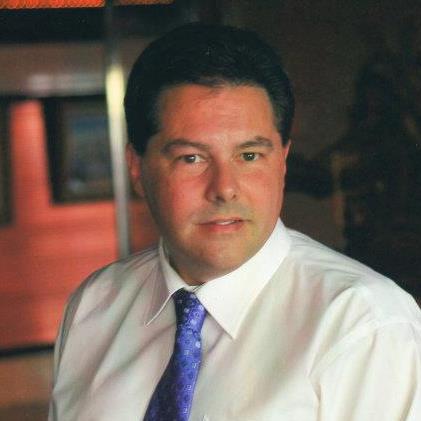
The birth of a child, is one of the most beautiful experiences a parent can experience. I am not just talking about the actual “birth” as experienced in a medical facility. I am talking about the “birth” of a child into a family.
For many, biological birthing is not an option to those who wish to be parents. Other options to assist in physically giving birth exist, but for many, not even those methods provide fruitful.
For parents like me, for me to become a parent, adoption was the only option available. One of the chemotherapy drugs used to treat my Hodgkin’s Lymphoma was “mustargen”, a derivative of the same mustard gas Saddam Hussein used to kill thousands of his people. The plus side about the drug is that it was critical in curing my cancer. The down side, it also took away my ability to have children.
My only option, if not able to have a significant other give physical birth to my child, yet be able to experience “birth”, was to go through adoption. Once that decision was made, the decision of whether to go international or stay domestic had to be made. I will address what went behind those decisions in a different post. Today, I wanted to make this post about what it was like, to experience the “births” of my daughters.
Both of my daughters were adopted from China. We submitted our dossiers (biological and personality information about us) to China, and the magic happened. Daughters were matched up to us, and we were sent photos along with information about our daughters. Travel needed to be planned to adopt our daughters. You can equate this to all the pre natal appointments.
I can only imagine about the range of emotions and excitement swirling in a delivery room. And other than the physical experiences of giving birth, I am certain what happened next, whether through adoption or giving birth, the feelings of becoming a parent were the same.
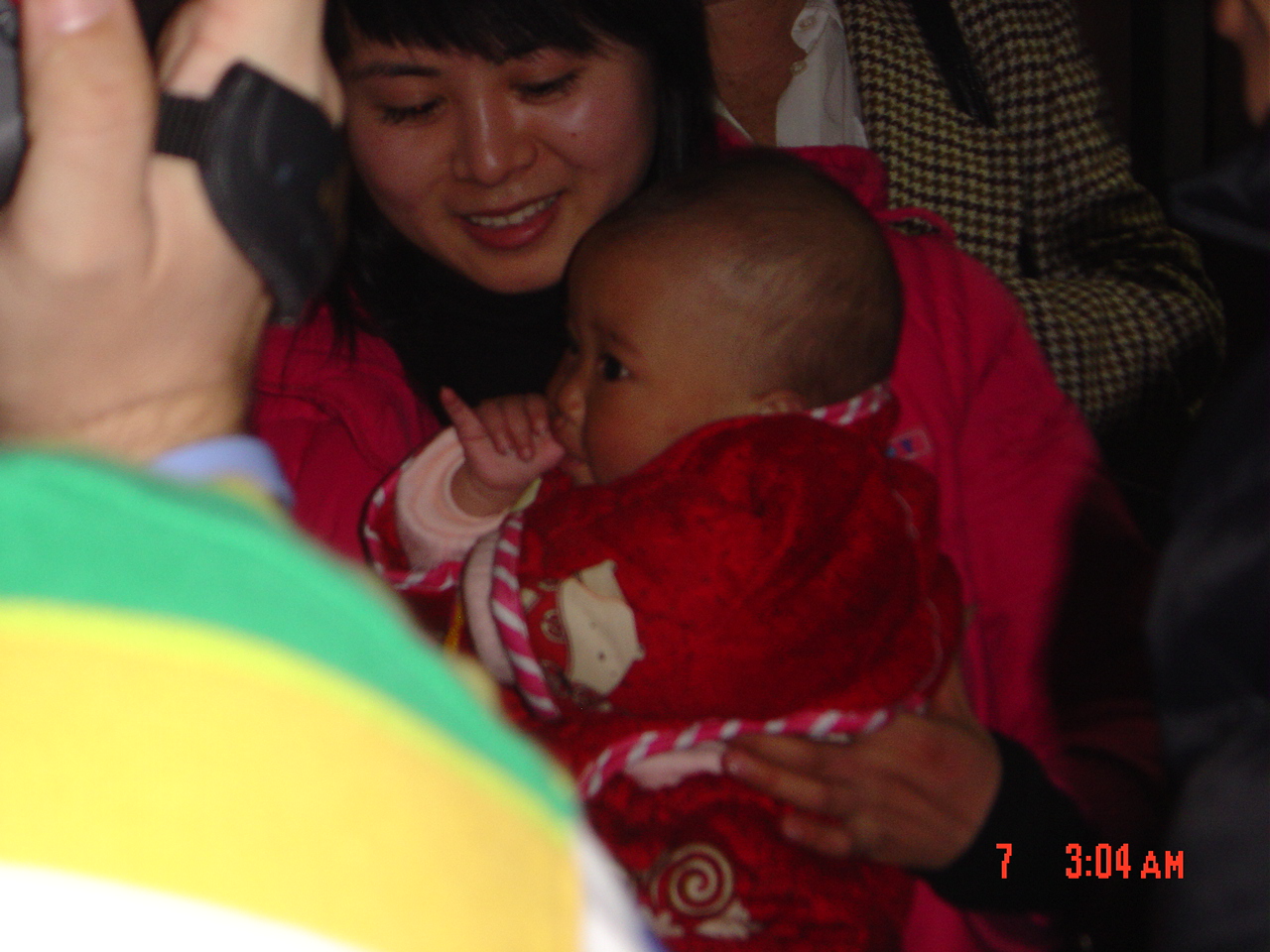
All the families who travelled with us were gathered into a main room. Down the hallway, we could hear the cries of our children coming to us, assisted by staff from the orphanage where our daughters were adopted from.
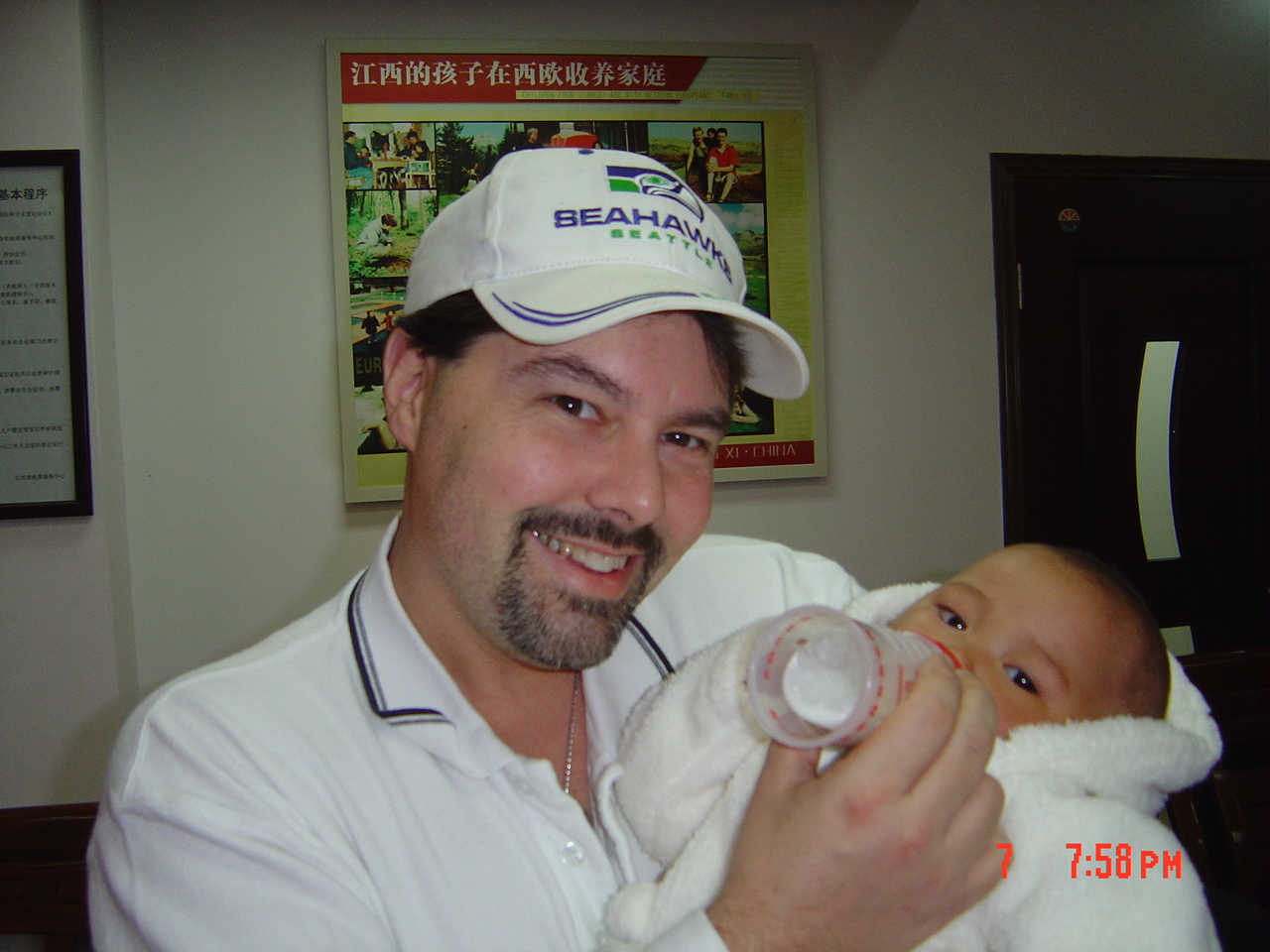
And then it happened, just as a doctor delivering a baby, our daughters were placed into our arms.
It took less than five minutes after Madison was placed in my arms that I knew I wanted to adopt again, and this would bring Emmalie into our lives. Yes, that is how I experienced “birth.”
Not only did I gain two beautiful girls into my life, but so many other people who will always be forever in my heart. There are the “facilitators” that took care of us while we were in China.
And of course, there were nineteen other families that forever will be tied to us for the rest of our lives.
For some, we may never see each other again, but there is a reason that adoptive families are often referred to as “forever” families. Our daughters that were adopted together all share that one bond with each other, the dates of March 14, 2004 and February 6, 2006. Most of the children still see each other to this day, perhaps not in large groups, but by individual visits. And with social media, it makes it even easier for the children to keep in touch with each other as they grow into their teen years.
I want to offer a bit of a disclaimer with this post, because the title makes it look like this is going to be a super negative and depressing post. Quite the contrary, it is going to be a post that is truly inspirational. So please, read this post for what it is truly meant to represent… determination, hope, perseverance, survival.
I am a musician by nature, and most of my internal strength I draw comes from every note that I sing, every tune that I hear, every beat that I feel. I listen to most kinds of music depending on the kind of mood I am in, or the mood I need to be put in.
When it comes to inspirational songs, many find strength through church hymns, and there are plenty. Contemporary songs have such inspirational lyrics by the likes of Josh Groban, Bette Middler, and the late Whitney Houston. But for me, no song sums up my life, no song lifts me up higher, than a song that never really got any kind of airplay, and was pretty much hidden in the Karate Kid 2 soundtrack. But being a true fan of music, I listen to a lot of music that does not make mainstream radio.
I came across this song ironically, during the days when I was diagnosed with cancer. But nearly 25 years later, I still find myself facing struggle after struggle, never giving up. And while I do have loved ones close to me who stand by me, and friends who support me, ultimately, it still falls upon me, to get through my trials. It is a beautiful and powerful song written and recorded by the late Jimi Jamison of Survivor, and recorded by the band of the same name. It is called “A Man Against The World.” You can listen to the song, and view the powerful video at this link:
The music is beautiful. The words… well… read on, and you be the judge if it sums me up and you will see, why I will never give up. It is not in me.
“A Man Against The World”
Survivor
“Have you ever walked alone at night like a man against the world. No one takes your side, a boat against the tide.”
A small child, I was an easy target of bullies. Not just one-on-one, but more often than not, gangs of bullies. People who I thought were friends, stood by and only watched the daily beatings I took. My days in school were not spent learning, but studying how to evade those waiting in ambush for me on school property, and beyond, on my way home. No father around to teach me to defend myself. My family telling me to turn the other cheek or worse, calling the school to report the incidents which I soon learned to no longer speak of them. And of course, school officials telling me to “start standing up for myself.”
“When your faith is shaken you start to break, and you heart can’t find the words, tossed upon the sand I give you a man against the world.”
The first Edelman to graduate from high school, I enrolled in a local college. While studying, I held a full time job and a part time job. A management opportunity was offered to me, leading to me withdrawing from college with less than a semester to go. But it was a career move that was expected to set me up for life. It did not.
“All the people cheer ’til the end is near and the hero takes a fall. Then they’ll drag you through the mud, you’re only flesh and blood.”
I would now officially begin my life simply surviving working in the “working world” with college no longer a consideration. But my work skills instead of being seen as a benefit by my employers, were seen as threats by my co-workers. There were never intentions of replacing anyone’s position by me, but my work ethics were always seen as “getting in their way” or “showing them up.” My reputation became more about my “inability to get along with others.”
“I have walked the path from dark to light and they’ve yet to come to terms. Alone I take my stand, I’m only a man against the world.”
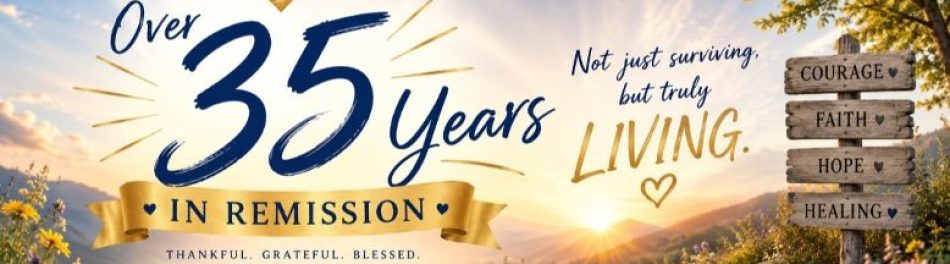
And just when I finally seem to get my world to be what everyone else wants it to be, and all should be good and perfect, I am diagnosed with Hodgkin’s Lymphoma, cancer.
“And love, like a distant reminder it tugs at my shoulder, it calls me home. I shout, can a single voice carry, will I find sanctuary within your arms?”
Following a failed marriage, based on false hopes of a family, I move on to another relationship. Get married. Adopt two beautiful girls. Again, life going great, and another major health issue strikes. Only now it appears far worse news, because it became apparent that the treatments used to save my life, now almost resulted in costing me my life, and from that point on, would discover many other health challenges that I would face.
“Someday when the answer’s clearer, someday when I even the score. You’ll reach and you’ll find me near you, right beside you, forevermore.”
I would much rather forget the last twelve months. Having filed for my second divorce. Having to put my best fur friend Pollo to sleep, after his fourteen years of a healthy and fun life, left him unable to see, hear, and smell, most importantly the loss of his never-ending wagging tail. The loss of a close friend from the same cancer that I had, coincidently at the same age as I was when I dealt with it. The loss of my father after battling lung cancer as defiantly as he possibly could. The loss of my job after 17 years due to corporate downsizing and complications of my health. And because of the violent reactions of certain family members through my marriage, I relocated a great distance away from my daughters, just so that they would not be a witness to the aggression and harassment from those family members towards their father.
“But for now I’ll walk the night alone like a man against the world. A brand new day will shine through the avalanche of time.”
Now in the process of my second divorce, facing all kinds of consequences as a result of domestic court, still searching for employment, and most importantly, anticipating the next time I will ever see my daughters if these situations are not resolved, I am still fighting. I am not giving up.
“Now the road’s grown long, but the spirit’s strong, and the fire within still burns. Alone I take my stand, I give you a man against the world.”
I have the strongest support of my friends both far and near, in physical presence or on-line. I have the love of my family, and my daughters to give me strength. And I have the love of one of the strongest women I will ever know to keep pushing me forward, looking forward to the day that this will all be behind me.
I am typing this, because I truly believe that day will finally come. If I did not believe that, I would have given up a long time ago. Some may see me as an “angry” person. Though really, could you blame me given everything I have been through (there is actually a lot more than I have written, but what I did write is bad enough by itself)? But I have never given up. I fight not because I like to, but because I have to. When I have finally dealt with everything, and corrected everything, and the way that does not sacrifice who I am, those who have stood by me, and most importantly, my daughters will know that I stood tall and survived.
Geezer alert! I am going to show my age by being able to recall days gone by, when local mattered. And times were good. I do not normally do stories like this, but an incident this morning kind of struck me just how far things have gone. And honestly, I do not know if it has been worth it. I will let that up to you.
I was helping a friend with their stove this morning. I used to do that kind of work years ago, and this particular task was easy, and not very physical to do. So I made the call to the local supplier to see if they had the part, which they did.
Simple enough, “how much?” “A little bit over $50 and we have it in stock.”
My next question threw him for a loop.
“Do you have any aftermarket replacements?” I asked this because at one point, the aftermarket company “Chromalox” actually used to make the element for the name brands. Yes, you then paid the much higher price just to have the name brand logo on the part. Years ago, being able to buy “generic” from local parts places saved you considerable money. But if you went to an “authorized” wholesaler, per the manufacturer, they were not allowed to sell the generic equivalent. The truth is, at one time, if you needed a belt for your washer, a lint screen for your dryer, a door gasket for your refrigerator, or an element for your stove, generics were always available.
“No, we only carry OEM (original equipment manufacturer) parts.” So of course I looked around to find someone who was not authorized to sell those parts thinking surely, I would be able to get the original part with the original manufacturer’s name, Chromalox, not the manufacturer of the stove. It was then that I found out that the manufacturer had bought out the generic replacement line I was looking for. And yes, now my friend must pay the higher price. But as I reflect on the past, for decades we have seen that mergers, though originally sold to us as “good for the consumer because it would increase competition which of course would bring lower costs,” I now call bull officially.
Here are some other examples:
Do you remember when nearly every town had their own telephone company? Do you remember the customer service we had when there were issues with the lines? Sure, the costs we thought were high, but look at the times now with just a couple of major players? Customer service now means talking to someone outside of the US if you are lucky, and with all the hidden extra fees, we are now paying WAAAAYYY more than the days when it was just “Ma Bell”.
Banks? I do not even have to go there because we all know that all the mergers produced one of the biggest collapses in our economy.
Cable TV? We are on the verge of a monopoly with this one, and our rates have never been higher. Sure, their defense is “look at everything we are now offering your though… 1000’s of channels of programming.” I only want four or five of those channels. And if you try to break down your “package” by eliminating the services, amazingly, it will only drop your $150+ bill by five or ten dollars. Come on, cable, phone, and internet for $150? But if I want to drop the phone line, my bill will still be $145? And anyone who has tried calling “customer service” for at least one of the major providers knows that company only provides “disservice.”
Big Pharm… wow. The motto used to be “everyone needs prescription drugs” which of course should have translated to job security. But as mergers occurred, jobs were eliminated. And as drugs came off patents, generics soon crept in making the medications affordable. But then Big Pharm started gobbling up generic manufacturers, and now look at today. The costs of generics are beginning to climb to where many patients are in the same situation as trying to afford the original drug… they cannot!
And here in Florida, as in many other states, doctors are being swallowed up by “health networks”. This is resulting in the elimination of the general practitioner. The numbers of general practitioners in the state of Florida are down nearly 50% as their practices are swallowed up by these networks. Gone will be the times that you could see a doctor, for your life, who knew you, and cared for you. You will now become just a number, and will get a “standard” level of care set by the network, not necessarily what you need, and perhaps might not need.
Of course, there is the big target, Wal-Mart. How many local businesses have been put out of business by this company?
American Cancer On-Line Resources
Internet support from peers, caregivers, survivors, and professionals in several hundred types of cancers and related issues
American Cancer On-Line Resources
Internet support from peers, caregivers, survivors, and professionals in several hundred types of cancers and related issues