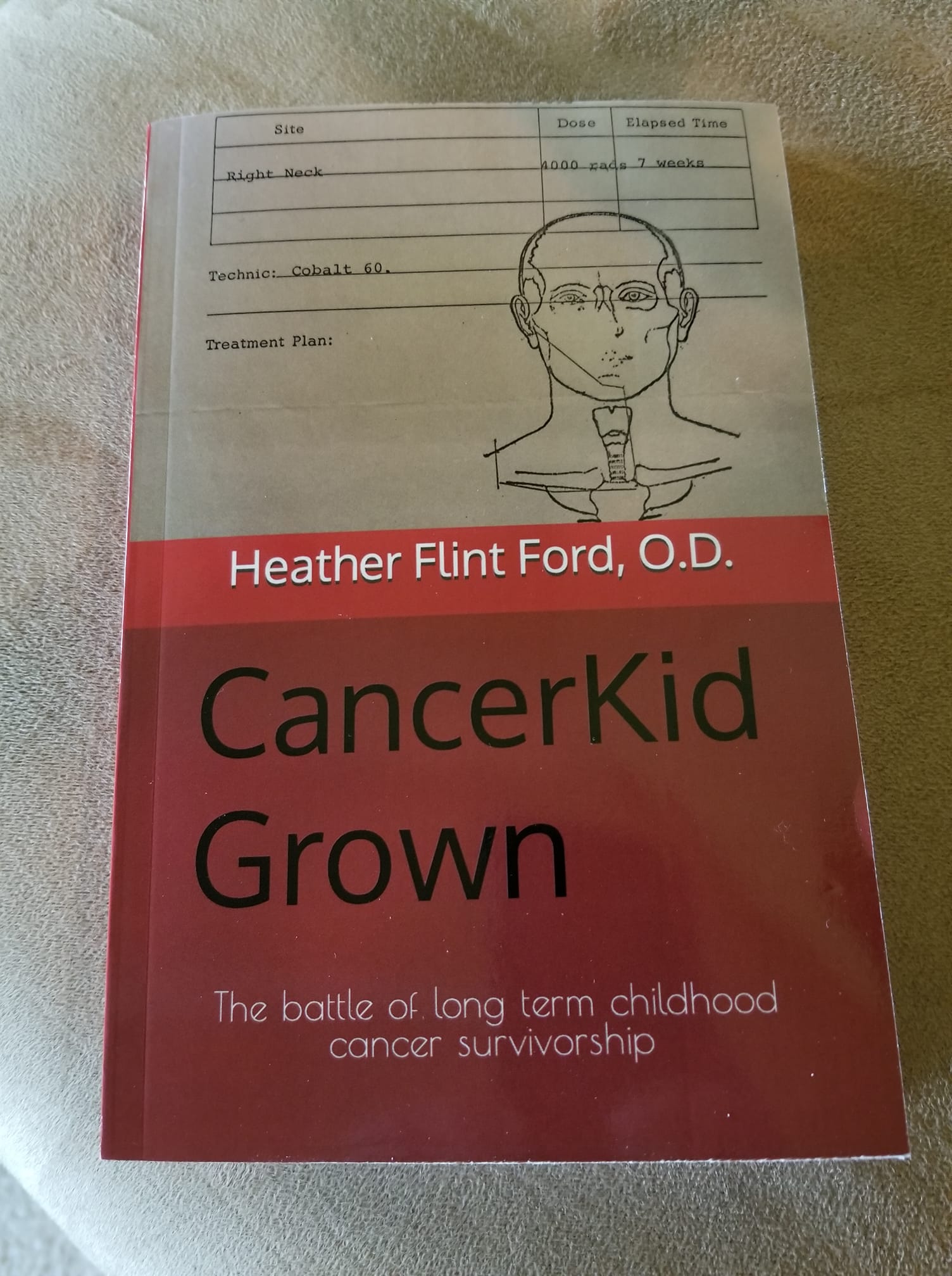
I wanted to share a book that I recently read. As you can tell from the cover, it is not just about surviving cancer, but long term. Especially if you notice, that there is a title after her name, combined with the title of the book, you can tell that author Heather Flint Ford, O.D. has survived cancer a real long time.
Dr. Ford is the youngest diagnosed survivor I know, at the age of infancy, and has a survivorship longevity well into her fifth decade. Our cancers were different, however, our modes of treatment were similar, which is how our paths crossed.
For some of my older survivors, the cover of the book catches the immediate attention. What I assume to be a snapshot of her health record, the image states “technic: Cobalt 60.” Cobalt was the type of radiation used back prior to the 1980’s. Those of us treated from the 1980’s through the rest of the century, know how harsh our radiation was. Cobalt was even worse. The cover also states the dose and duration, 4000 rads over six weeks. This was very similar to my exposure.
Dr. Ford goes through in very clear lay person detail, her journey through cancer and survivorship. She recites what she was told as an infant, recalls what she did as a teenager, and then reflects on her adulthood.
She then transitions to the stage that myself, and many others currently experience, dealing with the many late developing side effects from our treatment exposures. Not only the late effects, but also the fact just how hard it is to find a doctor who knows what we are experiencing and how to treat us. And finally, she tells of the torment that gets buried so deeply inside of us, the pain, physical and emotional, because we mistakenly believe, it is part of the process.
“CancerKid Grown” is a great book, from a “you don’t have to be a cancer patient to understand” reader level. I enjoyed many of the references she made growing up, as I am from the same area as she was, so reminiscing was fun. And as people read her book, I get the satisfaction that at least more will definitely learn about the medical plights of the cancer survivor. As time goes on, there are only going to be more of us.
“CancerKid Grown” by Heather Flint Ford, O.D. can be found on Amazon.
When you fly on an airplane, it is possible to be removed from your flight for no reason (especially when a flight is overbooked). Hotel reservations may not always come through with the “suite” you thought you had reserved. Hell, I even had a cruise cancelled because the ship had been “chartered,” by someone clearly with enough money to make my anniversary cruise irrelevant. The truth is, these are all examples of “privileges.” The companies are private, they can do whatever they want, whether the optics result in bad PR. We have no rights when it comes to things we do.
Health care is treated that way also, and it should not. Health care for the last fifty plus years has been treated as a privilege, in spite of advocates calling for it to be a human “right.” Whether we refer to ourselves as “Americans” or those who stand behind religion, the majority of people in the United States, if they believe in their tenets of patriotism and faith, MUST believe health care is a right.
Over the years, I have done my share of slamming any entity that does not support health care for all, as a right. My favorite targets have been politicians and insurance companies. To be clear, the health system is not perfect either, especially when they do not make it accessible. And I am not just talking about a “denial” of service.
It is no secret, I have cardiac issues related to my cancer treatments thirty plus years ago. So, I see a cardiologist once every year. My appointment is made upon my departure from the current appointment. Bottom line, I expect to see my doctor the following year.
Things can happen. A family emergency. An illness. In the case of my first ever cardiologist (I have had several over the last thirteen years), they might even leave their practice. So, I can understand if something has to be changed, even with a year’s notice given.
The timeline. Appointment made in October of 2020 for October 20201. Robo call received on a Friday, confirming Tuesday morning appointment. Monday evening, received call from cardiologist office, appointment needs to be changed.
Ok. No problem. Like I said, things come up. I have no issue with that. I am totally understanding. I do not even care why. I just need to get it rescheduled.
“The next available we have is in January,” the scheduling person stated matter-of-factly and calmly.
I responded, “excuse me?” because I really doubted what I had heard. She repeated the next availability again.
I said, “but you guys are cancelling the appointment. Why am I being penalized with the next appointment three months away instead of being booked upon the doctors return from his two week leave? At least squeeze me in somewhere…it is just a follow up for crying out loud.”
“I can get you to see his PA (physician assistant) at the end of the month.” I have already expressed my objections, no disrespect to PA’s all around the globe, to seeing a PA. Doctors do not understand my particular medical issues, yet, I am to be scheduled with someone holding just a masters degree in medicine? Complicating this, I do live in a high tourist area of Florida, and within the next week, “snow bird”, travelers from up north will arrive for the winter, bogging down our health systems down here, extending times to see a doctor, ESPECIALLY A SPECIALIST.
But it makes me wonder, I remember a time, when you needed to see a doctor, whether it was primary care, or an orthopedist, or a cardiologist, you got in, fairly quickly, at the most, perhaps a two week wait when it came to a specialist. Given that the cardiac system is a crucial part of the body to care for, what is the logic, of rescheduling someone, with known cardiac issues, who was last seen a year prior, of pushing off that patient another three months instead of perhaps three weeks later?
I am open for answers. Is it something corporate? Are doctors limited, seeing only a certain number of patients, regardless of need? Have the doctors been removed totally from the scheduling process, with a pen pusher sitting by a phone, making the determination when a patient sees their doctor?
As I said in the beginning, it is one thing for services such as flying, travel, dining out, and such to make decisions that negatively impact customers. As private entities, that is their right to do so. That is their “privilege.” But health care is not a privilege. Patients needing care have rights, or at least we should. And the number one right, should be that to be seen in a timely fashion, even if it means squeezing someone in.
In one of my last posts, I wrote that it was absolutely “worth it,” to have chosen the option to undergo difficult chemotherapy and radiation treatments for my Hodgkin’s Lymphoma. That post was written in hindsight, because I have had thirty plus years to look back and say, yes it was worth it. At the time, going through the actual treatments, physically, it was not easy. Emotionally, it was just as hard a fight as it was physically.
Making things more difficult, is if you are one of the fortunate ones, to be told, “you are in remission” before you have completed your full set of treatments. It is not hard to understand, that someone would want to bail on any further toxicity. Being a prime example, when I hear, “why do I have to go through the rest of the treatments when I am in remission?”, my answer is simple and never waivers. “You want the best chance of staying in remission. You got there, you want to stay there. Your doctor knows what it takes to do that. Finish the treatments. I should know, I am out over 31 years now. And I don’t think I would have had that chance if I had quit treatments halfway through, just because they said I was “in remission.”
To put it in terms that everyone can understand. When you take an antibiotic for a virus or infection, what does the doctor tell you? Finish the prescription. And why is that? You either feel better or a wound may look better, so perhaps you reason that it may make sense to “save” the rest of the medicine should you ever need it again. No. You finish the entire prescription so that whatever you are dealing with, is gone, for good. In fact, it is likely the medicine is continuing to work some days past the last dose. The same goes for chemotherapy or radiation treatments, you want the cancer gone, for good.
The next flawed thinking, enabled by doctors, is allowing a cancer patient to think, just because you are done with your treatments, that means you are all done with doctors. This gets complicated as survivors strive towards a magical “five year mark,” an imaginary bench mark many entities such as insurance companies and employers use (secretly because it is illegal to discriminate) to consider you “safe” for hire. Mentally for cancer survivors, that five year mark is further proof, we have nothing to worry about with our health. And that can be wrong thinking, very wrong.
Or, you could be lucky, very lucky.
With Hodgkin’s Lymphoma being one of the few cancers with such a high remission rate, that also means there are a lot of survivors. This is where luck versus ignorance collides. I am going to keep this simple so as not to get lost in any weeds. There are roughly 50,000 new cases of Hodgkin’s diagnosed each year. Times that by 30 years (though I was diagnosed 32 years ago), would give you 1.5 million cases of Hodgkins. With a generous estimate of a survival rate around 90% (depending on the type of Hodgkin’s), that would leave roughly 150,000 patients who would not survive what is considered one of the top cancers to treat. That means 1,350,000 survivors, long and short term in theory could exist. If we cut that number in half, 675,000 would be what some refer to as the “long term” survivors, survivors having dealt with a much higher level of toxicity of treatment whether radiation or chemotherapy prior to the turn of the 21st century.
I am involved on several social media pages for cancer survivors, and in one, specific to Hodgkin’s Lymphoma, there are less than 850 members. Like me, each and every one of us has at least one issue, some, like me, many more, related to our treatments. What about the other 674,150 survivors not on our survivor page? Are they lucky enough, not to actually have any late developing issues? Or are they ignorant to what is going on beneath their skin, because they stopped seeing a doctor long ago, not being followed up for potential late developing side effects.
From 1995 until 2008, I always believed I had been one of those lucky 674,150, leading to a totally separate issue that I have dealt with frequently here on “Paul’s Heart,” survivor’s guilt. I knew so many other survivors, yet I was the only one who did not have to deal with any of the issues that they were dealing with. Though I was in remission as of 1989, I used the year 1995, because that is when I was jettisoned from my doctor, no longer needing to be followed up for my Hodgkin’s, and unaware of any potential for late side effects. My “healthy” condition had nothing to do with luck. I was surviving in spite of my ignorance. To be fair, no one told me of the possibilities that could be affecting me, until April of 2008. My ignorance would meet reality, in a hard way. I was actually dying. I was diagnosed with a fatal condition called a “widow maker,” a major blockage of a main artery going to the heart. At age 42, the last thing on my mind was heart disease. And at the time, being 18 years out from my cancer, anything related to that was also far from thought. Ignorance.
But for the first time in my survivorship, I was actually “lucky.” I was referred to two doctors at Memorial Sloan Kettering Cancer Center who had spent the majority of their careers, dedicated to survivorship issues of long term cancer survivors. I have documented many of my issues on this blog, all because I had doctors who knew what they were looking for and how to manage them.
But there are obviously too many who do not have this benefit. As I said, less then 850 of us are even aware of this issue. Hundreds of thousands likely go through their lives, scratching their heads at ailments that simply make no sense for someone of their age, conditioning, or health. Organizations such as Hodgkin’s International are finally providing education and support to bring awareness to the needs of Hodgkin’s survivors. There is still so much that needs to be done.
There is still a major concern for the small group of us, and that is having access to the care that understands our situation. Medicine is finally catching up with this need, in the form of survivorship clinics. But for those without access, survivors are at the mercy of primary care doctors or occasionally specialists. Trying to convince “non survivor doctors” that our issues are related to our treatments usually falls on deaf ears, because it is like the “bricklayer telling the engineer what to do.”
It is not just the average doctor that is hesitant, but even many in the survivorship realm. In my thick file of medical records, never once, has any mention ever been put in writing that my health issues are related to my treatments. BUT… every one of my appointments and emergency events, all occurred because of these late issues caused by my treatments. Scientifically, this has been proven. So, why is it not written in my records?
It has been put into my records now, “radiation-induced,” caused by damage from my radiation therapy 32 years ago. Now if only the rest of my fellow survivors could be as fortunate it would make caring for their needs so much easier. For my small group, we know we have the health issues, and most of us are being taught by our fellow survivors how to navigate around the world of medicine to get the help and care we need as our own advocates. It should not be this difficult. Medicine is taking too long to catch up to most of my fellow Hodgkin’s survivors, many in their 4th and 5th decades of survivorship.
I am no longer ignorant of the issues that were not looked for. And I am not lucky, being untouched by late developing side effects. But I am lucky, that I am able to have things taken care of by hands and minds that have learned to deal with our special needs, because they recognize what caused them. But I am not the only one. There are 674,150 others who need this help, who need this recognition, “treatment-induced side effects.”
In 30 years, I have seen the progress in the diagnosis and treatment of Hodgkin’s to see less toxic therapies used with similar or greater success. In 15 years, I have seen newer methods of dealing with our late side effect issues to be used, sparing the extreme risks. And I want to see in my next ten years, all cancer survivors getting the follow up care, and the recognition of the late side effects and their causes, so that once and for all, we can all have the quality of life best possible and deserve.
American Cancer On-Line Resources
Internet support from peers, caregivers, survivors, and professionals in several hundred types of cancers and related issues
American Cancer On-Line Resources
Internet support from peers, caregivers, survivors, and professionals in several hundred types of cancers and related issues



 Paul's Heart