
5 Second Paul

In the movie “50 First Dates,” Adam Sandler falls for Drew Barrymore whose character unfortunately suffered a head injury in a car accident, leaving her with a condition that causes her to lose her memory of anything happening the day before, once she wakes up. As Sandler feels convinced he can help her overcome this malady, those around Barrymore’s character try to convince Sandler’s character that it is not this simple. Brain trauma is difficult to understand, and difficult to live with, not just for the patient, but for those around the patient.
To get their point across to Sandler, Barrymore’s character’s father takes Sandler to a facility treating brain injuries, where they meet “10 Second Tom.” There are five or six people in the room when they meet Tom, and as Tom goes around introducing himself, by the time he gets around to everyone and back to the first person, he reintroduces himself again, as if for the first time, no recollection that he had done so previously. In just ten seconds, he had forgotten everyone.
As the title of this post shows, I have my own cognitive issue with memory, to be clear, in certain situations, that clearly happen within five seconds of being told. For those around me, in the beginning, there was confusion as both sides tried to figure, “did they tell me or didn’t they?” Soon, emotions would turn to anger on their end, frustration on my end, they thinking I was just being irresponsible, me wondering what is going on with me.
This is not the first time that I am dealing with this type of issue. The first time that I faced this issue, was when I was going through my chemotherapy. In fact, it is simply called “chemo brain,” a type of fog created that causes memory and cognitive issues. For many, the condition goes away at some point after treatment ends, for others, it can linger. As I did not discuss this issue with anyone, including my then fiance, it went relatively undetected.
It was nearly eighteen years later, following my emergency open heart surgery, that this issue became quite serious. I began to notice my memory being blocked from remembering a simple 4-digit code that I had used for years. While driving, in spite of me assuring my second wife that I had looked both ways with traffic, there were multiple incidents of me either pulling into traffic and oncoming cars, and on one occasion, nearly striking a pedestrian. While I recall of these incidents, even to this day, I did not “see” the other cars or person. The final straw, occurred while sitting at the dinner table with my family, my three year-old had spilled her glass of water. I freaked out, completely uncharacteristic of me. My then-wife stared at me in horror and anger, I know my look had to be one of shock as I had never reacted this way before. I left the table, and walked out of the house, to try and grasp not only what had happened, but there was a likelihood that all of these issues were related.
I was sent to a neurologist at the University of Pennsylvania, who was unable to determine any cause of what was happening. I looked inside myself, what could possibly be happening if there was nothing physiological going on? What had changed over the last many months, what was different?
One of my medicines had been changed, and the dosage increased dramatically following my surgery. This had to be it. I just knew it, but how do I get the doctors to listen to my concerns? Thanks to Google, I found Dr. Beatrice Golomb at the University of California in San Diego. She had done studies on cognitive issues related to statin use, for cholesterol. Federal regulations do not require side effects to be published as warnings, if the percentage of occurrence is low enough. That does not mean the side effect does not exist. But that is the proof I had been looking for. I reached out to Dr. Golomb and told her of my situation, and while I was unable to be a part of her studies, she did encourage me to press on for answers.
That ended up being my issue. My cholesterol medicine, which I had needed, was changed to a different drug, and increased the dosage 400%, the protocol following my open heart surgery. But I was not going to go through my life this way. I immediately stopped taking the drug, and within days, this issue began to clear up. That was the good news. The bad news was, my cholesterol would begin to skyrocket as it had before. Eventually, the doctors and I would come to terms after trying multiple solutions, and I would return to the original drug, and the original dose before the surgery. I have had no issues like this since.
I am a bit older now, twice divorced. And as it turns out, I am dealing with cognitive issues once again. While I am certain it is no longer “chemo brain,” and I am certain that it is not senility or Alzheimer’s, just on the basis I am only 57 years old. But my body has been through a lot. I went through eight months of extremely toxic chemotherapy, and six weeks of high dose radiation therapy thirty-five years ago.
Like “10 second Tom,” there are things I can forget, literally within five seconds. It does not have to be a list of anything either. I can simply walk from one room to the other, or pick up my phone to Google something, and my thoughts can be gone. It does not happen all of the time, but frequently enough to upset me and those around me. It gets quite frustrating. My long term memory is spot on. But more and more it is happening, I can forget something I was just told, less than five seconds prior.
I have a long list of doctors that I currently see, and it is going to be likely somewhere down the road, I will be adding yet another, neurology, and for the same reason as my others, issues related to the treatments I underwent decades ago for Hodgkin’s Lymphoma.
A recent article shared by a fellow long term Hodgkin’s survivor like me, published in December of 2022 stated that signs of early dementia had been discovered earlier in Hodgkin’s survivors. To be clear, in all of the forums that I participate with other survivors, cognitive issues is not normally the focus as is others such as cardiac, pulmonary, or secondary cancers. The body of a long term Hodgkin’s survivor is often described by doctors as having aged faster than someone who has not had Hodgkin’s. In other words, our bodies are appear older than our stated age. This study, done at the Wilmot Cancer Institute led by Dr. AnnaLynn Williams, shows survivors of Hodgkin’s Lymphoma, now in their 30’s, showed an increased age of 7.7 years biologically than those who were not, and would be consistent with showing the potential for early signs of dementia. These results were eventually shared with the American Society of Hematology’s annual meeting. This, along with other physical developing side effects are finally getting recognized for those of us, 30, 40, 50 years out from our treatments. That is the good news. The bad news is, they are just figuring out what to do now. Other than screenings to try and deal with them before they develop or at least early enough after development, survivors may finally get the help that is needed. That has long been the story of the life of a Hodgkin’s survivor.
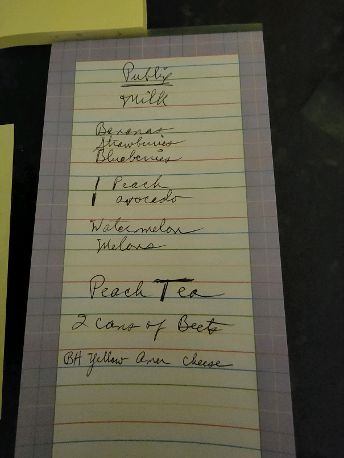
While those around me may be frustrated, empathetic, or accepting with my health issues, especially this one in particular, I am doing my part to make sure that I am aware how fast this might progress. A simple task, a grocery list, I use now as a test, to see how many items I can remember to buy. I intentionally leave the list at home. To be honest, this particular list pictured went with me. But there are lists that have only four or five items, and those I try to do by memory. More times than not, I do forget at least one or more of the items on the shortened list.
To be clear, my long term memory is as sharp as ever, every detail. Even a random phone number of my high school sweetheart is still locked in my noodle. But if it were not for post-it notes, I might have to resort to methods used in the movie Memento, body notes tatooed to remember.

Below are two very important links. The first, is for the Golomb Research Group at the UC San Diego. The second link is for the article pertaining to early dementia signs in Hodgkin’s survivors.
 Paul's Heart