Paul's Heart

Life As A Dad, And A Survivor

Archive for the month “June, 2023”

A Scary Story


Back when I was a young kid, I remember being scolded by my Grandmother, “don’t sit so close to the television! You’ll ruin your eyes.” That was the simplest way to warn a kid. However, my Grandmother had a bigger fear, and just did not want to scare me, radiation emitting from the television. If she only knew, proximity to the television was the least of my worries when it came to radiation.

So yesterday, I wrote a story about the latest issue to reveal itself to me, related to late developing side effects from my treatments for Hodgkin’s Lymphoma over three decades ago, osteopenia, a loss of bone density. Both radiation and chemotherapy are the culprits behind this diagnosis. And last week, my confirmed first injury related to that condition, a cracked rib.

But this post is not about osteopenia or my cracked rib. And I am going to try to avoid getting too nerdy or lost in the weeds with an explanation. This post is going to be about understanding, as easy as I can possibly make it.

First, likely all of us have been exposed to a minimal amount of radiation at one time or another, probably at the least, during a dental visit, having x-rays taken of the teeth. It is a tiny amount of radiation and does not last long inside your body at all. The actual time that it takes for dental x-ray radiation to leave your body is referred to as “half-life”, is so minimal, it is not even referred to as “half-life.” But when you are referring to the amount of radiation a person is exposed to either in a work environment or as a patient, “half-life” depends on the isotope and the exposure/dose.

There are a lot of different terms used to describe the exposure to radiation such as: sieverts, mrem, and grays. If I understand correctly, sieverts and mrem refer to the actual dose, while gray refers to the “absorbed” dose. Again, if I understand correctly, both end up meaning the same exposure. OSHA, the Occupational Safety and Health Administration, puts the annual dose limit exposure to radiation at 5,000 mrems. Just because I happen to be more familiar with the measurements in “grays,” that equates to .05 grays per year. The lifetime limit per the NIH, the National Institute of Health, is 400 mSv, or 40,000 Mrem, or .4 grays. Again these are lifetime numbers. Now hang on to your socks.

In February of 1989, I was treated with 4 grays (also described as 4,000 rads) of ionized radiation, or 400,000 Mrem, or 4,000 mSv. You do not need to be a scientist or math genius to know, the amount of radiation that I was exposed to, and similarly many other Hodgkin’s survivors from that time and beyond, was not safe. It was considered experimental, and it worked. The question is, at what cost?

Up until last week, bone density was the least of my worries, but with a simple cracked rib, the condition of my spine, and my susceptibility to an increased risk of fractures needs to be kept in mind now. The increased time for a broken bone to heal, or increased risk of bleeding to death (especially during surgery) are quite extreme. Combine this issue with my cardiac (3 heart surgeries and a carotid repair), pulmonary (pre-cancerous spots on both lungs and other issues), endocrine, musculoskeletal, and gastrointestinal systems, radiation may have saved my life from cancer, but the cure might just have been worse.

Which brings me back to the topic of “half-life.” Each year, my department at work was required to hold a “radiation safety training” session. To the average co-worker, this was as entertaining as watching paint dry. But for me, a fan of the Incredible Hulk, and carrying likely as much radiation as the Hulk, I was one of the few paying attention, for the question and answer portion at the end that is.

Part twisted sense of humor, and part hope for cure, I asked the same question, which I was able to do every year, because there was a different instructor. Every year, I would ask the same question.

“What is the half-life of 4 grays of ionized radiation?” It was a simple enough question, short, direct, to the point, simple math. But I knew the reaction, and the conversation that would follow.

Instructor: That’s impossible.

Me: Yes, I know (I said with a straight face, knowing what I was going to do to him). But what if it did happen? What would be the half-life?

Instructor: That’s impossible, no one would ever be subjected to that exposure. They would never lose that contamination.

Me: Well, I was exposed to that, back in 1989, treated for Hodgkin’s Lymphoma.

I had seen the look on his face before, disbelief. It was not that he did not believe me. He just could not believe that it had been done to me. I actually know several people who work with the Nuclear Radiation Commission, and one of them actually broke down in tears, because even their employees are not to be exposed to high levels of radiation.

Instructor: (in a shaken voice) You’ll never get rid of it in your lifetime.

Translation? Radiation will continue to wreak havoc on me for the rest of my life, even when it comes to repairs already done. This is why many of my survivors and I, call radiation, “the gift that keeps on giving.” It gave us remission, but it keeps giving us more than we asked for.

The truth is, there are many like me. At least until the turn of the century, this level of radiation was still being used. Many of my “older” or longer survivors, were exposed to even more radiation than I was, leaving most of us with some sort of late effect(s) to deal with. We may not interfere with television signals or be able to cook foods holding them in our hands, or in my case, possess the strength of the Hulk, but the truth is, there are many issues, some quite severe underneath our “shells.” I have written often about the issues with my heart from radiation damage.

There are now better treatment plans as far as radiation is concerned. Medicine learned they can do more with less. There are better protections such as face or body shields (as pictured), and doctors are now able to beam the radiation directly to the tumor, sparing surrounding areas, known as “scattered field” (this is why us long termers have so many issues).

This conversation is indeed quite scary. But it is a conversation that awareness is needed. If all goes as planned, remission will get reached, but surveillance once completed is critical to catch anything that develops sooner than later.

Snap, Crackle, Oh Sh**!


It took long enough. It has been fifteen years, since I found out, one of my late developing side effects from radiation and chemo treatments for Hodgkin’s Lymphoma, would result in an increased risk for a particular event, in the case for this post, risk of a bone fracture. Radiation history is actually a double whammy as it impacts the healing of such an injury. For instance, when my chest was cracked open to perform the emergency heart surgery on me (for one of my other late effects), normal heal time for the breast bone I was told, would be about three months. Because of my radiation exposure, I was told to expect six months for my sternum to heal properly, not something my employer wanted to hear for sure.

Some time after my heart surgery, as evaluation after evaluation was performed on various systems of my body to determine late effect concerns, included a DEXA scan, a measurement for bone density and bone loss, one of the potential late side effects from both radiation and chemotherapies. Without getting lost in the weeds, results would diagnose me with osteopenia, simply, the little sister to osteoporosis. Osteopenia is a lowered bone density, where as osteoporosis is a full blown disorder. Osteoporosis is commonly thought of a something only women have to deal with. But just as with breast cancer, especially with late term side effects from treatments, osteo can impact men as well.

An MRI would confirm the effects of osteopenia, with the L1-L5 vertebrae showing facet joint arthritis, a wear-and-tear of those vertebrae, this was a late effect I would be dealing with. The most concerning comments made on the report, was the potential for an increased risk of bone fractures. I do not think of myself as clumsy, and following my heart surgery, and the reduction of my physical activity, especially anything with a risk of injury, was not really a concern to occur imminently.

And then last week…

I was sitting in my chair, reviewing some paperwork for college with one of my daughters, when I dropped my pen on the floor. I leaned over the arm of the chair to reach for the pen. I felt it. I heard it. If you have ever snapped a pencil between your fingers, that is exactly the sound, exactly the feel, that I experienced. I had cracked one of my ribs and instantly leaned back in my seat to relieve what I was hoping was just a cramp, soon realizing it was much more serious than that. One thing was certain, I knew what had just happened. This was not a simple crack like made with the knees when standing, or stretching the back, or cracking the knuckles. This was bad.

As I am prone to do, I process any crisis or trauma rationally. I do not understand how I can do this, I just do. But I reached out to my doctor, and the first concern is whether or not to do an x-ray to confirm it. With the amount of radiation that I was exposed to during my cancer treatments, he is always reluctant to expose me to any more radiation than necessary. To keep things in perspective without getting all nerdy, here is how this plays out for me. My medical history shows that I was exposed to 4,000 grays of ionized radiation in a period of 30 days. The maximum amount per year a person in the industrialized arena (a.k.a. work), is .05 grays per year. So, you can see the shit load of radiation I was exposed to, not just in one year, but covering so many lifetimes of exposure.

There are exceptions as to when I do not question exposure to more rads, and that is the concern that exists for lung cancer, as I have multiple spots on my lungs likely from my treatments. It is urgent that the moment any of these spots gain additional concern, response is quick before too late to do anything, and that requires a CT scan to do it, more radiation.

But in this case, while an x-ray will officially diagnose my rib being cracked, treatment for my rib, will just be care and rest. Therefore, both my doctor and I agreed, additional radiation from an x-ray was of no benefit to an increased shot of radiation. The important thing with this injury, my breathing was not impacted, so I was not worried about any injury to the lung. All I can do in the meantime, is “exercise” my lungs, to keep my rib cage expandable, which I do using a spirometer or singing around the house, anything to expand my lungs.

Of all the trauma my body has gone through, this is clearly one of the most frustrating, because I want to continue my “fitness” routine that I have been doing since my last heart surgery. My arms are fine. My legs are fine. But my rib is saying “hold my beer.” So, still no exercising.

One thing is certain, if I am that fragile now, that the simple act of leaning over something can cause a bone injury, clearly I need to be careful with any kind of fall, as already noted with the vertebrae in my back, my body is already compromised.

When Art Imitates Life


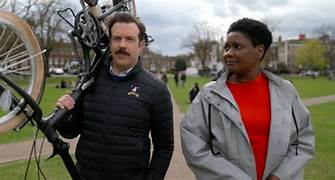
Though a fan of Jason Sudeikis, I was definitely a late-comer to his Apple TV show, “Ted Lasso.” I would describe it as a “dramedy,” a comedic drama, with the main character making obscure 1980’s and 1990’s references when dealing with the serious issues of mental health. I have watched the series twice now, and could probably watch it again, still learning things that I had missed the first two times watching it. For instance, you may not be aware that the books that Coach Beard is reading, make reference to the subject of that episode.

Lasso could be described as simplistic, optimistic, with a touch of “redneck Confucius.” Crossroads faced, odds overcome, and personality battles occur at a furious pace with the viewers likely thinking a different obvious solution, which after addressed by Lasso, leave us thinking, we might just be wrong in our thinking.

There are situations that I will remember from the first two seasons, one deals with a decision by the character Keeley Jones, who is given an opportunity to run her own public relations firm. The conflict for Jones, is that means she has to give notice to her boss, who just happens to be her best friend. Stressed by not wanting to disappoint her “boss,” she is given the advice, “a good mentor hopes you move on. A great mentor knows you will move on.” This is such a great quote that I have repeatedly shared with my daughters frequently, so that when the time comes, they should accept with pride, advancements in their careers that I know they will work hard for.

Another moment comes between Lasso and the soccer team’s shrink. The coach himself had begun seeing her for his own issues. Just as he had begun realizing the many things that weigh him down emotionally, the doctor informs him that she is moving on to another team. Lasso wants to organize a “going away” party and gift, but she pulls the rug from under him by leaving early, leaving him quite upset.

He finally finds the doctor and admonishes her for leaving him behind. He felt she was finally helping him, and now she was leaving him. As it turns out, just like his father, just like his wife. Don’t worry, I won’t spoil what happened with them. The point is, he struggled with what he considered abandonment. Was it these issues that made Ted Lasso tick and hence gave him the mechanism to react with bumpkin-level stories and advice? Maybe.

Lasso brings mental health front and center in this series. And for the most part, like many, he keeps his own issues to himself, a.k.a. private. But an incident occurs, and with him being a public figure, Lasso’s own mental health comes front and center, and for the most part, still manages to keep it under wraps. Lasso ends up betrayed, and that issue becomes public, and Lasso faces something just as difficult to deal with as the issue itself. As a leader of his soccer team, and surrounded by friends, he kept a secret from all of them. And all was discovered by them, from an outside source, not Lasso himself. While some may not have been bothered by it, some did feel upset that Lasso did not feel that he could confide in them for support. And that really is a big deal, whether a friend or relative.

I occasionally find myself being ridiculed about the disregard for my privacy, whether it be “Paul’s Heart” or social media. But I have reasons for being the way that I am. Not only do I benefit from those around me knowing what I am going through, all know that they are hearing straight from the source, commonly known as “controlling the narrative.” There is also another reason I do what I do. Whether it is cancer, adoption, or divorce/custody, and I know the struggles of all of these issues, if my story can help even just one person, then me exposing my privacy was worth it. I will never discover a cure or invent anything. But if this is how I can make a difference, then this is how I will do it.

Perhaps the greatest scene of the whole series, Lasso invokes a quote from poet Walt Wittman. “Be curious, not judgmental.” Memories of being picked on by others, he noted, were never curious about him. Had these others known anything about him, they might feel differently if they chose to get to know him. Instead they chose to just make assumptions about him and others. And because people make these assumptions, it leads to those people underestimating their target. Because all they had to do is ask him questions, be curious, and they would have discovered they might want to reconsider their behavior. “Be curious, not judgmental.” So many in my life could have learned that lesson, even some close to me. Because in the end, here I stand. And so did Lasso.

Truth is, there is likely something in the show Ted Lasso that many of us can relate to on a personal level. And when we see the results, as simple as they may be, the answers might just be what we were looking for.

Post Navigation