
Chasing Cures
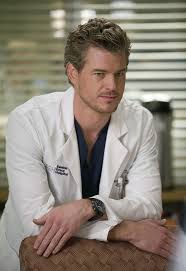
(photo courtesy of E!News)
It was not the photo that caught my attention when the news came out originally, I knew who Eric “McSteamy Sloane” Dane was, though admittedly I had never seen any of his work. He had announced that he was battling ALS, Amyotrophic lateral sclerosis, more commonly known as Lou Gehrig’s Disease. As someone who has battled cancer, a diagnosis of ALS is just as jarring, just worse, because there is no cure. ALS is a neurologically progressive disease destroying motor neurons in the brain and the spine leading to crippling and cruel health issues such as muscle atrophy, paralysis, and respiratory failure, all the while leaving the brain seemingly untouched, completely aware of what is happening to the body, eventually, unable to communicate how they are feeling and what they are experiencing.
ALS is considered a rare disease. Hodgkin’s Lymphoma, my cancer, is also considered a rare cancer. I have had no one else in my immediate family or circle having faced Hodgkin’s. Sure, I have hundreds of Hodgkin’s survivors in my life socially, but none in my immediate orbit. I have currently witnessed four people go through ALS, from beginning to end; my brother-in-law, a co-worker, a fellow school board candidate, and a close family friend. A comment by a friend that I knew 4 people personally who dealt with ALS was shocking for being such a rare disease.
My reaction to Dane’s diagnosis was similar to anytime I hear of someone battling a serious illness, with perhaps a bit more empathy. Having watched what ALS does, and takes away, I knew what his path would be, and how painful and cruel.
My brother-in-law was a good man, a good husband, and a good dad. He was also a good friend, a good worker. He was also a confidante. He was selfless and hard working, gave of himself to make sure his family was taken care of, while making sure, he had fun in life as well.
It was during a morning visit as he explained, that someone had implied that he had been partaking in some early morning “jack and coke”, as his speech was noticeably slurred. It should be noted, there were no other signs that he could have been drinking. But my brother-in-law was known for his favorite drink, so the accusation kind of made sense. Until later, following several doctor appointments including specialists, he was diagnosed with ALS. Then it all made sense, sort of. The slurring of his speech was not from “jack and Coke,” but rather the impact on his speech from ALS.
My brother-in-law’s case was not the typical case as speech is not normally the first sign. In fact, speech and swallowing often come later on, after clearly muscles in the rest of the body have been affected, at which point diagnosis gets made. The cruelest part of this illness, while the body degenerates neurologically, the brain remains untouched, meaning, it is totally aware of what is happening to its body, and no matter how much the patient wants to communicate what it is experiencing or feeling, it eventually no longer allows words to come from the lips. As hard as an ALS patient wants to talk, they cannot. Eventually my brother-in-law obtained an Ipad and an app developed by Penn State that allowed him to communicate for him, which with his sense of humor, he also took advantage of.
Over time, I watched ALS take my brother-in-law, little by little. He would exchange his motorcycle for a motortricycle. Eventually he would begin using a walker and wheelchair. Everyone in the family would take on more of a caretaker role having to assist him with even the most simple tasks. Not wanting to slow down, he took a dream trip to Ireland. At home, he and I took a couple of trips, one to see the original members of Asia perform in concert. I remember to this day, we stopped for something to eat first, he had his Ipad, but was reluctant to use it, feeling he could still ennunciate his words clear enough for the waitress to make out what he was saying. Understanding the words coming from someone with ALS takes a long time to adjust and learn. I could tell he was frustrated as he finally put everything into his Ipad.
Being able to swallow food is another major issue for someone with ALS, and that came on fairly quickly, even before the rest of his body was fully immersed in atrophy and paralysis. It is often at this point, that ALS is at its most consequential and dangerous. One evening at the table, my brother-in-law (and I apologize for using that term instead of his name, but I have trolls that will stir shit up), taught me one of the most important lessons of my cancer survivorship. While he was battling his swallowing issues, I had my own swallowing issues as a long term cancer survivor. Radiation therapy had weakened and destroyed my esophagus, and combined with chemo created issues that would cause me to struggle with swallowing as well. I could not help, sitting across from him, thinking, “don’t you dare feel sorry for yourself with this swallowing issue, you aren’t going to die. He is.” And he and I would actually have this conversation, resulting in an awareness that I would share constantly among my fellow survivors who may occasionally feel their issues are not as severe as others, and therefore not warrant the attention.
“Paul, it is not a question about how severe our situations are, or that I will eventually die from mine. Your issues are just as real, just as difficult for your to deal with, and that does not make them any less important to share or lean on others.” This outlook has lasted with me forever, and I am the first one to point out to anyone of my peers who starts with, “I know my situation is not as bad as others…”, I remind them of what my brother-in-law reminded me, regardless of the situations and how serious they may or may not be, does not make them any less real.
I had anticipated my brother-in-law’s struggle to be long in span, but as he suspected, the fact that his ALS had been diagnosed in the stage of speech and swallowing being affected before muscular, his time was definitely limited.
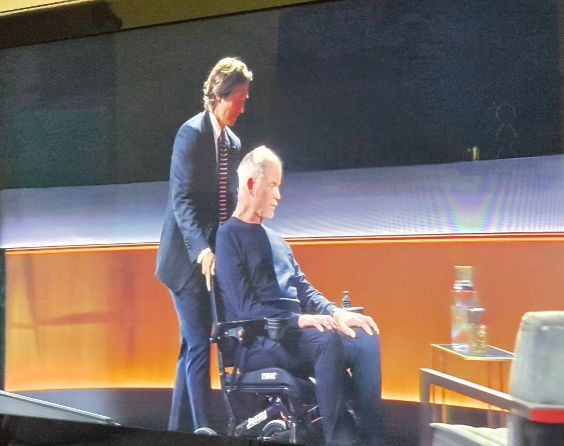
(photo courtesy of Netflix – Famous Last Words)
I cannot say what compelled me to watch Dane’s “documentary” on Netflix, “Famous Last Words,” but as Dane was rolled out onto the platform where the interview would take place, I knew I was going to be thrown back to a time that I personally experienced as a caregiver for someone with ALS. While I will warn you, regardless who could have been sitting in that wheelchair, to know anyone fighting this disease, is heartbreaking, even toward the end. Again, I knew nothing of Dane other than who he was, but I learned all I needed to after the hour special had ended.
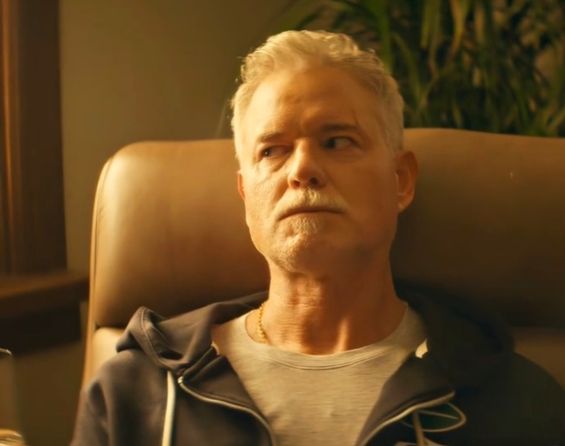
(photo courtesy of Netflix – Famous Last Words)
Dane talked about his works including Grey’s Anatomy and his latest work, Euphoria. He also mentioned his earlier more obscure and unrecognizable roles that he had in shows like Saved By The Bell and others. But it was the final segment of his interview that hit the hardest. A father of two young daughters, he took the opportunity in the final minutes to record a special message to his daughters. Me having two young adult daughters as well, hit hard.
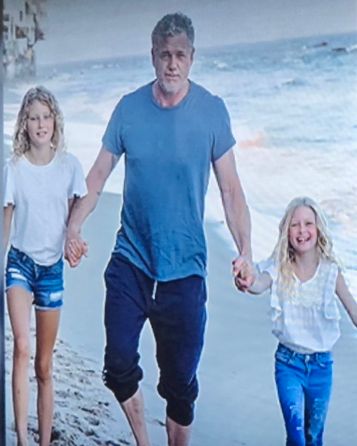
(photo courtesy of Netflix – Famous Last Words)
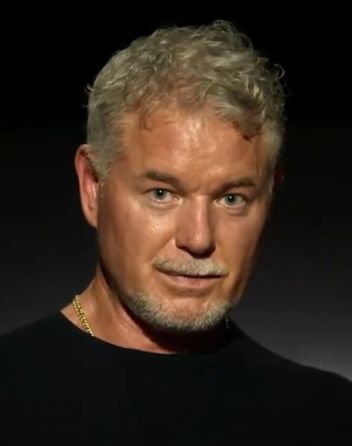
Dane recalled all the great times that they had together. He admitted sometimes he stumbled as a Dad. Dane had four things that he wanted his daughters to remember. His first point was to “live now, in the present,” not to live in the past, second-guessing things that had been done. Secondly, he told them to “fall in love.” This was not just about finding someone special, but finding a passion about something, a joy, “find the thing that makes you want to get up in the morning.” His message was that having something that meant so much, would get them through their darkest of days. “Find something that excites you, find your path, your purpose, your dream. Then go for it.” Third, “choose your friends wisely.” I am paraphrasing Dane, find those friends and let them find you. Your true friends will always be there. There doesn’t have to be a need, your friends “just show up.” Finally, to “fight with every ounce of their being and dignity. When you face challenges health or otherwise, fight. Never give up. Fight until your last breath. Never let anything take your spirit.” Dane acknowledged that both his daughters are different people, but both are strong and resilient. He took credit for his daughters having those traits, calling it his “super power.” No matter how many times he has been knocked down or counted out, he always came back. So when something comes up, and it will, “fight and face it with honesty, integrity, and grace, even if it feels or seems insurmountable.” Dane hoped he had been their example to fight like Hell, and hold their heads high. He finished his comments with something only a father who truly kept his daughters in his heart and soul could say, “you are my heart, you are my everything. I love you.” Every father should feel this way about his children. I know that I do about my daughters. With the many health challenges I have faced over the years, I should probably record some message similar to this for my daughters. I can relate to Dane, in that I have the same beliefs of the values I want my daughters to keep, and to believe what they are capable of.
(photo courtesy of Netflix – Famous Last Words)
And with that, those were his last words, at least publicly. I imagine, this documentary had not been more than a year before he had passed. As it had been for all the other times that I witnessed this horrible disease, I could actually see Dane as he faded, I had seen it so many times. Soon after he passed, tributes popped up all over the place whether testimonials or video collages. One in particular hit me personally as it provided me some context for something in my life that I was unaware of the impact that it had on others.
(video courtesy of Entertainment Tonight)
Then another video surfaced, titled “Mark Sloan Dies”. It was in this episode that would be his final episode as that character, though, not being a fan of the show (as in never having watched it), I am not sure how he passed, though certain not from ALS. I am trying to figure how to segway this next part.
I used to enjoy singing in public when I was still able to. And one night, I had been requested to sing a song I had only ever heard of a few notes. It was insisted that it was in my range, and it would sound great. I normally don’t perform that way, especially what would have amounted to a “suicide dare”, either way horrible or super cool. I stepped outside so that I could hear the song in its entirity, and I decided to give it a go. I got up in front of the crowd, and for the first time in my life sang a song I had just learned. As I finished, looking around the room, I noticed several females around the room wiping their eyes, me totally clueless as to why. By the applause I was confident that I did a good job for my first time singing it. I just thought I had done a great job. And when I recently saw this video, it finally clicked. I had never watched Greys Anatomy, and evidently this song I sang, “Chasing Cars” by Snow Patrol was featured on this show I assume during the demise of “Mark Sloane.” And that explained the tears. In fact, a friend of mine even told me I can’t sing that song, to which I thought she was undercutting my ability, but rather, emotionally it would just be too much.
And I must admit, even though I did not follow Dane’s career, his passing at such a young age, from ALS, and with two daughters just like me, next time I sing this song, I suppose it may just hit me differently from now on as well.
 Paul's Heart